Search News
Industry Portal
Popular Tags
SiC in Power Electronics Is Advancing Faster Than Packaging
Author
Time
Click Count
SiC is reshaping power systems faster than packaging can adapt, making the impact of sic on power electronics a critical concern for engineers, buyers, and decision-makers. As highlighted in the global advanced materials report 2026, advances in thermal reliability, ceramic thermal shock resistance, and composite layer bonding strength are becoming decisive factors in next-generation industrial electronics.
For industrial users, the core issue is no longer whether silicon carbide devices can switch faster, run hotter, or reduce losses. Those benefits are already visible in EV charging, grid conversion, servo drives, UPS systems, renewable inverters, and high-density industrial power supplies. The real bottleneck is that packaging, interconnect materials, substrate choices, and thermal pathways often lag behind the electrical progress of SiC devices by 1 to 2 product generations.
This gap matters across the full B2B chain. Operators need stable uptime under thermal cycling. Procurement teams need reliable qualification criteria beyond the chip datasheet. Technical researchers need benchmarkable parameters tied to standards and service life. Executive decision-makers need to understand where packaging constraints can erase the value of a premium SiC design. In practice, the impact of sic on power electronics is increasingly determined by materials engineering, not only semiconductor performance.
Why SiC Device Progress Is Outpacing Packaging Readiness
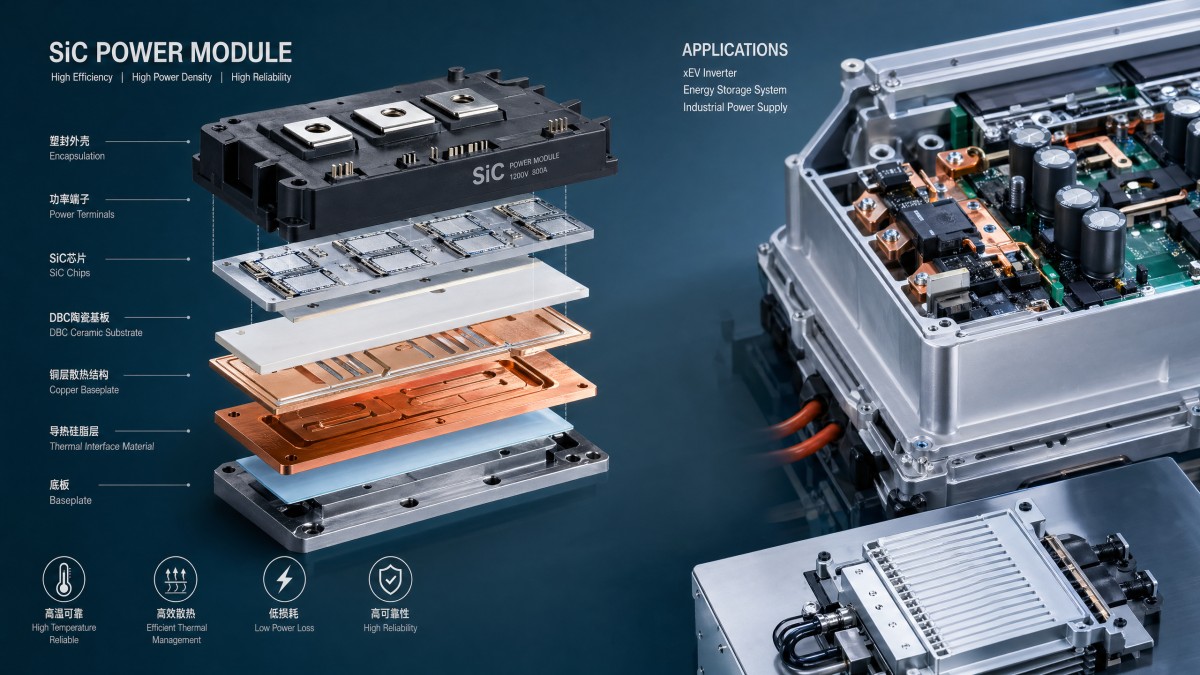
SiC power devices deliver clear electrical advantages: lower switching loss, higher breakdown capability, and higher operating temperatures than many conventional silicon devices. In typical industrial designs from 10 kW to 500 kW, this can support switching frequencies 2 to 5 times higher than legacy silicon layouts. That enables smaller magnetics, better efficiency, and more compact converter assemblies. However, those gains shift mechanical and thermal stress into package layers that were not always designed for repeated high-speed switching and elevated junction conditions.
A recurring problem is that a device qualified at the die level may still underperform at the module or system level because of solder fatigue, bond wire degradation, substrate cracking, or delamination in composite layers. When junction temperatures move toward 175°C to 200°C, and thermal cycling spans hundreds of thousands of load transitions, package integrity becomes a first-order design parameter. In many use cases, packaging reliability limits the usable performance window long before the SiC die reaches its theoretical ceiling.
The impact of sic on power electronics therefore extends beyond efficiency charts. Faster voltage slew rates, often above 20 kV/µs in advanced switching conditions, place additional demands on insulation systems, gate drive layout, parasitic inductance control, and EMI containment. A package that is electrically acceptable at lower switching speeds may become a source of oscillation, heat concentration, or premature wear once SiC is introduced into high-density industrial power stacks.
Where the mismatch appears first
In field practice, the first mismatch usually appears in one of four areas: die attach reliability, substrate thermal expansion mismatch, interconnect fatigue, or housing-level thermal management. These issues become more visible in applications with duty cycles above 16 hours per day, rapid load changes, or outdoor deployment where ambient variation may swing from -20°C to 55°C. Buyers evaluating only electrical efficiency can miss the true life-cycle risk.
- High switching speed can amplify package parasitics and create overshoot that stresses insulation and gate structures.
- Higher thermal gradients can accelerate solder crack initiation after repeated on-off cycling.
- Compact module design may reduce thermal margin if heat spreading layers are underspecified.
- Mechanical mismatch between ceramic, metal, and polymer layers can shorten service life under vibration or pulse loading.
For benchmarking and sourcing, it is useful to separate electrical advancement from package maturity. A module may show a 1% to 3% efficiency improvement at system level, but if field failure risk rises or cooling overhead increases, the total cost advantage can narrow quickly. This is why advanced materials, thermal shock resistance, and bonding strength have become procurement-level discussion points rather than purely laboratory topics.
The Packaging Layers That Now Define SiC Reliability
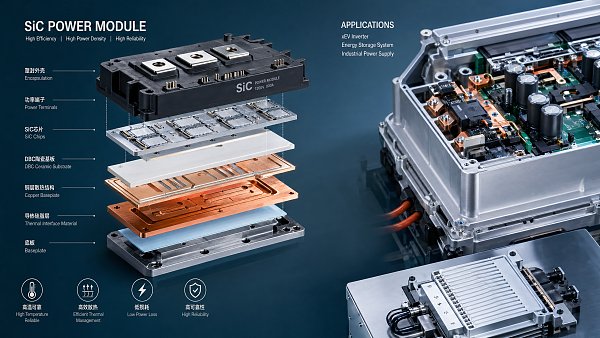
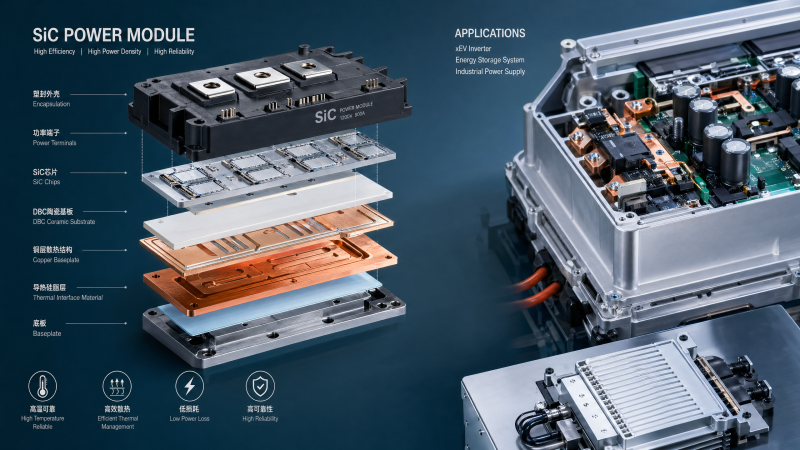
As SiC adoption expands, packaging is no longer a passive enclosure. It is the active reliability architecture between the die and the industrial environment. In most power modules, the critical stack includes die attach material, ceramic substrate, copper layers, interconnect structures, baseplate or heat spreader, encapsulation, and interface materials to the cooling system. Each layer sees a different combination of temperature, current density, vibration, humidity exposure, and mechanical strain.
Ceramic substrates are especially important. Materials such as Al2O3, AlN, and Si3N4 offer different trade-offs between thermal conductivity, insulation strength, and fracture toughness. For high-cycling industrial drives or rail-adjacent power systems, silicon nitride often receives attention because it can provide better resistance to crack propagation and thermal shock than lower-cost options. Yet material selection must still be matched to the real switching profile, baseplate design, and maintenance expectations.
Bonding technology is another decisive variable. Traditional wire bonds remain common, but they are vulnerable to fatigue under repeated thermal and current stress. Sintered silver, advanced clip interconnects, and improved die attach methods can enhance current spreading and thermal stability, but they also affect sourcing, process control, inspection methods, and repairability. For procurement teams, the key question is not which technology sounds most advanced, but which one is best aligned with the target duty cycle and field service model.
Key packaging elements and what to evaluate
The table below outlines the packaging elements that most often determine whether the impact of sic on power electronics remains positive at the system level or is diluted by reliability events.
A practical takeaway is that no single layer can be reviewed in isolation. A premium ceramic substrate can still fail to deliver if interconnect geometry raises local hot spots, or if interface materials degrade after 2,000 to 4,000 thermal cycles. This is why cross-layer benchmarking is increasingly necessary when qualifying advanced power electronics for long-life industrial service.
Minimum screening questions for technical buyers
- What is the target junction temperature range, and how much margin exists below the package limit?
- Which substrate material is used, and what is its thermal shock performance under rapid cycling?
- How is die attach integrity verified during incoming quality checks or supplier audits?
- What is the expected thermal cycling profile in the actual duty cycle: 500, 5,000, or more than 50,000 events?
- Does the package support low inductance switching suitable for SiC edge speeds without excessive EMI mitigation cost?
These questions help turn a broad SiC sourcing discussion into a measurable qualification process. For infrastructure and industrial programs with 5- to 15-year service expectations, that shift is essential.
What Engineers, Operators, and Procurement Teams Should Measure First
Different stakeholders look at the same SiC module from different angles, but packaging brings their interests together. Engineers care about switching performance, thermal impedance, insulation coordination, and mechanical robustness. Operators care about uptime, maintenance interval, and stable thermal behavior under fluctuating loads. Procurement teams care about supplier consistency, qualification evidence, and replacement risk. Senior decision-makers care about total ownership cost over 3 to 10 years.
The most effective starting point is a short list of measurable indicators that can be checked before full deployment. Rather than relying on a single efficiency claim, buyers should compare package-level risk indicators. In many industrial environments, one unplanned outage or one redesign cycle can outweigh the energy savings expected from a faster SiC rollout.
Below is a practical comparison framework for pre-qualification. It is especially useful for teams evaluating power converters in renewable systems, charging infrastructure, motion control cabinets, or high-availability backup power systems.
Pre-qualification checklist for SiC packaging decisions
This checklist shows why the impact of sic on power electronics must be measured at module and system level, not just at component level. A technically superior SiC die can become commercially risky if package validation is incomplete. Conversely, a well-qualified package may justify a slightly higher unit price because it reduces derating, field returns, and integration uncertainty.
Priority metrics by stakeholder
- Engineers: loop inductance, thermal impedance drift, insulation coordination, transient voltage overshoot.
- Operators: expected maintenance interval, thermal alarm frequency, cooling system cleanliness tolerance, failure predictability.
- Procurement: lot consistency, incoming inspection criteria, replacement lead time of 8 to 16 weeks, and multi-source feasibility.
- Executives: payback period, outage risk, lifecycle cost, and regulatory alignment across regions or project types.
When all four groups use the same measurement logic, SiC adoption becomes faster and more disciplined. That alignment is especially important in global industrial supply chains where one packaging weakness can affect multiple product families at once.
Material and Process Choices That Improve Packaging Resilience
Improving packaging resilience does not always require a complete platform redesign. In many cases, gains come from disciplined material selection and process control. Three of the most influential areas are ceramic selection, bonding or die attach optimization, and thermal interface management. Together, these factors shape how well the package survives rapid thermal excursions, high current pulses, and multi-year field exposure.
Ceramic thermal shock resistance matters because SiC often enables fast changes in operating state. In industrial converters that shift between partial load and high-demand operation several times per hour, repeated thermal gradients can damage brittle structures over time. A substrate with better fracture toughness may cost more upfront, yet it can reduce the probability of crack-related downtime in environments with frequent start-stop cycles or variable renewable input.
Composite layer bonding strength is equally important. Delamination at interfaces increases thermal resistance and can create localized heating. Even a small rise in interface resistance can accelerate aging when high current density and rapid switching coincide. For this reason, process repeatability during sintering, soldering, lamination, or bonding must be part of supplier review, not treated as a hidden manufacturing detail.
Material strategy options in common industrial scenarios
The table below summarizes practical material and process considerations for different operating priorities.
The key conclusion is that packaging improvement is a system decision. Better ceramic alone will not solve poor interface flatness or insufficient heat removal. Likewise, advanced bonding methods need stable process windows and supplier discipline. For organizations benchmarking advanced engineering materials, the right question is how each material-process combination performs across 3 dimensions: thermal stability, mechanical durability, and sourcing repeatability.
Implementation sequence for reliability-focused upgrades
- Map the real load profile, including peak duration, cycling frequency, and ambient range.
- Identify the weakest packaging layer through thermal, mechanical, and inspection data.
- Compare 2 to 3 material or process alternatives at pilot scale before full sourcing.
- Run accelerated validation tied to the actual service model, not generic lab assumptions.
- Lock in traceability and incoming inspection checkpoints before volume deployment.
This staged method helps companies avoid overengineering while still improving field reliability. In many cases, selective packaging upgrades yield better long-term value than simply choosing the fastest SiC switching option available.
How to Source, Qualify, and Deploy SiC Power Electronics Without Packaging Blind Spots
A strong SiC adoption strategy combines commercial discipline with technical validation. For procurement leaders, the most common mistake is to treat packaging as a secondary vendor detail after device selection. In reality, package robustness affects field performance, maintenance cost, spare planning, and even regulatory compliance where insulation, temperature rise, and safety margins are audited. A structured qualification path can reduce redesign cycles and improve confidence across business units.
A practical deployment model usually moves through 4 stages over 8 to 24 weeks, depending on application complexity. Stage 1 is requirement mapping: power level, switching frequency, cooling architecture, environmental conditions, and expected service life. Stage 2 is supplier comparison with emphasis on package materials, process control, and evidence of cycle testing. Stage 3 is pilot validation under representative duty conditions. Stage 4 is controlled rollout with traceability, incoming inspection, and maintenance feedback loops.
For organizations operating across semiconductor equipment, motion systems, industrial software-linked power infrastructure, or advanced materials programs, this approach supports better cross-functional decisions. It also aligns well with technical benchmarking models that compare not only component performance but long-term operational integrity.
Common sourcing mistakes to avoid
- Selecting a module based only on peak efficiency while ignoring thermal cycling profile and ambient exposure.
- Assuming all ceramic substrates perform similarly under shock, vibration, and repeated start-stop duty.
- Overlooking replacement lead times, especially when advanced package materials create 10- to 18-week replenishment windows.
- Failing to connect electrical test data with mechanical inspection and interface quality control.
- Accepting generic reliability claims without application-specific validation conditions.
These mistakes are avoidable when qualification is treated as an integrated technical-commercial workflow. The impact of sic on power electronics is strongest when faster switching, higher efficiency, and packaging resilience are validated together rather than in separate teams.
FAQ: questions that often guide final decisions
How should buyers compare SiC options if package details are incomplete?
Request package-level information on substrate material, interconnect style, die attach method, thermal cycling evidence, and recommended operating temperature range. If those data points are missing, treat the offer as higher qualification risk, even if electrical specifications look competitive.
Which applications feel packaging limits first?
High-duty systems with frequent switching and thermal variation typically reveal packaging weaknesses first. Examples include fast chargers, renewable inverters, servo drives, industrial UPS units, and power-dense converters running above 20 kHz with daily load cycling.
Is a higher-cost substrate always justified?
Not always. The right choice depends on life-cycle cost, not unit price alone. If the duty profile is mild and the thermal margin is wide, a premium substrate may not change business outcomes. But in harsh or high-cycling conditions, better fracture resistance and interface stability can reduce downtime cost over 5 to 10 years.
What is the best first action for companies scaling SiC adoption?
Build a package-focused qualification checklist and apply it consistently across suppliers and product lines. This creates comparable data, shortens decision cycles, and helps technical and commercial teams speak the same language during sourcing and deployment.
SiC is changing industrial power systems at a pace that packaging teams, sourcing workflows, and reliability frameworks must now match. The organizations that benefit most are not simply those using the newest devices, but those that benchmark ceramic behavior, thermal paths, bonding strength, cycling endurance, and traceability with equal rigor. For engineers, operators, procurement managers, and strategic decision-makers, that is where the real impact of sic on power electronics becomes visible and commercially meaningful.
G-CST supports this decision process by connecting advanced materials insight, cross-industry benchmarking, and procurement-grade technical evaluation across high-performance industrial systems. If you are assessing SiC packaging readiness, validating material trade-offs, or preparing a sourcing framework for next-generation power electronics, contact us to get a tailored benchmarking approach, review critical package variables, and explore more reliable deployment options.
Recommended News
 May 09, 2026Impact of Silicon Carbide on Power Semi: Where Margins May Shift NextImpact of silicon carbide on power semi is reshaping margins across wafers, devices, packaging, and system integration. Discover where pricing power may weaken, where profits can hold, and what to watch next.
 Apr 28, 2026SiC in Power Electronics Is Advancing Faster Than PackagingImpact of SiC on power electronics is growing faster than packaging can keep up. Explore thermal reliability, ceramic thermal shock resistance, and sourcing insights in this practical 2026 guide.
 Apr 28, 2026Impact of SiC on Power Electronics Is Showing Up in System CostImpact of SiC on power electronics is reshaping system cost. Explore TCO, efficiency, thermal design, and insights from global advanced materials report 2026.