
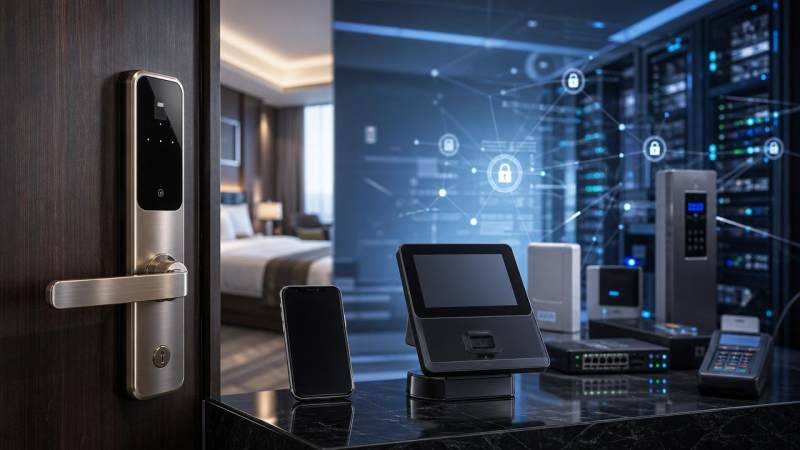
Before deploying a smart hotel application, enterprise leaders should treat the initiative as an operational transformation, not a guest-facing software launch.
The core question is whether the application can improve service, efficiency, and revenue without exposing the hotel group to avoidable risk.
For decision makers, the biggest risks are rarely cosmetic features. They usually sit inside integrations, cybersecurity, compliance, vendor dependence, and rollout governance.
A well-designed smart hotel application can raise guest satisfaction and reduce manual workload. A weak rollout can damage trust, uptime, and investment confidence.
Start With Business Risk, Not Feature Lists
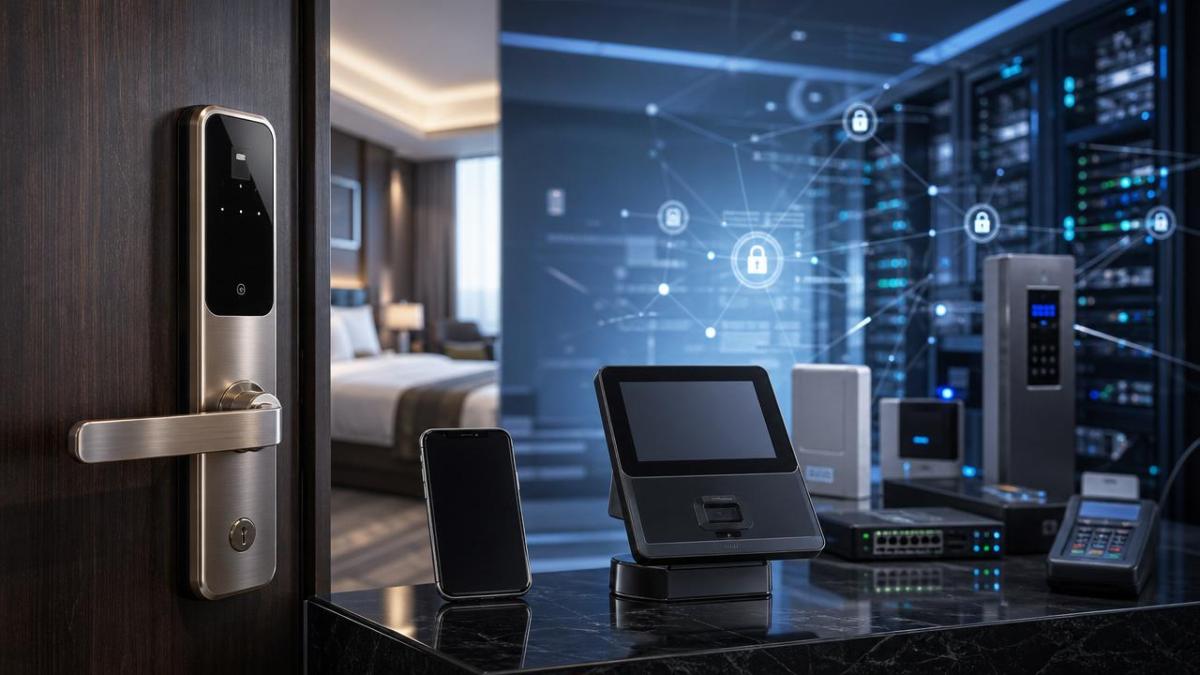
Many smart hotel application projects begin with mobile check-in, digital keys, in-room controls, messaging, payments, and personalized offers.
Those capabilities matter, but enterprise buyers should first ask which business outcomes the application must protect and improve.
For a hotel group, success may mean faster check-in, fewer front-desk queues, higher ancillary revenue, or better loyalty engagement.
For an owner or operator, success may also include lower staffing pressure, reduced energy waste, stronger asset performance, and scalable brand standards.
The rollout becomes risky when executives approve features without defining measurable targets, operational responsibilities, and acceptable failure thresholds.
A practical assessment should connect each feature to revenue impact, service continuity, labor efficiency, compliance exposure, and guest trust.
If the business case depends on adoption, the plan must explain how guests will discover, use, and continue using the application.
If the business case depends on automation, leaders must know what happens when systems fail or staff must intervene manually.
Integration With PMS, POS, CRM, and Building Systems
The most important technical risk is integration complexity. A smart hotel application rarely operates as a standalone digital channel.
It often connects with property management systems, point-of-sale platforms, loyalty databases, payment gateways, door locks, elevators, and energy systems.
Each integration creates a dependency. If one system changes, slows, or fails, the guest experience can deteriorate quickly.
Enterprise decision makers should request a full integration map before approving rollout across multiple properties or brands.
The map should identify data flows, system owners, authentication methods, failure scenarios, service-level agreements, and vendor support responsibilities.
Particular attention should be paid to PMS connectivity because it affects reservations, room status, guest profiles, billing, and operational workflows.
Legacy PMS environments may require middleware, custom APIs, or batch synchronization, all of which can introduce latency and reconciliation issues.
Executives should avoid assuming that a successful pilot at one property guarantees smooth deployment across different hotel technology stacks.
The stronger approach is phased validation by system environment, property type, region, and operational complexity before scaling the application.
Cybersecurity Exposure From IoT and Mobile Access
A smart hotel application expands the attack surface because it connects guest devices, cloud services, hotel networks, and physical infrastructure.
Digital keys, room controls, smart thermostats, cameras, access systems, and voice assistants require strong security governance.
The risk is not limited to data theft. A compromised system can disrupt room access, guest safety, energy operations, and service delivery.
Enterprise leaders should require independent security testing before rollout, including penetration testing, API testing, and mobile application security review.
They should also evaluate how vendors manage vulnerabilities, patches, encryption, key rotation, logging, and incident escalation.
IoT devices deserve special scrutiny because many are deployed for long periods and may not receive frequent firmware updates.
Network segmentation is essential. Guest Wi-Fi, administrative systems, IoT devices, payment infrastructure, and corporate systems should not share uncontrolled pathways.
Executives should ask whether the application supports zero-trust principles, least-privilege access, multifactor authentication, and auditable administrator controls.
A cyber incident involving guest access or personal data can become a brand crisis, not only an IT service issue.
Data Privacy, Consent, and Regional Compliance
Smart hotel applications collect sensitive information, including identity data, stay history, location signals, payment details, preferences, and behavioral patterns.
This data can improve personalization, but it also triggers privacy obligations under regulations such as GDPR, CCPA, and regional hospitality rules.
Decision makers should confirm what data is collected, where it is stored, how long it is retained, and who can access it.
Consent design is especially important. Guests should understand which data is required for service and which data supports optional personalization.
Privacy notices must be clear, localized, and aligned with actual system behavior rather than generic legal language.
Hotels also need processes for data access requests, deletion requests, breach notification, cross-border transfers, and vendor subprocessor disclosures.
If the application uses analytics or AI-driven personalization, executives should demand transparency around profiling, segmentation, and automated decision logic.
Failure to manage privacy properly can reduce guest trust, invite regulatory scrutiny, and limit future use of valuable customer data.
The safest approach is privacy-by-design, where compliance requirements are embedded before development, procurement, and property rollout decisions.
Vendor Lock-In and Long-Term Commercial Control
A smart hotel application can become deeply embedded in guest journeys, staff workflows, loyalty operations, and property infrastructure.
That depth creates switching costs. If the vendor relationship weakens, the hotel may face migration expense, disruption, or limited negotiation power.
Enterprise buyers should examine contract terms beyond licensing price, especially data ownership, API access, exit rights, and roadmap commitments.
They should clarify whether guest data, operational data, and configuration rules can be exported in usable formats.
Open standards and documented APIs reduce lock-in, while proprietary integrations can restrict future flexibility and merger integration options.
Vendor financial stability also matters. Hotels need confidence that the provider can support security updates, uptime, regional expansion, and regulatory changes.
Procurement teams should evaluate support coverage, incident response times, implementation capacity, partner ecosystem, and references from comparable hotel groups.
A low upfront price may become expensive if customization, support, data migration, or integration changes require premium services.
The right commercial model should preserve control while allowing the application to scale across brands, regions, and asset classes.
Operational Readiness Across Properties and Teams
Even strong technology can fail when hotel teams are not prepared to operate it consistently.
A smart hotel application changes front desk routines, housekeeping coordination, maintenance workflows, guest communication, and escalation paths.
Staff must know when to trust automation, when to override it, and how to help guests who prefer traditional service.
Training should be role-specific. Front desk agents, revenue teams, engineers, housekeeping supervisors, and managers need different operating procedures.
Properties also need fallback plans for outages, lost phones, lock failures, payment errors, identity verification issues, and guest complaints.
Without clear procedures, staff may create informal workarounds that undermine security, data quality, and service consistency.
Enterprise leaders should assess whether each property has adequate network reliability, device readiness, support capacity, and local leadership commitment.
Rollout sequencing should consider operational maturity, not only brand priority or market visibility.
The best pilot properties are not always the most luxurious; they are the ones able to generate reliable operational evidence.
Guest Adoption, Accessibility, and Brand Experience
A smart hotel application only creates value if guests actually use it and perceive it as helpful.
Executives should avoid assuming that every guest wants a fully digital journey or will download another hotel application.
Adoption depends on clear benefits, easy onboarding, reliable performance, multilingual support, and visible alternatives for less digital guests.
Applications should support accessibility standards so guests with disabilities can use essential functions without additional friction.
Digital convenience must not become digital exclusion. Luxury, business, family, and senior travelers may have different expectations.
Brand experience is also at stake. Poorly timed notifications, confusing permissions, and failed digital keys can feel intrusive or unreliable.
Hotels should measure adoption by journey stage, not just downloads. Check-in completion, key usage, messaging response, and upsell conversion matter.
Guest feedback should be collected early, segmented carefully, and translated into product and operational improvements before wider deployment.
A successful application should reduce friction while preserving hospitality, human judgment, and brand warmth.
Financial Risk, ROI Assumptions, and Hidden Costs
The financial case for a smart hotel application often includes labor savings, higher conversion, better retention, and operational efficiency.
These benefits are achievable, but executives should challenge assumptions with conservative modeling and property-level evidence.
Hidden costs may include integration development, cybersecurity testing, staff training, hardware replacement, network upgrades, localization, and ongoing support.
There may also be costs related to compliance reviews, accessibility audits, vendor management, data governance, and guest support channels.
ROI should be evaluated over the full lifecycle, not only the initial launch budget.
Decision makers should distinguish between revenue uplift that can be directly attributed and benefits that are strategic but harder to quantify.
For example, improved brand perception may support loyalty, while reduced front-desk pressure may improve service during peak periods.
Both are valuable, but they require different measurement methods and different executive expectations.
A disciplined business case includes baseline metrics, target improvements, rollout milestones, risk reserves, and stop-go decision points.
Governance Framework Before Enterprise Rollout
Before approving a multi-property deployment, leadership should establish a governance framework that aligns business, technology, legal, and operations teams.
This framework should define ownership for cybersecurity, guest data, vendor performance, integration quality, service standards, and incident response.
A cross-functional steering group can prevent decisions from being made in isolation by marketing, IT, operations, or procurement alone.
Governance should also include technical benchmarking, especially when applications interact with mission-critical infrastructure or regulated data environments.
Enterprise buyers can benefit from independent validation of security controls, integration reliability, vendor claims, and compliance readiness.
This is where structured intelligence and technical benchmarking become valuable for reducing procurement uncertainty and implementation risk.
For hotel groups managing multiple brands or regions, standardized decision criteria are essential for consistent rollout quality.
Governance should not slow innovation unnecessarily. It should make risk visible, assign accountability, and protect enterprise value.
The goal is not to reject smart hospitality technology, but to deploy it with confidence and operational discipline.
Key Questions Executives Should Ask Before Launch
Executives should begin with the guest journey: which pain points does the application solve, and how will success be measured?
They should then ask whether the PMS, POS, CRM, access control, and IoT integrations have been tested under real operating conditions.
Security questions should cover encryption, authentication, vulnerability management, incident response, third-party access, and network segmentation.
Compliance questions should confirm consent management, data retention, cross-border transfers, deletion workflows, and regional privacy obligations.
Commercial questions should examine exit rights, data portability, support obligations, roadmap transparency, and total cost of ownership.
Operational questions should test staff readiness, fallback procedures, property infrastructure, guest support, and escalation responsibilities.
Financial questions should compare expected benefits with implementation cost, lifecycle cost, adoption risk, and delayed-value scenarios.
If leadership cannot answer these questions clearly, the rollout should pause until evidence, ownership, and safeguards improve.
A short delay before launch is often cheaper than a rushed deployment followed by guest dissatisfaction or operational disruption.
Conclusion: De-Risk the Application Before Scaling the Experience
A smart hotel application can become a powerful platform for guest engagement, operational efficiency, and brand differentiation.
However, the application must be evaluated as enterprise infrastructure because it touches data, payments, rooms, staff workflows, and physical access.
The greatest risks arise when leaders focus on visible convenience while underestimating integration, cybersecurity, compliance, and operational readiness.
Decision makers should demand measurable business outcomes, resilient architecture, clear governance, and contractual flexibility before approving broad deployment.
When these foundations are in place, smart hotel technology can scale with confidence rather than becoming another fragmented digital experiment.
The right rollout strategy protects guests, strengthens operations, and turns digital transformation into durable enterprise value.