Search News
Industry Portal
Popular Tags
Harmonic Drive Transmission Accuracy: Key Error Sources
Author
Time
Click Count
For operators and system users, harmonic drive transmission accuracy directly affects positioning stability, repeatability, and overall machine performance. Understanding the main error sources—from gear deformation and assembly deviation to load variation and lubrication conditions—helps reduce motion loss, improve control precision, and support more reliable operation in high-precision industrial applications.
Why does harmonic drive transmission accuracy change in real operating conditions?
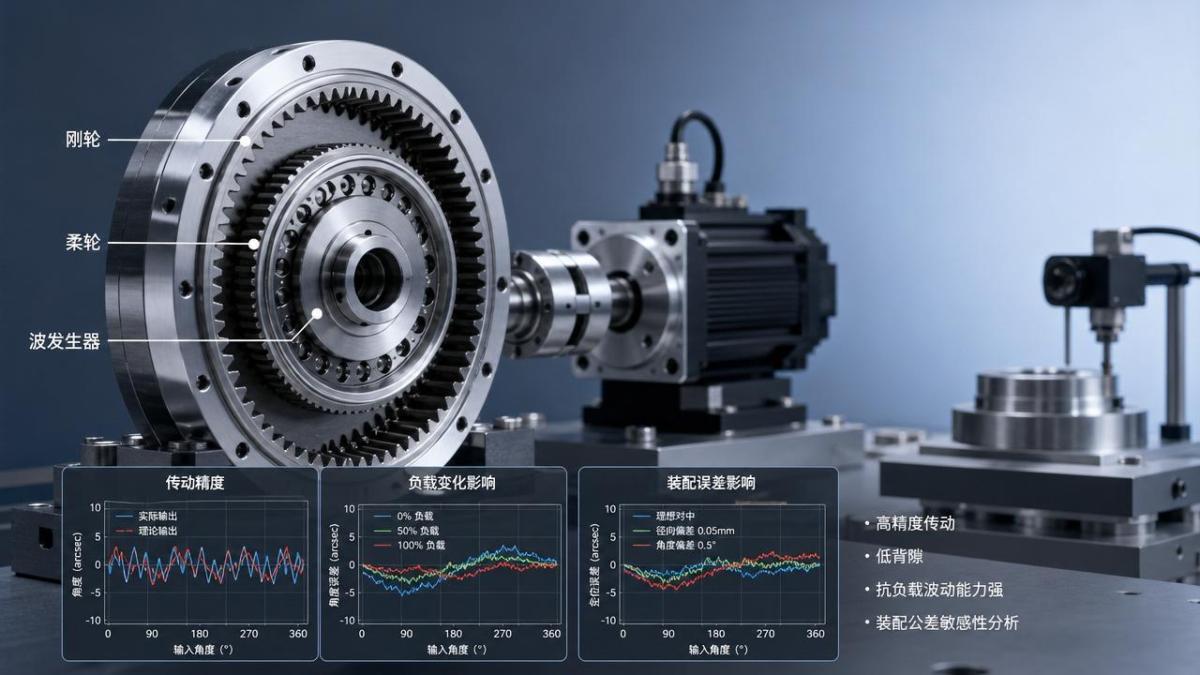
In many precision systems, harmonic drive transmission accuracy is discussed as if it were a fixed catalog value. Operators know the reality is different. Actual accuracy changes with load, speed, temperature, mounting condition, controller tuning, and duty cycle.
This matters across the broader industrial landscape, especially in semiconductor tools, precision motion platforms, robotics, metrology fixtures, automated valve actuation, and digital twin-verified equipment. In these environments, even a small angular deviation can create yield loss, vibration, or unstable path tracking.
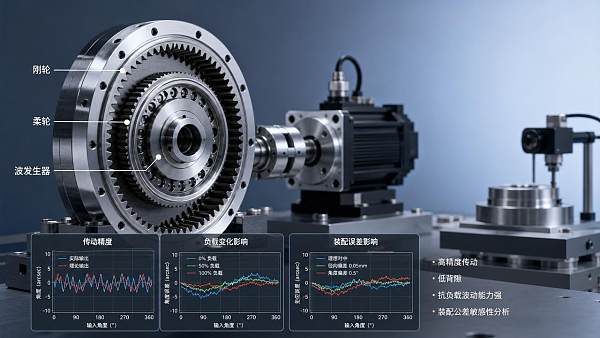
A harmonic drive achieves high reduction ratio and compact structure through the interaction of a wave generator, flexspline, and circular spline. That same elastic deformation principle is also the reason accuracy must be judged as a dynamic system behavior rather than a single static number.
- Static positioning error affects whether the axis reaches the commanded angle at stop.
- Repeatability determines whether the same point can be reached consistently over repeated cycles.
- Lost motion and hysteresis influence reversal behavior, contouring quality, and fine alignment tasks.
- Torsional compliance under changing torque changes the effective output position under real load.
For users, the practical question is not only “What is the nominal accuracy?” but also “Which error source dominates in my process window?” That is the point where data-backed benchmarking becomes valuable.
What are the main error sources behind harmonic drive transmission accuracy?
The most useful way to evaluate harmonic drive transmission accuracy is to separate design-related errors from installation and operating errors. This makes troubleshooting faster and avoids replacing components that are not the real cause.
Core mechanical error mechanisms
- Elastic deformation of the flexspline changes tooth engagement geometry and creates position deviation under varying torque.
- Manufacturing tolerances in spline geometry, bearing elements, and wave generator roundness can introduce transmission error.
- Assembly deviation, including shaft misalignment and mounting face runout, often amplifies cyclic error patterns.
- Lubrication condition affects friction consistency, heat generation, wear progression, and reversal smoothness.
- Thermal growth in adjacent structures may shift preload or distort the housing, changing output behavior over time.
Control and application-side influences
- Servo gain settings can mask or amplify mechanical oscillation, especially near low-speed reversal points.
- Shock loads and asymmetric duty cycles can increase wear and gradually reduce harmonic drive transmission accuracy.
- Payload offset and overhung moment increase torsional strain and may create axis-specific tracking errors.
- Contamination, poor sealing, or unsuitable lubricant viscosity can destabilize long-cycle precision.
For operators, these categories are important because each one requires a different corrective action. A controller adjustment will not cure mounting eccentricity. A new gearbox will not solve thermal drift caused by the surrounding machine frame.
Which error source should users check first?
The table below helps operators prioritize inspection based on visible symptoms. This approach is useful in mixed industrial settings where maintenance teams must make decisions quickly and cannot stop production for full teardown analysis.
This type of symptom-to-cause mapping reduces guesswork. It also supports maintenance logging and digital twin validation, both of which are increasingly important in high-value industrial assets where downtime and misdiagnosis are costly.
How operating environment affects harmonic drive transmission accuracy
A harmonic drive that performs well in a controlled lab may behave differently on a factory floor. Environmental variables often explain why a unit meets acceptance testing but later shows drift in production.
Temperature and thermal cycling
Thermal effects are often underestimated. Heat from motors, nearby process tools, or ambient cycling can alter internal clearances and housing geometry. In semiconductor handling or precision inspection systems, this can shift the axis enough to affect alignment-sensitive tasks.
Load variation and shock
If the load spectrum includes frequent starts, stops, and intermittent impact, harmonic drive transmission accuracy may deteriorate faster than expected. The issue is not only peak torque, but also torque reversal frequency and how long the system remains near its upper load band.
Contamination and lubrication aging
Fine particles, chemical vapor, or unsuitable grease selection can change friction and wear characteristics. In cross-industry applications, this is especially relevant where motion components are close to corrosive media, clean process chambers, or high-cycle automation cells.
- Track accuracy changes from cold start to stabilized temperature rather than relying on one-time readings.
- Measure performance at multiple torque points, including expected overload moments during process upset.
- Include lubricant inspection intervals in preventive maintenance instead of treating it as a lifetime constant.
What should buyers and users compare before selecting a solution?
When procurement teams evaluate transmission solutions, they often compare reduction ratio and price first. For applications where harmonic drive transmission accuracy is critical, that is not enough. Operators should push for a wider comparison set that reflects actual machine behavior.
The table below summarizes practical selection factors for cross-industry use cases, from robotics and indexing systems to precision pumps, valve actuators, and motion modules integrated into larger digital control platforms.
This comparison framework is especially useful when multiple departments are involved. Procurement may focus on cost and lead time, while operators focus on motion quality. A shared checklist reduces conflict later in commissioning.
How to improve harmonic drive transmission accuracy during installation and operation
Users can often improve harmonic drive transmission accuracy without changing the core reducer. The highest returns usually come from installation discipline, load control, and more structured maintenance data.
Installation checklist
- Verify housing flatness, concentricity, and shaft alignment before final tightening.
- Use controlled tightening sequence to avoid distortion of the mounting interface.
- Check coupling condition and encoder mounting, especially where servo feedback is used to validate transmission accuracy.
- Confirm that external radial or axial loads do not exceed the supported architecture of the assembly.
Operational discipline
- Avoid unnecessary shock loading during startup and emergency stops where process design permits.
- Trend position error against temperature and torque rather than reviewing only pass-fail alarms.
- Revisit servo tuning after mechanical changes, since control compensation may no longer match the system stiffness.
- Set maintenance thresholds for noise, heat, and reversal response before noticeable product quality loss appears.
In advanced facilities, these steps can be linked with SCADA, condition monitoring, and digital twin models. That gives users a better basis for predicting when precision drift is caused by wear progression versus when it is caused by process-side changes.
What standards and validation practices support reliable selection?
No single standard fully defines harmonic drive transmission accuracy across every application, but buyers can still use recognized engineering frameworks. Validation should combine dimensional quality, motion testing, environmental suitability, and system-level integration checks.
- ISO-based quality management frameworks support process consistency in component manufacturing and assembly control.
- SEMI-related expectations may matter when harmonic drives are integrated into semiconductor equipment or adjacent sub-systems.
- ASME and IEEE references can be relevant where mechanical integrity, actuation reliability, or control-system interfacing affects final equipment acceptance.
For users, the key is not collecting certificates for their own sake. It is verifying whether the selected transmission has been evaluated under a load case, duty cycle, and environmental condition close to the target application.
Common misconceptions and FAQ about harmonic drive transmission accuracy
Does zero backlash mean perfect harmonic drive transmission accuracy?
No. Low backlash or near-zero backlash improves reversal behavior, but it does not eliminate elastic deformation, thermal drift, mounting error, or control-related deviation. Users should evaluate lost motion together with stiffness and load-dependent error.
Why does accuracy look good during commissioning but worsen later?
Commissioning often occurs under short-duration, controlled conditions. Production introduces heat, real payloads, repeated reversals, contamination, and variable duty cycles. These factors expose weaknesses that a brief acceptance test may not reveal.
Is a higher reduction ratio always better for precision?
Not always. A higher ratio can improve motor-side resolution, but total axis precision still depends on stiffness, encoder strategy, structural rigidity, and process dynamics. The best choice depends on the full motion chain, not the reducer alone.
What should operators record to diagnose accuracy problems faster?
Record commanded versus actual position, load condition, direction of travel, speed, ambient and housing temperature, lubrication service history, and any recent mechanical changes. A simple trend record often reveals whether the issue is cyclic, thermal, or load-related.
Why work with G-CST when precision motion decisions carry procurement risk?
In cross-industry projects, the difficulty is rarely limited to one gearbox specification. Teams must balance motion precision, international compliance expectations, supply-chain resilience, maintenance strategy, and total system reliability. That is where G-CST provides practical value.
G-CST connects precision motion control and bearing intelligence with adjacent pillars such as industrial software, advanced materials, semiconductor equipment, and specialized fluid systems. This multidisciplinary view helps users and procurement teams avoid isolated decisions that create hidden system risk.
- Benchmark harmonic drive transmission accuracy requirements against broader machine architecture and international engineering norms.
- Review parameter suitability for torque, stiffness, thermal condition, and operating cycle before purchase commitment.
- Compare solution paths when lead time, export-control context, or supply continuity becomes a project constraint.
- Support discussions around validation scope, sample evaluation, integration risk, and documentation requirements.
If your team is reviewing harmonic drive transmission accuracy for a new build or troubleshooting precision loss in an existing system, contact G-CST for focused support on parameter confirmation, product selection logic, delivery-cycle assessment, custom solution matching, certification-related questions, sample evaluation scope, and quotation communication aligned with your actual operating conditions.
Recommended News
 Jul 10, 2026How to Read a Harmonic Reducer Accuracy Chart for Motion System SelectionHarmonic reducer accuracy chart explained for smarter motion system selection—learn how to assess transmission error, repeatability, load response, and supplier risk with confidence.
 Jun 16, 2026Harmonic Drive Transmission Accuracy: Key Factors to VerifyHarmonic drive transmission accuracy explained: verify load, lost motion, stiffness, thermal effects, and lifetime stability to compare options with confidence and reduce precision risk.
 May 22, 2026How Robotics Is Reshaping Harmonic Drive Load CyclesDiscover the impact of robotics on harmonic drives and how shifting load cycles affect torque, precision, thermal limits, and lifecycle reliability in advanced motion systems.
 May 20, 2026Harmonic Drive Transmission Accuracy: Key Error SourcesHarmonic drive transmission accuracy depends on load, heat, mounting, lubrication, and control tuning. Learn key error sources and practical fixes to improve precision and reliability.
 May 18, 2026Harmonic Drive Manufacturer Comparison: Accuracy, Backlash, and Service LifeHarmonic drive manufacturer comparison for accuracy, backlash, and service life. Learn how to evaluate suppliers by application, durability, and support to reduce sourcing risk.