Search News
Industry Portal
Popular Tags
PLC Programming Software Wholesale: Licensing Risks to Check
Author
Time
Click Count
For procurement teams evaluating plc programming software wholesale options, the biggest risk is not usually the quoted unit price. It is the licensing model hidden behind the quote.
Many software deals look commercially attractive at the RFQ stage, yet later create cost overruns, audit exposure, deployment delays, and integration restrictions across plants, regions, or subsidiaries.
The core search intent behind this topic is practical due diligence: buyers want to know which licensing clauses actually create downstream risk, how to compare offers, and what to negotiate before purchase.
For procurement readers, the most important questions are straightforward. Can the software legally scale across sites? Are upgrades included? Who may use it? What happens during audits, mergers, or cross-border deployment?
The most useful content, therefore, is not a generic overview of PLC tools. It is a buyer-focused checklist covering license scope, commercial traps, compliance issues, and supplier evaluation criteria.
This article focuses on those decisions. It emphasizes contract review, operational impact, and sourcing control, while minimizing broad technical explanations that do not materially improve buying judgment.
Why licensing risk matters more than headline price in plc programming software wholesale
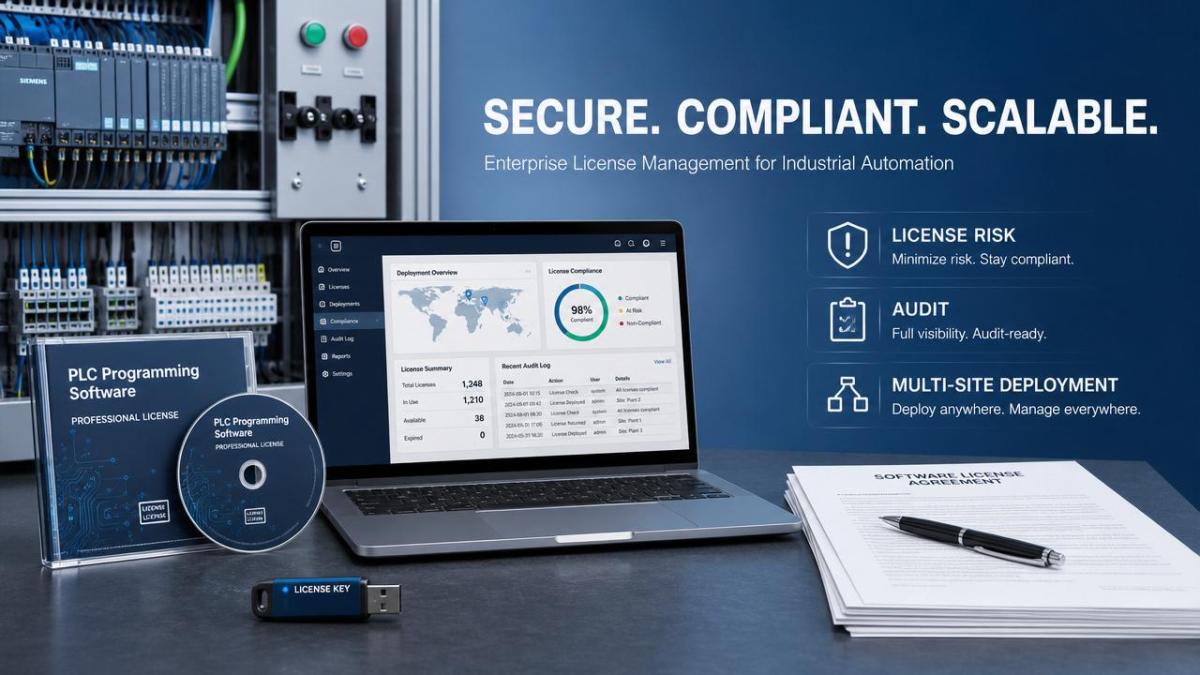
In industrial software procurement, licensing terms often determine the real total cost of ownership far more than the initial wholesale discount. This is especially true for PLC programming environments.
A low per-seat price may appear favorable, but restrictions on activation, maintenance, project transfer, remote access, or multi-site use can force unplanned purchases within months.
For buyers supporting multiple facilities, OEM relationships, and regional engineering teams, licensing risk becomes an operational risk. If the software cannot be used where work actually happens, productivity drops immediately.
There is also a governance issue. Procurement may secure a cost-effective agreement, yet legal, IT, and plant engineering later discover noncompliant usage patterns caused by unclear contract language.
That is why a defensible sourcing decision must evaluate not only software functionality, but also the enforceability, portability, and future fit of the license structure.
What procurement teams are really trying to verify before signing
When buyers search for guidance on plc programming software wholesale, they are usually trying to answer a small set of high-impact commercial questions rather than technical ones.
First, they need clarity on scope. Does the license apply to a named user, a device, a site, an enterprise, or a temporary contractor?
Second, they need predictability. Can budgeting remain stable over three to five years, or will support renewals, version changes, and add-on modules trigger recurring spend?
Third, they need compliance confidence. If a vendor performs an audit, can the organization prove proper usage across all business units and external engineering partners?
Fourth, they need resilience. If the company expands globally, acquires another plant, changes system integrators, or standardizes engineering workflows, will the original license still support that operating model?
These are the questions that should shape supplier comparison matrices and contract review checklists.
License scope: the first clause that can break your rollout plan
The first area to check is how the vendor defines the licensed unit. This may sound basic, but it is where many expensive misunderstandings begin.
Some PLC programming platforms are licensed per named user. Others are tied to a hardware dongle, engineering workstation, serial number, project server, or plant location.
Each model affects flexibility differently. Named-user licenses may constrain shift-based teams. Device-based licenses can complicate hardware refresh cycles. Site licenses may exclude affiliates or contract engineers.
Procurement should ask for explicit definitions of user categories, site boundaries, transfer rules, and concurrency rights. Terms such as “internal use,” “authorized personnel,” or “designated location” must be clarified.
If your organization works across multiple factories, service hubs, or joint ventures, verify whether internal sharing is allowed or whether each entity must buy a separate license set.
A wholesale package that looks scalable may become fragmented if the agreement only permits use within one legal entity or one country.
Upgrade, update, and maintenance rights: where hidden future costs emerge
One of the most common sourcing mistakes is treating software version access as automatic. In many contracts, it is not.
Buyers should separate three different rights: bug-fix updates, feature upgrades, and major version migrations. Vendors may price these differently or place them behind annual support subscriptions.
For PLC environments, version compatibility is not a minor issue. Engineering teams often need alignment between development stations, controller firmware, simulation tools, HMI packages, and project archives.
If upgrade rights are weak, one missed maintenance renewal can create a version gap that later raises reactivation costs or blocks collaboration with OEMs and integrators.
Ask whether lapsed maintenance can be reinstated without penalty, whether perpetual licenses retain security updates, and whether archived projects remain editable after support expires.
Procurement should also verify if license entitlements transfer to successor product lines, because vendors sometimes retire product families and steer customers toward higher-cost platforms.
Cross-border use and export control restrictions should not be treated as legal footnotes
Global industrial buyers often assume software can be used anywhere inside the group once purchased. That assumption is dangerous.
Some licenses restrict use by country, region, or contracting entity. Others prohibit hosting, access, or technical support from embargoed or high-risk jurisdictions.
For organizations with distributed engineering centers, remote maintenance teams, or overseas system integrators, these restrictions can interrupt project execution without warning.
Export control and data residency issues also matter. PLC programming software may include encryption, cloud services, remote diagnostics, or technical libraries subject to specific regulatory handling.
Procurement should ask whether licenses permit installation and use across all intended countries, whether cross-border remote access is allowed, and whether sublicensing to local branches is prohibited.
It is also wise to confirm if the vendor can suspend service because of regional compliance changes, and what contractual remedies exist if that happens.
Audit rights and compliance exposure can turn a low-cost deal into a high-cost dispute
Software audit clauses deserve the same scrutiny as pricing schedules. Many buyers review them too late.
Vendors may reserve broad rights to inspect installations, usage logs, virtual environments, backup systems, and affiliate operations. They may also impose short response windows and customer-funded audit costs.
In practice, the risk is not only intentional overuse. It is often accidental noncompliance caused by image cloning, temporary laptops, contractor access, disaster recovery servers, or test environments.
Procurement should verify what counts as a licensable instance, whether cold standby systems require full licenses, and how long uninstall and reassignment windows remain valid.
It is also important to review financial remedies. Some contracts apply list price, not discounted wholesale price, when calculating true-up fees after an audit.
A strong sourcing position includes negotiated caps on look-back periods, reasonable notice requirements, confidentiality protections, and clearly defined methods for measuring actual usage.
Vendor lock-in risk is not abstract when PLC software touches plant continuity
PLC programming software can become deeply embedded in plant engineering routines, controller libraries, maintenance practices, and technician training. That makes switching difficult even when commercial terms deteriorate.
Procurement should identify lock-in signals early. These include proprietary project formats, paid access to source archives, closed libraries, restricted API availability, and limited interoperability with third-party tools.
Another red flag is dependence on vendor-specific activation infrastructure. If licenses require online validation or centralized account control, outages or account disputes can delay urgent engineering changes.
Ask whether projects can be exported in usable formats, whether historical versions remain accessible, and whether the organization retains practical access to its own engineering assets after contract termination.
Where possible, negotiate retention rights for archived projects, migration assistance, and transition support if the supplier discontinues the platform or materially changes commercial terms.
Questions to ask suppliers before comparing wholesale quotations
Good procurement outcomes depend on disciplined questioning. A quote comparison without licensing interrogation is incomplete.
Start with usage mapping. How many engineers, plants, contractors, virtual machines, and backup environments will realistically need access during the contract term?
Then ask the supplier to explain the proposed model in operational terms, not just legal terminology. Have them confirm allowed use cases in writing.
Useful questions include: Can licenses move between users and devices? Are training, staging, and DR environments covered? Are OEMs or integrators permitted to access the platform on your behalf?
Also ask: What support level is included? What happens after nonrenewal? Are legacy versions available? Can licenses be merged after an acquisition or redistributed after site closure?
The quality of the vendor’s answers often reveals as much as the commercial proposal itself. Clear, specific responses usually indicate a more mature software governance model.
A practical evaluation framework for procurement teams
To make decisions more defensible, use a weighted evaluation framework rather than choosing the cheapest compliant-looking quote.
One practical model is to score vendors across six dimensions: license flexibility, five-year cost predictability, audit exposure, cross-border usability, upgrade continuity, and exit risk.
Each category should be supported by documentary evidence, including the EULA, maintenance policy, support SLA, price book logic, and any reseller or channel-specific amendments.
Procurement should involve engineering, IT asset management, legal, and if relevant, regional compliance personnel before final award. PLC software touches all four functions.
It is also helpful to create a red-amber-green matrix for nonstandard clauses. Any restriction affecting multi-site use, contractor access, or version continuity should be escalated for negotiation.
This process improves supplier comparability and helps buyers justify decisions internally when stakeholders challenge why one quote was not selected on price alone.
How to negotiate better terms without slowing the purchase cycle
Many buyers assume industrial software licenses are nonnegotiable. In reality, some of the highest-risk terms can be improved, especially in wholesale or multi-license deals.
Focus negotiation on a few operationally critical points: reassignment rights, affiliate use, maintenance reinstatement, audit procedures, version access, and disaster recovery coverage.
Where vendors resist broad concessions, seek side letters or ordering document clarifications that convert ambiguous rules into concrete permitted use cases.
It is also effective to request fixed pricing logic for expansion licenses, so future plants or engineering teams are not exposed to opportunistic repricing.
If cross-border deployment is expected, obtain pre-approved country coverage language. If contractors are essential, define their access rights directly instead of relying on broad “internal use” wording.
The goal is not a perfect contract. It is a contract aligned with the way your engineering operations actually function.
Final takeaway for buyers reviewing plc programming software wholesale deals
In plc programming software wholesale procurement, licensing is not an administrative detail. It is a commercial control point that shapes cost, compliance, and operational continuity.
The safest buyers do not ask only whether the software can program the target controller. They ask whether the contract can support real-world usage across plants, teams, jurisdictions, and years.
Before signing, verify license scope, upgrade rights, cross-border permissions, audit mechanisms, and lock-in exposure. Those five areas account for most downstream disputes and surprise costs.
If a supplier offers a strong discount but cannot provide clear written answers on those topics, the perceived savings may be misleading.
A disciplined review process helps procurement teams reduce sourcing risk, protect budget integrity, and support engineering operations with fewer licensing disruptions over the software lifecycle.
Recommended News
 Oct 16, 2026How Do I Size a Pump System for Variable Production Demand?How do I size a pump system for variable production demand? Discover how to match flow, head, VFDs, and staged pumps to reduce energy waste and keep production reliable.
 Sep 27, 2026How valve pressure containment data supports safe system designValve pressure containment data helps engineers verify ratings, materials, tests, and temperature limits for safer system design. Explore practical selection insights.
![]() Oct 16, 2026Which Valve Specifications Help Prevent Chemical Media Leakage?Which valve specification prevents chemical media leakage? Explore sealing, materials, pressure ratings, and fugitive-emission features for safer chemical containment.
Oct 16, 2026Which Valve Specifications Help Prevent Chemical Media Leakage?Which valve specification prevents chemical media leakage? Explore sealing, materials, pressure ratings, and fugitive-emission features for safer chemical containment. Sep 20, 2026When strategic procurement reduces total cost without disrupting supplyStrategic Procurement lowers total cost without risking supply continuity. Learn how to compare delivered value, qualify suppliers, and prevent hidden rework.
 Sep 04, 2026When do oil and gas industrial valves require API 6D certification?Industrial Valves for oil and gas may require API 6D certification for pipeline isolation and transportation systems. Learn key compliance triggers, procurement checks, and safety standards before sourcing.
 Aug 27, 2026Industrial supply chain analysis for finding single-source riskIndustrial Supply Chain Analysis resilience helps uncover hidden single-source risks, map critical dependencies, and build practical mitigation plans for stronger operational continuity.
 Jul 21, 2026How to Evaluate an ISO Compliance Equipment ManufacturerISO compliance equipment manufacturer evaluation starts with more than certificates. Learn how to verify capability, traceability, documentation, and supply reliability.
 Jul 12, 2026Rotary Lobe Pump Exporter Checklist: Certifications, Materials, and Service RiskRotary lobe pump exporter checklist: verify certifications, wetted materials, traceability, and after-sales support to reduce compliance risk, hidden costs, and downtime before you buy.
 Jul 10, 2026ASME Certified Components Quotation: Cost Drivers and Hidden Review PointsASME Certified Components quotation explained: uncover real cost drivers, hidden review points, and supplier risks to compare quotes fairly and avoid costly approval delays.
 Jul 09, 2026How to Compare Global Water and Oil Valve Tenders Databases by Coverage and Update SpeedGlobal water and oil valve tenders database comparison starts with coverage and update speed. Learn how to spot faster, deeper tender intelligence before opportunities are missed.
![]() Jul 07, 2026Air Filters for Clean Processes: When Pressure Drop Becomes a Cost ProblemAir filters can quietly raise clean-process costs through pressure drop, energy loss, and downtime. Learn how to balance filtration efficiency, uptime, and lifecycle savings.
Jul 07, 2026Air Filters for Clean Processes: When Pressure Drop Becomes a Cost ProblemAir filters can quietly raise clean-process costs through pressure drop, energy loss, and downtime. Learn how to balance filtration efficiency, uptime, and lifecycle savings.![]() Jul 07, 2026Metering Pump Manufacturer Checklist for Accuracy and Lifecycle CostMetering pump manufacturer selection goes beyond flow accuracy. Learn how to compare lifecycle cost, reliability, materials, service support, and compliance before you buy.
Jul 07, 2026Metering Pump Manufacturer Checklist for Accuracy and Lifecycle CostMetering pump manufacturer selection goes beyond flow accuracy. Learn how to compare lifecycle cost, reliability, materials, service support, and compliance before you buy.![]() Jul 07, 2026CIP Rotary Lobe Pump Selection: Cleanability, Shear, and Downtime RiskCIP rotary lobe pump selection starts with cleanability, shear control, and downtime risk. Learn how to choose a hygienic, low-maintenance pump that protects product quality.
Jul 07, 2026CIP Rotary Lobe Pump Selection: Cleanability, Shear, and Downtime RiskCIP rotary lobe pump selection starts with cleanability, shear control, and downtime risk. Learn how to choose a hygienic, low-maintenance pump that protects product quality. Jul 06, 2026Food Grade Lobe Pump Shear: How It Affects Product TextureFood grade lobe pump shear directly affects texture, particle retention, and filling stability. Learn how to evaluate shear, protect product quality, and choose the right hygienic pump.
 Jun 30, 2026API Valve Tenders: Cost and Delivery Risks in Global ProjectsGlobal water and oil valve tenders for API valves often hide cost and delivery risks. Learn how to compare bids, spot exclusions, and avoid expensive project delays.
 Jun 27, 2026Slurry Pump for Mining: Common Wear Problems and FixesSlurry pump for mining wear issues explained: spot abrasive wear, cavitation, corrosion, seal leaks, and bearing damage early, with practical fixes to cut downtime and repair costs.
 Jun 25, 2026How to Use an Industrial Buyers Directory for Construction VendorsIndustrial buyers directory for construction: learn how to find, compare, and qualify vendors faster, reduce sourcing risk, and make smarter purchasing decisions for complex projects.
 Jun 23, 2026Radiators vs Heat Exchangers: Which Fits Industrial Cooling Better?Radiators or heat exchangers? Discover which industrial cooling solution delivers better efficiency, uptime, and cost control—and when radiators are the smarter choice.
 Jun 18, 2026Rotary Lobe Pump Factory Checklist: What to Verify Before OrderingRotary lobe pump factory checklist: verify application fit, quality control, material traceability, lead times, and support before ordering to reduce risk and buy with confidence.
 Jun 17, 2026How to Choose Dust Collectors for Fine Powder Controldustcollectors for fine powder control: learn how to compare collector types, filter media, safety, and lifecycle cost to choose a safer, more efficient system.
 Jun 15, 2026How to Compare Storage Solutions for Energy Density and RiskStorage solutions compared by energy density and risk: learn how to evaluate safety, compliance, lifecycle cost, and reliability to choose the right system with confidence.
 Jun 14, 2026Car Batteries Wholesale: Cost Factors, MOQ, and Warranty RisksCar batteries wholesale buying is about more than price. Learn key cost drivers, MOQ terms, landed cost, and warranty risks to choose safer suppliers and protect margins.
 Jun 11, 2026How to Evaluate an Air Compressors Supplier for UptimeAir compressors supplier selection directly affects uptime. Learn how to compare service, parts, data visibility, and technical fit to reduce risk and choose with confidence.
![]() Jun 09, 2026How to Read Centrifugal Pump Head and Flow Data CorrectlyLearn how to read centrifugal pump head and flow data correctly, avoid sizing mistakes, check BEP and NPSH, and make smarter pump selection decisions with confidence.
Jun 09, 2026How to Read Centrifugal Pump Head and Flow Data CorrectlyLearn how to read centrifugal pump head and flow data correctly, avoid sizing mistakes, check BEP and NPSH, and make smarter pump selection decisions with confidence.