Search News
Industry Portal
Popular Tags
How to Vet a Semiconductor Manufacturing Standards Distributor
Author
Time
Click Count
Choosing a reliable Semiconductor Manufacturing Standards distributor requires more than price checks. Buyers must verify SEMI Standards compliance, assess ISO Compliance Equipment custom capabilities, and confirm whether the partner can support High-tech Procurement Intelligence sourcing across complex supply chains. For procurement teams and technical decision-makers, rigorous vetting reduces risk and ensures every component aligns with demanding industrial and regulatory expectations.
In semiconductor manufacturing, the distributor is not just a reseller. It often becomes a documentation gatekeeper, a lead-time buffer, a compliance translator, and a risk-control partner between OEMs, fabs, subsystem integrators, and maintenance teams. A weak distributor can delay qualification by 2–6 weeks, create traceability gaps, or introduce non-conforming parts into a tightly controlled process environment.
For information researchers, operators, buyers, and enterprise leaders, the evaluation process should combine standards knowledge, commercial discipline, and supply-chain intelligence. The practical question is not only whether a distributor can supply a component, but whether it can support qualification, documentation, change control, and long-term sourcing resilience across high-spec industrial environments.
Why distributor vetting matters in semiconductor manufacturing
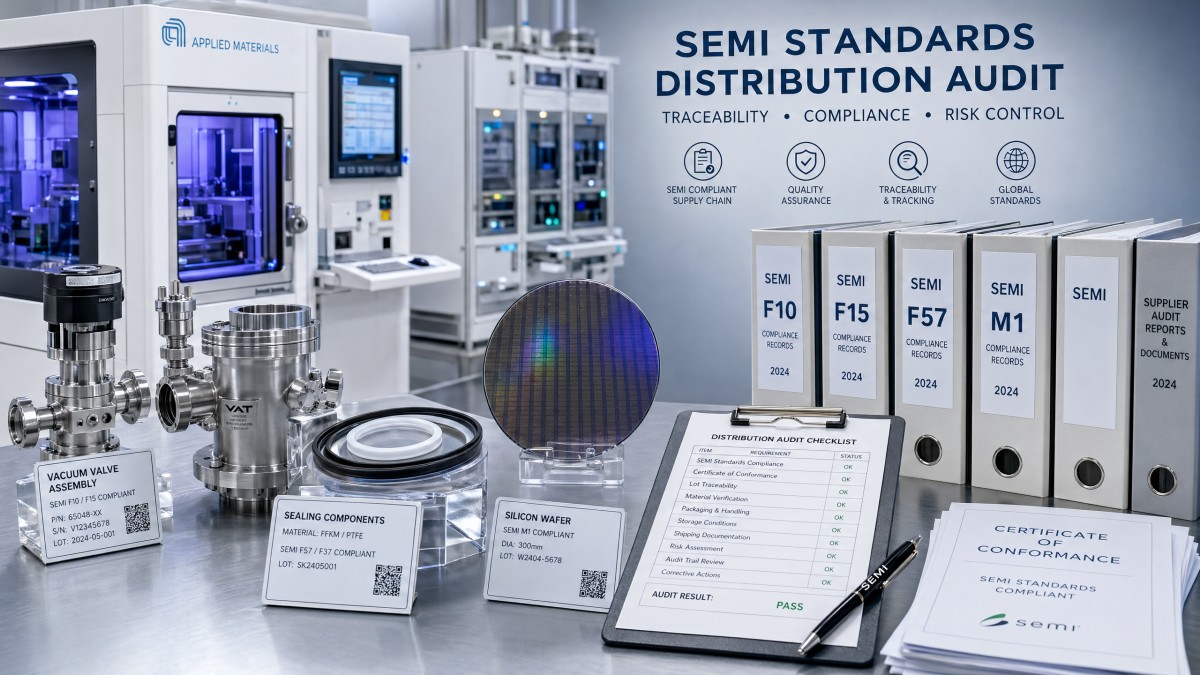
Semiconductor manufacturing standards distribution sits at the intersection of technical conformity and procurement execution. Components linked to cleanroom systems, chemical delivery, vacuum handling, motion subsystems, control networks, and materials handling must often meet multiple frameworks at once, including SEMI, ISO, ASME, and sometimes IEEE-related interface expectations. A distributor that understands only catalog sales is rarely sufficient for this environment.
The risk profile is unusually high because qualification windows are narrow and downtime costs are significant. In many facilities, a missed delivery of a standards-compliant seal, valve assembly, sensor module, or bearing unit can interrupt preventive maintenance cycles scheduled every 30, 60, or 90 days. Even a small documentation omission, such as missing lot traceability or material declaration, may force re-inspection or quarantine.
From a G-CST perspective, buyers should assess distributors as part of a broader high-tech procurement intelligence process. That means comparing not only commercial terms, but also engineering data quality, export control awareness, revision handling, and support for benchmark-driven sourcing across five industrial pillars: semiconductor fabrication equipment, specialized pumps and valves, precision motion systems, industrial software interfaces, and advanced engineering materials.
Where weak distributors create hidden cost
The most common hidden costs appear in four areas: incorrect specification matching, incomplete compliance records, unstable lead times, and poor post-sale change communication. A buyer may save 3%–5% on unit price yet absorb far greater losses through line interruption, urgent air freight, duplicate incoming inspection, or failed site acceptance preparation.
This is especially relevant when sourcing items tied to contamination control, fluid handling, vacuum integrity, or sub-micron motion precision. In those categories, the distributor must understand tolerance windows, clean packaging expectations, revision compatibility, and whether the part is intended for new equipment builds, retrofit programs, or field-service replacement.
Core warning signs
- Unable to provide current standards references or explain how product documentation aligns with SEMI or ISO-related requirements.
- Lead-time commitments that vary widely, such as 2 weeks in one quote and 8–10 weeks in another, without supply explanation.
- No clear process for engineering change notifications, obsolescence notices, or alternate part review.
- Limited traceability on lot number, country of origin, material composition, or calibration status where applicable.
The 6-point due diligence framework buyers should use
A structured vetting model helps cross-functional teams evaluate a semiconductor manufacturing standards distributor consistently. The most effective framework includes 6 checkpoints: standards literacy, documentation control, customization capability, supply continuity, technical support depth, and commercial governance. This approach gives procurement and engineering teams a common decision language instead of relying on isolated price comparisons.
The first checkpoint is standards literacy. Ask the distributor to explain which SEMI or ISO-related requirements typically affect the product categories you buy. A capable partner should discuss practical implications such as cleanliness, labeling, dimensional consistency, packaging, test records, and revision control. If the answer stays generic for more than 10–15 minutes, that is usually a warning sign.
The second and third checkpoints are documentation control and customization readiness. In semiconductor-adjacent procurement, documentation often matters as much as the hardware. Buyers should confirm whether the distributor can handle datasheets, declarations, certificates, inspection reports, and custom configuration records within a repeatable process. Custom kitting, private labeling, modified interfaces, and pre-assembled delivery can reduce handling steps by 1–3 stages in receiving and installation.
Decision checklist for evaluation meetings
The table below can be used during supplier interviews, RFQ reviews, or distributor onboarding workshops. It focuses on practical evidence rather than promises.
The strongest candidates are usually those that can show process evidence quickly. A distributor that delivers records within 1–3 business days, explains risk boundaries clearly, and escalates technical exceptions before shipment is typically more valuable than one offering a nominally lower quote.
Six evaluation points to score internally
- Standards understanding by category: valves, seals, motion parts, sensors, software-linked devices, or engineered materials.
- Accuracy of quotation package, including revision level, Incoterms, lead time, and documentation scope.
- Custom capability for kits, bundles, pre-inspection, clean packaging, or customer-specific labeling.
- Responsiveness across 3 stages: pre-sales, order execution, and after-sales change notice.
- Risk transparency for export restrictions, long lead items, and single-source dependencies.
- Alignment with your internal QA, EHS, and maintenance workflows.
How to verify compliance, customization, and traceability in practice
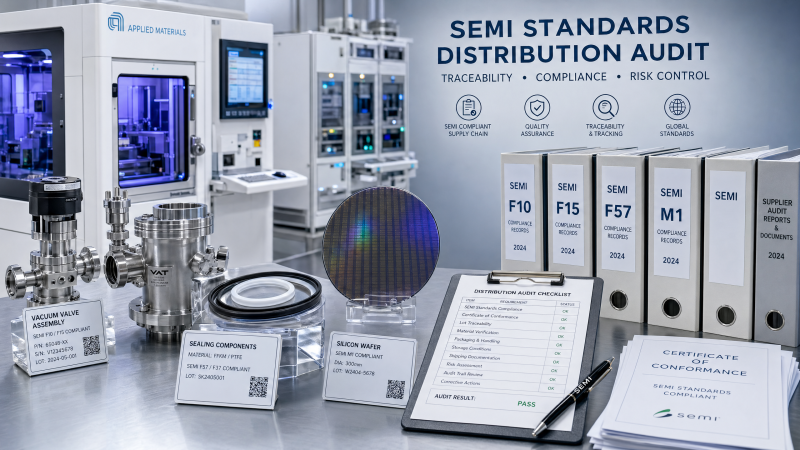
Many distributors claim compliance support, but buyers need practical proof. Start with document sampling. Request 3–5 recent examples relevant to your category, such as certificates of conformity, material declarations, calibration records, clean packaging procedures, or revision histories. The goal is not to collect paperwork for its own sake, but to determine whether the distributor operates with disciplined control.
Next, test customization capability through a controlled RFQ. For example, ask whether the distributor can provide a modified kit for a maintenance shutdown, including labeled components, specified packaging sequence, and inspection hold points. In many high-tech facilities, reducing unpacking, sorting, and verification from 5 steps to 2 or 3 can shorten maintenance windows and reduce installation error risk.
Traceability should be reviewed at batch, shipment, and engineering-change levels. A dependable semiconductor manufacturing standards distributor should be able to show how a product lot links to source, documentation, and shipment history. If a specification changes, the distributor should identify whether the change is form, fit, function, or only administrative revision. That distinction affects qualification effort and spare-part interchangeability.
What good evidence looks like
The following comparison helps buyers distinguish between acceptable and high-confidence distributor practices during audits or qualification reviews.
If the distributor can support these stronger practices, qualification tends to move faster and internal confidence improves across QA, engineering, and procurement. That becomes especially important for multinational operations where one approved distributor may serve 2–4 facilities with different documentation expectations.
Questions to ask before approval
- How are product revisions communicated, and what is the standard notification period before shipment?
- Can custom packaged or configured orders be linked to internal customer part numbers?
- What records are retained for 12 months, 24 months, or longer when traceability is required?
- What is the escalation path if a discrepancy is found during incoming inspection or installation?
Supply-chain intelligence, lead times, and risk control for enterprise buyers
In high-tech procurement, distributor quality is inseparable from supply-chain intelligence. Semiconductor projects often involve long-cycle equipment builds, staggered maintenance shutdowns, and globally distributed suppliers. Buyers should therefore examine how the distributor manages lead-time volatility, shortage alerts, export-control changes, and logistics alternatives. This is where commercial intelligence becomes a competitive advantage rather than an administrative layer.
A practical review should separate products into at least 3 categories: routine consumption items, engineered configured items, and critical long-lead parts. Routine items may tolerate 1–2 approved substitutes and replenishment cycles of 2–4 weeks. Configured items may need customer approval before release. Critical long-lead items may require forecast visibility for 8–16 weeks or more, especially when upstream fabrication or special materials are involved.
G-CST’s cross-sector benchmarking logic is useful here because semiconductor reliability is linked to more than semiconductor tools alone. Pump and valve systems, bearing precision, digital monitoring interfaces, and material performance all affect the procurement outcome. A distributor with stronger cross-domain visibility is usually better prepared to identify dependencies before they become operational problems.
Risk review points for sourcing teams
When comparing distributors, procurement teams should capture both technical and commercial resilience indicators. The checklist below is effective for quarterly review, new vendor onboarding, or critical project sourcing.
- Lead-time reliability: compare quoted versus actual delivery over the last 3–6 orders.
- Buffer inventory options: confirm whether safety stock, bonded stock, or scheduled release programs are available.
- Trade compliance awareness: verify whether the distributor flags export-control or re-export risks early.
- Single-source exposure: identify components with no qualified alternate and define mitigation plans.
- Response discipline: critical shortage updates should ideally be issued within 24 hours, not after the promised ship date passes.
An enterprise buyer should also define decision thresholds. For example, if on-time delivery falls below 95% for critical parts over two consecutive quarters, or if documentation errors exceed 2 incidents per 100 line items, the distributor should enter corrective review. Measurable thresholds make vendor governance more objective and easier to defend internally.
Typical distributor risk scenarios
Common scenarios include silent substitutions, incomplete customs paperwork, last-minute source changes, or confusion over obsolete revisions. None of these issues are rare in global industrial sourcing, but a mature distributor documents and escalates them early. That is often the difference between a manageable schedule change and a costly project interruption.
Implementation steps, internal alignment, and final selection criteria
The final selection process should involve more than procurement alone. In most semiconductor-related sourcing decisions, engineering, quality, operations, and in some cases legal or trade-compliance teams should all review the distributor before approval. A 4-step implementation model works well: scope definition, evidence review, pilot order, and performance monitoring.
During scope definition, list the product families, standards sensitivities, documentation needs, and forecast volumes. During evidence review, request records, audit responses, and service process descriptions. The pilot order should include at least 1 moderately complex item, not only a low-risk stock part. Monitoring should then track delivery, documentation quality, discrepancy resolution time, and communication discipline for the first 60–90 days.
A robust distributor selection decision usually balances five factors: standards alignment, technical support, supply resilience, documentation control, and total cost of ownership. Unit price remains important, but the more strategic question is whether the distributor reduces coordination burden, qualification friction, and operational uncertainty across the procurement lifecycle.
Suggested approval workflow
- Define critical categories and classify them by operational risk and compliance sensitivity.
- Score 2–3 candidate distributors using a weighted matrix with technical, compliance, and commercial criteria.
- Run a pilot order with documentation checks, delivery checks, and internal user feedback from operators or maintenance staff.
- Approve conditionally, then review after the first quarter using measurable KPIs.
FAQ for buyers and technical teams
How long does distributor vetting usually take? For a standard review, 2–4 weeks is common. If export controls, custom configurations, or multi-site approvals are involved, the process may take 4–8 weeks.
Which teams should participate? At minimum, procurement and quality should be involved. For engineered or critical parts, include maintenance, process engineering, and compliance stakeholders.
What are the most overlooked checks? Change-notice handling, lot traceability depth, and the distributor’s ability to support custom packaging or configuration for shutdown and service work.
When should a buyer reject a candidate? If documentation is inconsistent, revision control is unclear, or lead-time commitments cannot be supported with credible supply logic, rejection is often the safer option.
A semiconductor manufacturing standards distributor should be evaluated as a long-term operational partner, not just a transactional source. The right choice supports SEMI and ISO-related expectations, improves traceability, strengthens supply continuity, and helps procurement teams make decisions with greater confidence across complex industrial environments.
For organizations managing semiconductor equipment, advanced materials, motion systems, pump and valve assemblies, or digital industrial infrastructure, disciplined vetting reduces qualification risk and protects project schedules. G-CST’s benchmark-driven approach can help buyers align technical evidence with procurement intelligence and supplier resilience analysis.
If you are reviewing distributors for high-spec manufacturing programs, now is the right time to build a more rigorous shortlist. Contact us to discuss your sourcing criteria, request a tailored evaluation framework, or learn more about standards-focused procurement solutions for advanced industrial supply chains.
- Semiconductor Fabrication Equipment
- Advanced Engineering Materials
- Semiconductor Manufacturing Standards
- ISO Compliance Equipment
- SEMI Standards
- High-tech Procurement Intelligence
- SEMI Standards compliance
- High-tech Procurement Intelligence sourcing
- ISO Compliance Equipment custom
- Semiconductor Manufacturing Standards distributor
Recommended News
 May 09, 2026Wafer Fabrication Investment Insights: Cost Signals to Watch in 2026Wafer fabrication investment insights for 2026: uncover the cost signals shaping fab ROI, risk, utilities, yield, and compliance before capital plans are approved.
![]() May 08, 2026How to Compare ALD Precursor Delivery Precision Without Missing Hidden VariabilityALD precursor delivery precision comparison starts with the hidden variables vendors often omit. Learn a practical checklist to assess pulse stability, thermal control, dead volume, and long-run reliability.
May 08, 2026How to Compare ALD Precursor Delivery Precision Without Missing Hidden VariabilityALD precursor delivery precision comparison starts with the hidden variables vendors often omit. Learn a practical checklist to assess pulse stability, thermal control, dead volume, and long-run reliability. May 07, 2026Ion Implantation Dose Precision: What Actually Matters in Process QualificationIon implantation dose precision defines yield, reliability, and qualification risk. Learn what evaluators should verify in dose accuracy, repeatability, beam stability, and supplier control.
 May 06, 2026ALD Film Thickness Uniformity Data: Common Mistakes That Skew Quality ReviewALD film thickness uniformity data mistakes can hide drift, distort quality review, and trigger costly decisions. Discover the key checks, warning signs, and actions every team should know.
 May 06, 2026Etching Selectivity Benchmarks: A Practical Way to Judge Process StabilityEtching selectivity benchmarks give technical evaluators a practical way to judge process stability, repeatability, and qualification risk—discover how to assess reliable scale-up with confidence.
 May 06, 2026CMP Removal Rate Data: What Actually Matters for Process TuningCMP removal rate data matters most when tied to pad condition, slurry behavior, pressure stability, and wafer uniformity. Learn how to tune CMP for better yield, control, and repeatable results.
 Factory Before RFQ") May 05, 2026What to Check in an Atomic Layer Deposition (ALD) Factory Before RFQAtomic layer deposition (ALD) factory selection starts before RFQ. Learn what to audit for process stability, compliance, scale-up, and supply-chain reliability.
May 05, 2026What to Check in an Atomic Layer Deposition (ALD) Factory Before RFQAtomic layer deposition (ALD) factory selection starts before RFQ. Learn what to audit for process stability, compliance, scale-up, and supply-chain reliability. May 05, 2026How to Compare a Plasma Generator Manufacturer for Stable Process OutputPlasma generator manufacturer comparison guide: learn how to assess power stability, control precision, compliance, and lifecycle support for stable process output.
 May 04, 2026Wafer Deposition System OEM: When Lower Upfront Pricing Becomes a Long-Term RiskWafer deposition system OEM choices with the lowest upfront price can create hidden long-term risks. Learn how to assess downtime, yield, compliance, and lifecycle support before approving capital equipment.
 May 04, 2026Wholesale Etching Machines: Common Performance Gaps That Show Up After InstallationWholesale etching machines often show hidden performance gaps after installation. Learn the real causes behind drift, low throughput, and maintenance issues to improve stability and buying decisions.
 Wholesale: What to Check Before Scaling Supply") May 04, 2026Chemical Mechanical Polishing (CMP) Wholesale: What to Check Before Scaling SupplyChemical mechanical polishing (CMP) wholesale success depends on more than price. Learn how to assess quality, traceability, compliance, and supply resilience before scaling.
May 04, 2026Chemical Mechanical Polishing (CMP) Wholesale: What to Check Before Scaling SupplyChemical mechanical polishing (CMP) wholesale success depends on more than price. Learn how to assess quality, traceability, compliance, and supply resilience before scaling. Apr 27, 2026How to Vet a Semiconductor Manufacturing Standards DistributorSemiconductor Manufacturing Standards distributor vetting starts with SEMI Standards compliance. Learn how to verify traceability, customization, and sourcing resilience before you buy.
![]() Apr 21, 2026What Causes Drift in Semiconductor Fabrication Equipment?Semiconductor Fabrication Equipment drift affects yield, Precision Motion Control, EUV Lithography Systems and Industrial Software Solutions—learn root causes, benchmarking methods, and prevention strategies.
Apr 21, 2026What Causes Drift in Semiconductor Fabrication Equipment?Semiconductor Fabrication Equipment drift affects yield, Precision Motion Control, EUV Lithography Systems and Industrial Software Solutions—learn root causes, benchmarking methods, and prevention strategies.