Search News
Industry Portal
Popular Tags
How reliability engineering reduces precision manufacturing downtime
Author
Time
Click Count
A machine that restarts after a fault has not necessarily returned to productive service. A spindle may rotate while producing unacceptable surface finish. A motion axis may home successfully but lose repeatability after warming up. A process pump may recover pressure while introducing flow instability. In precision manufacturing, downtime ends when the equipment can consistently produce acceptable output.
Reliability Engineering in precision manufacturing reduces downtime by connecting failure prevention, faster diagnosis, and verified recovery. It helps teams identify which failures threaten production, detect useful warning signs, and prepare interventions that restore both equipment function and process capability. The practical starting point is the recurring failure that consumes the most production time, including troubleshooting, spare-part delays, stabilization, and quality release.
Measure the production loss that repairs leave behind
Maintenance records often capture when a machine stopped and when the repair finished. That leaves out time spent warming up, correcting offsets, checking contamination, running trial parts, and waiting for inspection. When these activities remain invisible, a repair can appear successful even though the same equipment repeatedly delays production.
Track three milestones: equipment failure, restoration of mechanical or electrical function, and release for normal production. Separating them reveals whether the main opportunity lies in preventing faults, shortening repair work, or improving the return-to-service procedure.
Quality losses also matter. Gradual thermal drift or positioning error may generate scrap before an alarm occurs. A useful reliability record therefore links equipment events with dimensional trends, surface defects, process deviations, and rejected output. Maintenance and quality records need compatible timestamps and equipment identifiers so that these relationships can be investigated.
Mean time between failures and mean time to repair can help identify trends, provided failure definitions remain consistent. However, neither metric alone describes precision recovery. Pair them with recurring-fault frequency and the elapsed time from failure to approved production. An improvement that shortens wrench time while extending qualification time deserves closer examination.
Prioritize failure modes by their production consequences
A component list is a weak starting point for reliability planning. The more useful question is how each component can fail and what that failure does to the process. A bearing may seize, develop excessive vibration, or gradually lose stiffness. These failure modes have different warning signs and require different responses.
A focused failure mode and effects analysis, or FMEA, helps organize this judgment. For each important function, record the failure mode, likely causes, production consequences, available detection methods, and recovery requirements. Include supporting systems: cooling circuits, lubrication delivery, compressed air, feedback devices, and control communications can stop an otherwise healthy machine.
Give priority to failures that create safety hazards, damage expensive assemblies, compromise product quality without clear alarms, or require lengthy recovery. Frequency matters, but a frequently replaced low-cost sensor may deserve less attention than an infrequent pump failure that contaminates a sensitive process.
Numerical risk scores can support discussion, but they should not override clear engineering consequences. A hidden protective-function failure needs an appropriate functional test even if its historical occurrence appears low. Conversely, an accessible, inexpensive component with an obvious failure state may reasonably remain on a run-to-failure strategy when its consequences are acceptable.
Match the maintenance method to the failure mechanism
Condition monitoring works when a measurable change provides enough warning to act. Calendar replacement works when age or accumulated use meaningfully affects failure risk. Neither approach fits every component, and adding sensors does not automatically create a useful maintenance program.
For predictable wear, usage-based maintenance may be more meaningful than a fixed calendar interval. Operating hours, travel distance, load cycles, or process exposure can better represent the mechanism involved. For protective devices whose failures remain hidden during normal operation, scheduled functional checks may be necessary.
Some recurring failures call for an engineering change. Replacing bearings more frequently will not resolve incorrect preload, contamination ingress, or unsuitable lubrication. Repeated seal replacement will not correct incompatible materials or persistent dry running. A maintenance task earns its place by addressing a credible failure mechanism.
Build condition monitoring around comparable operating states
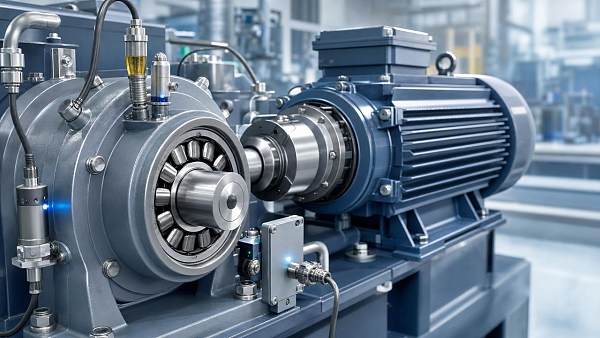
A rising vibration reading does not identify its cause by itself. Speed, cutting load, tool condition, mounting stiffness, and sensor location all affect the signal. Temperature changes with ambient conditions and warm-up state. Motor current changes with acceleration, payload, friction, and the production recipe.
Establish a baseline when equipment condition and output quality are acceptable. Record the operating state alongside each measurement, including speed, load, relevant temperatures, and process mode. Compare equivalent conditions wherever possible. Otherwise, normal production changes can trigger alarms while genuine deterioration remains difficult to distinguish.
An actionable alert needs a defined response. Specify who reviews it, which supporting checks follow, and what conditions require a controlled stop. A warning might trigger a repeat measurement and lubrication inspection; a more serious finding might require planned replacement. Safety-related limits require their own response and should not be treated as ordinary trend warnings.
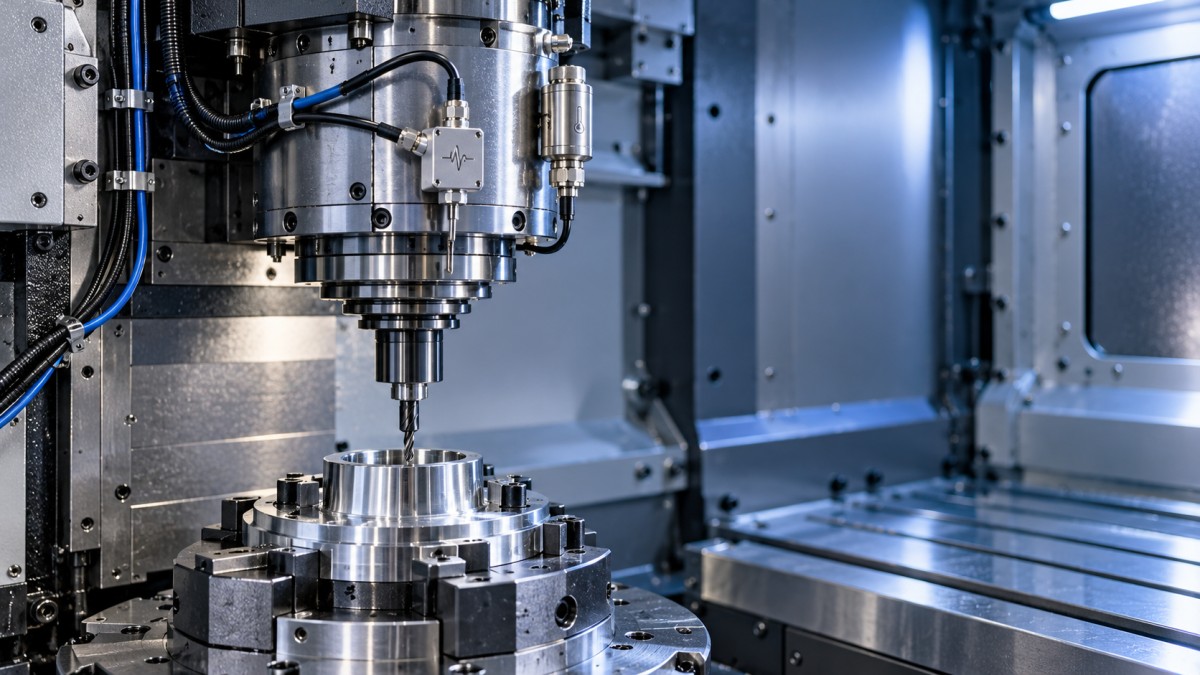
The monitoring interval must also suit the warning period. If deterioration can progress between monthly inspections, that schedule offers limited protection. Continuous monitoring may be justified for a critical, rapidly developing failure. Periodic measurements may be sufficient where degradation is slower and access is straightforward.
Begin with signals already available through the controller, inspection system, or maintenance instruments. Add dedicated sensors where they resolve a specific detection gap. This keeps attention on decisions rather than on collecting data that nobody uses.
Use failure analysis to stop repeat repairs
Replacing the failed part restores function; identifying why it failed changes future reliability. Preserve evidence before dismantling or resetting equipment. Relevant evidence includes alarm sequences, controller traces, lubricant condition, damaged surfaces, installation orientation, and recent operating or configuration changes.
Consider a hypothetical spindle that develops vibration after repeated bearing replacements. Bearing damage is the observed failure, but possible causes include lubrication delivery problems, contamination, incorrect assembly, thermal effects, or operating loads. Each explanation predicts different evidence. Replacing the bearing again without testing those explanations leaves the recurrence mechanism intact.
A practical investigation separates the symptom, failure mode, physical cause, and contributing conditions. “Axis overload” is a symptom. Excessive resistance to motion is a possible failure mode. A damaged guideway or insufficient lubrication may explain that resistance. An inaccessible lubrication point or an incomplete service procedure may explain why the condition persisted.
Use an evidence-led sequence:
- Define what changed, when it changed, and under which operating conditions.
- Compare the affected equipment with its earlier condition or a genuinely comparable healthy unit.
- Test plausible causes using targeted inspections or measurements.
- Implement a corrective action tied to the supported cause.
- Check recurrence and process performance under the conditions that previously produced the fault.
Change one variable at a time where practical. If several urgent changes are necessary, document them clearly so that later analysis does not assign success to the wrong intervention.
Prepare the repair and the precision recovery together
A planned intervention can still create prolonged downtime when the replacement part is available but the installation requirements are missing. Precision assemblies may need controlled handling, specific tightening sequences, alignment fixtures, cleanliness controls, parameter restoration, or thermal stabilization.
Build a recovery package for critical failure modes. Include the correct part revision, required tools, installation instructions, configuration backups, inspection methods, and release criteria. For long-lead components, consider repair exchange options and storage requirements as part of spare-parts planning. A spare that has deteriorated in storage or lacks configuration compatibility may not shorten recovery.
Replacement selection should cover more than nominal dimensions and ratings. Bearing preload and accuracy requirements, pump wetted-material compatibility, valve leakage performance, encoder interfaces, and software dependencies can determine whether an apparently interchangeable replacement works in the process.
Technical benchmarking resources such as G-CST can support comparisons across motion components, pumps, industrial software, and engineering materials. Their practical value lies in organizing relevant specifications and compatibility questions. The maintenance decision still needs to connect those specifications to the machine’s operating conditions and acceptance requirements.
Define release criteria before starting work
“Runs without alarms” is rarely a sufficient acceptance criterion for precision equipment. Choose checks that address the repaired function and its likely effects on the process. A motion-system repair may require repeatability and positioning checks; spindle work may require runout assessment and a machining trial; pump maintenance may require stable flow, leak checks, and process-specific cleanliness checks.
Perform checks under representative conditions, including warm-up or sustained loading where relevant. A cold machine can pass an initial inspection and drift after reaching operating temperature. Involve quality or process engineering when the intervention could affect product acceptance, and define that involvement before the shutdown begins.
Start with one recurring loss and verify the result
A useful first project is a recurring fault with a clear production consequence and accessible evidence. Review its failure history, separate repair time from production recovery, and identify the dominant failure mode. Then select a limited set of actions: a better inspection, an operating correction, a revised service task, a prepared spare, or a targeted engineering change.
Judge the result across comparable operating exposure. Changes in product mix, workload, or operating hours can make simple before-and-after comparisons misleading. Look for fewer repeat events, less unplanned production loss, and consistent acceptance after maintenance. Include the effort spent on inspections and planned interventions so that apparent improvement does not hide an excessive maintenance burden.
For the next critical asset review, bring together its failure history, current condition evidence, and return-to-service requirements. If those records cannot explain what fails, how it can be detected, and what proves recovery, closing those gaps is the most practical place to begin.
Recommended News
 Oct 25, 2026How reliability engineering reduces precision manufacturing downtimeReliability Engineering in precision manufacturing reduces downtime through failure prevention, faster diagnosis, and verified recovery. Discover practical ways to restore quality production sooner.
 Oct 23, 2026Which fab support equipment should get predictive maintenance first?Which fab support equipment needs predictive maintenance first? Compare pumps, chillers, and abatement systems to prioritize critical risks, reduce downtime, and turn early warnings into action.
 Oct 21, 2026How to benchmark AI training time for predictive maintenanceBuild an ai training time benchmark for predictive maintenance. Learn to compare runtime, model performance, and costs to choose an approach that fits your retraining window.
 Oct 17, 2026Which reliability engineering standards apply to predictive maintenance?Reliability Engineering standards guide predictive maintenance. Explore key ISO and IEC frameworks, assess supplier claims, and choose monitoring backed by validated performance.
 Aug 13, 2026How Digital Twin for Pump Systems Improves Failure Prediction in Oil and GasDigital twin for pump systems news oil and gas reveals how real-time modeling improves failure prediction, cuts downtime, and supports smarter maintenance decisions in demanding operations.
 Jul 14, 2026Vibration Isolator for HVAC Equipment: How to Cut Noise Without Hurting StabilityVibration isolator for HVAC equipment selection explained: cut noise, protect stability, and avoid load, sway, and bypass issues across rooftops, mechanical rooms, labs, and healthcare sites.
 Jul 05, 2026How Predictive Maintenance Reduces Downtime in High-Load EquipmentPredictive maintenance downtime reduction helps high-load equipment cut outages, improve uptime, and lower lifecycle costs. Discover practical strategies, key signals, and proven ways to act earlier.
 Jul 04, 2026AI in Precision Engineering for Medical Devices: Where It Improves Tolerance ControlAI in precision engineering for medical devices improves tolerance control through drift detection, tool wear prediction, and AI metrology—helping reduce scrap, boost Cpk, and support validated manufacturing.
 Jun 28, 2026Car Maintenance Price Checklist Before You Approve a RepairCar maintenance price checklist: review labor, parts, diagnostics, and hidden fees before approving repairs. Learn how to spot fair quotes, avoid overspending, and make smarter maintenance decisions.
 Jun 27, 2026Software Uptime Metrics That Actually Reveal System RiskSoftware uptime metrics that truly reveal system risk go beyond availability to expose failures, recovery gaps, and dependency risk—helping you assess resilience with more confidence.
 Jun 13, 2026Industrial Maintenance Checklist to Reduce Downtime in Automated LinesIndustrial maintenance checklist strategies to reduce downtime in automated lines. Learn what to inspect, how to prioritize assets, and how smarter maintenance improves uptime.
 Jun 06, 2026Plastic Machinery Maintenance Issues That Cut OutputPlastic machinery output often drops due to small maintenance issues like poor lubrication, heater drift, cooling fouling, and wear. Learn fast checks that reduce scrap and restore stable production.
![]() Jun 04, 2026AI in Precision Engineering for Medical Devices: 2026 Risk CheckAI in precision engineering for medical devices: uncover 2026 compliance, validation, and traceability risks, plus practical steps to reduce audit exposure and protect quality.
 Jun 02, 2026How to Improve Machine Vision Recognition RateImprove machine vision recognition rate with practical tips on lighting, optics, data quality, calibration, model selection, and validation for reliable automation.
 Jun 01, 2026Reliability Engineering Metrics That Reveal Equipment Risk Before FailureReliability Engineering metrics help reveal equipment risk before failure—compare MTBF, MTTR, availability, RUL, and condition data to improve uptime and supplier decisions.
 May 25, 2026Predictive Maintenance Software OEM: What to Verify FirstPredictive maintenance software OEM selection starts with data accuracy, integration, compliance, and vendor reliability. Learn what to verify first to reduce risk and speed deployment.
 May 23, 2026Smart Bearing With Integrated Sensors: Worth the Upgrade?Smart bearing with integrated sensors: is it worth the upgrade? Explore ROI, downtime reduction, implementation risks, and where embedded sensing delivers the strongest value.
 May 22, 2026Bearing Lubrication Interval Benchmarks to Cut Failure RiskBearing lubrication interval benchmarks explained with practical ranges, risk factors, and maintenance checks to cut failure risk, reduce downtime, and improve asset reliability.
 May 16, 2026Multistage Pump Vibration Metrics That Signal Early WearMultistage pump vibration metrics reveal early wear through axial, bearing, and frequency changes. Learn how to spot faults sooner, cut downtime, and improve maintenance planning.
 May 14, 2026Pump Efficiency Curve Benchmarks That Reveal Hidden Energy LossPump efficiency curve benchmarks expose hidden energy loss, system mismatch, and rising lifecycle costs. Learn how verified curve comparisons improve reliability, cut waste, and support smarter investment decisions.
 May 09, 2026Semiconductor Equipment Sustainability Report: Which Metrics Matter MostSemiconductor equipment sustainability report guide: discover the metrics that matter most—from energy intensity and water use to lifecycle durability, compliance risk, and supply resilience.
 May 07, 2026MTTF for Semiconductor Robots: A Practical Baseline for Uptime Planningmttf for semiconductor robots explained with a practical uptime planning baseline, checklist, and supplier review tips to reduce risk, justify investment, and improve fab reliability.
 May 06, 2026Plasma Density and Temperature Metrics Explained for Reliable Chamber MaintenancePlasma density and temperature metrics explained for smarter chamber maintenance. Learn how to detect drift early, reduce downtime, and improve reliable, evidence-based service decisions.
 May 05, 2026Semiconductor Chiller OEM Support: What Matters After InstallationSemiconductor chiller OEM support matters most after installation—improve uptime, speed diagnostics, secure spares, and protect long-term process stability in semiconductor production.