Search News
Industry Portal
Popular Tags
How Robotics Is Reshaping Harmonic Drive Load Cycles
Author
Time
Click Count
As robotics moves from isolated automation cells into precision-critical manufacturing, the impact of robotics on harmonic drives has become a key concern for technical evaluators. Higher duty cycles, dynamic torque fluctuations, and tighter positioning demands are reshaping how load cycles are defined, tested, and benchmarked. Understanding these shifts is essential for assessing reliability, lifecycle cost, and specification alignment in advanced motion-control systems.
For technical assessment teams, the short answer is clear: robotics is not simply increasing harmonic drive usage, it is changing the stress profile those drives must survive. Traditional sizing assumptions based on average torque and nominal motion are often no longer sufficient.
The most relevant evaluation question is not whether harmonic drives remain suitable for robotics. It is whether the selected drive can withstand the real load cycle created by high-frequency acceleration, reversing motion, compact joint packaging, and round-the-clock operation.
This article focuses on the practical impact of robotics on harmonic drives, especially how robotic applications are redefining load-cycle expectations, test criteria, and procurement decisions for precision motion systems.
Why robotic load cycles are different from traditional motion-control duty
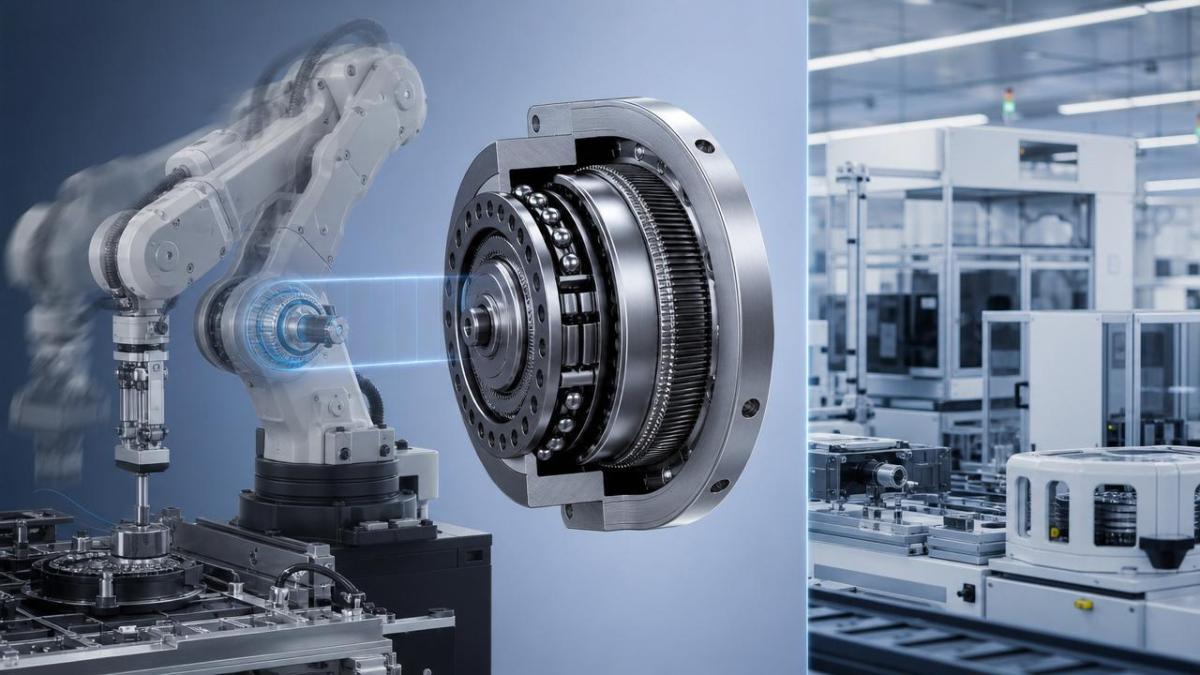
In conventional automation, many motion systems run predictable sequences with moderate acceleration, stable duty windows, and limited direction changes. Harmonic drives in those environments often experience load patterns that are easier to model using steady-state assumptions.
Robotics introduces a much less forgiving operating profile. Multi-axis arms, collaborative robots, surgical robots, warehouse manipulators, and semiconductor handling platforms all demand repeated starts, stops, reversals, and micro-positioning under variable loads.
That shift matters because harmonic drives are highly valued for compactness, zero or near-zero backlash, and reduction accuracy. Yet those same advantages place them at the center of robotic joints where torque spikes, reflected inertia, and thermal buildup can accumulate quickly.
For evaluators, the central implication is that robotic duty is defined less by static rated torque and more by transient events. Peak torque duration, acceleration frequency, dwell behavior, shock loading, and control-loop tuning now influence service life as much as nameplate capacity.
As a result, any serious technical review should move beyond catalog values and ask how the harmonic drive behaves across an actual robotic mission profile. That means understanding the load cycle as a time-based pattern, not a single design point.
How robotics changes the meaning of a harmonic drive load cycle
A harmonic drive load cycle traditionally describes the sequence of torque, speed, direction, and operating time experienced during service. In robotics, each of those variables becomes more dynamic, and their interaction becomes more important.
First, torque is no longer smooth. Robot joints encounter repetitive acceleration torque, payload-induced torque variation, and sudden corrective torque from closed-loop servo adjustments. These events may be brief, but repeated exposure can significantly influence fatigue and wear behavior.
Second, speed profiles have become more aggressive. Many robotic applications rely on short, rapid motions rather than long, uniform rotations. This causes more frequent elastic deformation cycles within the drive and increases the importance of thermal and mechanical recovery characteristics.
Third, reversing direction is now routine. Pick-and-place robots, articulated inspection systems, and collaborative assembly arms often cycle through bidirectional motion thousands of times per shift. Reversal frequency directly affects tooth engagement behavior and can magnify fatigue accumulation.
Fourth, loading is often offset and multi-axial. In real robot joints, harmonic drives may face combined radial, axial, and moment loads due to arm geometry, tooling position, cable routing, and end-effector dynamics. These external forces can alter internal stress distribution.
Together, these factors mean a robotic load cycle should be evaluated as a spectrum of events. Average torque may still be useful, but it is not enough to predict life, stiffness retention, backlash stability, or maintenance interval confidence.
What technical evaluators should examine beyond rated torque
For procurement and engineering assessment teams, rated torque remains a useful starting filter. However, the impact of robotics on harmonic drives is most visible when performance is assessed through a broader reliability framework.
The first priority is peak-to-RMS torque behavior. A drive may pass average load calculations while failing under repeated peaks that create localized fatigue or thermal overload. Evaluators should request duty-cycle-based sizing validation rather than relying only on nominal output ratings.
The second priority is torsional stiffness under dynamic conditions. In robotic systems, positioning accuracy depends not just on reduction ratio but on how the drive responds under changing load. Stiffness loss under cyclic stress can degrade repeatability even before outright failure occurs.
The third is backlash or lost motion stability over life. Harmonic drives are chosen partly because of precision advantages, but robotic duty can gradually alter compliance behavior. A drive that meets initial precision targets may drift outside acceptable control limits after extended cycling.
Thermal performance is another critical factor. Compact robotic joints often have limited heat dissipation, especially in enclosed or cleanroom environments. Continuous micro-movements and correction cycles may generate heat even when average rotational speed appears modest.
Lubrication retention and contamination resistance also deserve attention. Semiconductor, medical, and food-related robotic systems may impose constraints on lubricants, maintenance intervals, or particle generation. These environmental requirements can materially affect load-cycle durability.
Finally, evaluators should consider integration sensitivity. Encoder alignment, motor matching, bearing support, housing stiffness, and controller tuning all shape the real stress environment. A harmonic drive rarely succeeds or fails in isolation; system architecture matters.
Which robotic applications are putting the most pressure on harmonic drive design
Not all robots stress harmonic drives in the same way. Technical evaluators should distinguish application classes because duty-cycle severity depends on motion style, payload profile, uptime expectations, and precision requirements.
Industrial articulated robots create high dynamic loading through rapid cycle times, varying payloads, and large reach envelopes. Shoulder and elbow joints often see strong torque fluctuations, while wrist joints combine compact packaging with high-speed directional changes.
Collaborative robots present a different challenge. Their payloads may be lower, but frequent interaction, compliance control, and dense deployment can lead to constant adjustment movements. This creates a high count of small-amplitude load events that still contribute to fatigue.
Semiconductor robotics can be even more demanding from a precision perspective. Wafer handling, vacuum transfer, and metrology positioning require minimal lost motion, controlled particle behavior, and predictable thermal stability across long operating windows.
Medical and surgical robots add another layer of scrutiny. Here, the load cycle may not always involve high torque, but extremely precise, smooth, and repeatable performance is essential. Reliability margins are assessed not only mechanically but also through risk management standards.
Mobile manipulators and logistics robots introduce shock and vibration from vehicle motion, plus variable task sequences. In these systems, harmonic drives may face a combination of transport-induced disturbance and frequent manipulator cycling within the same operating day.
The takeaway is simple: evaluators should avoid generic robotics assumptions. The right harmonic drive decision depends on the specific robotic duty envelope, not the broad label of “robotic application.”
How load-cycle testing and benchmarking should adapt
If robotic duty is changing, validation methods must change as well. One of the biggest gaps in supplier comparison is the mismatch between standardized catalog ratings and actual robot operating patterns.
A stronger benchmarking approach begins with mission-profile testing. Instead of testing only continuous torque capacity, evaluators should request evidence based on realistic acceleration, dwell, reversal, and payload conditions that resemble the intended deployment environment.
Cycle-count data should also be interpreted carefully. A million cycles of light, smooth motion is not equivalent to a million cycles of aggressive reversing motion with thermal accumulation. Test methodology, load waveform, and environmental conditions must be disclosed.
Temperature monitoring under duty is especially important. In robotic joints, thermal rise affects lubricant behavior, dimensional stability, and long-term precision. Benchmark reports should show how temperature evolves over representative cycles, not merely at steady-state operation.
Another useful criterion is stiffness retention after endurance testing. Many specifications emphasize initial values, but technical buyers need to know how torsional performance changes after prolonged use. End-of-test precision data can be more informative than launch-day numbers.
Wear pattern inspection adds further value. Metallurgical examination, flexspline deformation analysis, and lubricant condition review help identify whether apparent performance margin is sustainable or only temporary under robotic cycling.
Where possible, benchmarking should align with recognized standards while still including application-specific supplements. International standards provide comparability, but robotic joint reality often requires additional test logic that reflects motion-control complexity.
Common specification mistakes when assessing harmonic drives for robotics
One common mistake is selecting by maximum rated torque alone. This can lead to undersizing when transient loads dominate, or oversizing that adds inertia, cost, and control penalties without solving the true duty-cycle problem.
Another mistake is ignoring reflected inertia and servo tuning. Poor dynamic matching between motor, controller, and harmonic drive can produce oscillation, corrective torque spikes, and unnecessary stress that shortens usable life.
Many teams also underestimate off-axis loads. Robotic joints rarely operate in ideal laboratory alignment, and cable pull, tool extension, and mounting deflection can impose moments that materially affect drive behavior over time.
A further issue is relying on incomplete life claims. If service-life data is provided without clear reference to torque waveform, speed pattern, temperature, lubrication state, and precision degradation criteria, it may not support a rigorous procurement decision.
Some buyers separate mechanical and control evaluation too sharply. In reality, harmonic drive reliability is strongly shaped by software behavior, motion planning, and safety constraints. An excellent component can still underperform in a poorly tuned robotic system.
Finally, teams sometimes overlook maintenance and replacement implications. In high-uptime environments, access difficulty, contamination control, recalibration time, and spare-parts availability can influence lifecycle cost as much as initial drive performance.
A practical evaluation framework for technical assessment teams
To assess the impact of robotics on harmonic drives effectively, teams should build a review process around real operating evidence. The first step is to define the robotic mission profile in measurable terms, not general descriptions.
That profile should include payload range, motion sequence, acceleration peaks, reversal frequency, dwell time, duty hours, ambient conditions, contamination sensitivity, and acceptable precision drift over life. Without this baseline, supplier comparison is weak.
Next, map the mission profile to drive stress variables. These include RMS torque, peak torque duration, input speed behavior, thermal rise risk, off-axis loading, and stiffness sensitivity. This helps distinguish theoretical suitability from application-fit confidence.
Then request supplier data that mirrors those variables. Useful evidence includes duty-cycle simulation reports, endurance test summaries, thermal curves, stiffness retention data, lost-motion trends, lubrication recommendations, and failure-mode limitations.
After document review, perform system-level validation where possible. Bench testing with the intended motor, controller, housing, and load configuration often reveals integration effects that standalone component data cannot capture.
Finally, assess total lifecycle impact. This includes replacement interval risk, unplanned downtime exposure, recalibration burden, spare strategy, and implications for safety or quality compliance. For advanced manufacturing, these downstream effects often justify deeper front-end scrutiny.
Conclusion: robotics is redefining harmonic drive reliability expectations
The impact of robotics on harmonic drives is not a narrow component story. It is a broader shift in how motion-transmission reliability must be defined, tested, and purchased in precision automation environments.
Robotic systems create denser, faster, more variable load cycles than many traditional applications. That makes average ratings less decisive and elevates the importance of transient torque behavior, stiffness retention, thermal management, and real mission-profile validation.
For technical evaluators, the best decision framework is evidence-based and application-specific. Harmonic drives remain highly relevant to robotics, but their suitability depends on how well the selected design matches the actual load cycle rather than an idealized catalog condition.
In practice, buyers who benchmark against real robotic duty will make better trade-offs on precision, service life, and lifecycle cost. In today’s high-performance motion systems, that is the standard that increasingly separates acceptable selection from resilient engineering.
Recommended News
 Jul 10, 2026How to Read a Harmonic Reducer Accuracy Chart for Motion System SelectionHarmonic reducer accuracy chart explained for smarter motion system selection—learn how to assess transmission error, repeatability, load response, and supplier risk with confidence.
 Jun 16, 2026Harmonic Drive Transmission Accuracy: Key Factors to VerifyHarmonic drive transmission accuracy explained: verify load, lost motion, stiffness, thermal effects, and lifetime stability to compare options with confidence and reduce precision risk.
 May 22, 2026How Robotics Is Reshaping Harmonic Drive Load CyclesDiscover the impact of robotics on harmonic drives and how shifting load cycles affect torque, precision, thermal limits, and lifecycle reliability in advanced motion systems.
 May 20, 2026Harmonic Drive Transmission Accuracy: Key Error SourcesHarmonic drive transmission accuracy depends on load, heat, mounting, lubrication, and control tuning. Learn key error sources and practical fixes to improve precision and reliability.
 May 18, 2026Harmonic Drive Manufacturer Comparison: Accuracy, Backlash, and Service LifeHarmonic drive manufacturer comparison for accuracy, backlash, and service life. Learn how to evaluate suppliers by application, durability, and support to reduce sourcing risk.