Search News
Industry Portal
Popular Tags
How to Compare Semiconductor Testing Equipment Factory Options for Stable Yield

Author
Time
Click Count
Selecting the right semiconductor testing equipment factory can directly influence yield stability, compliance readiness, and long-term supply resilience. For technical evaluators, the challenge is not only comparing specifications, but also verifying process capability, calibration discipline, traceability, and service support across global production environments. This guide outlines how to assess factory options with a data-driven framework that reduces procurement risk and supports consistent semiconductor manufacturing performance.
Why a checklist-based review works better than a brochure comparison
A semiconductor testing equipment factory may present strong headline claims on throughput, precision, and reliability, yet stable yield usually depends on deeper factory disciplines that are not visible in a standard quotation. Technical evaluators need a structured method because yield loss often comes from hidden variation: fixture repeatability, probe card interface tolerance, environmental control, firmware revision management, spare-part consistency, or weak outgoing inspection. A checklist prevents these details from being missed.
This is especially important in cross-border sourcing. Different factories may appear similar on paper, but differ significantly in process maturity, supplier qualification, software validation, ESD protection, and response time for field issues. When comparing semiconductor testing equipment factory options, the goal is not merely to find a lower purchase price. The goal is to identify which supplier can sustain measurement integrity and service continuity across product ramps, engineering changes, and high-mix manufacturing conditions.
Start with these priority checks before reviewing detailed specifications
Before diving into every technical line item, confirm whether the supplier is even worth a full evaluation. These first-pass checks help technical teams filter high-risk options quickly.
- Verify manufacturing scope: Does the semiconductor testing equipment factory design, assemble, calibrate, and validate equipment in-house, or mainly integrate third-party modules?
- Check product relevance: Has the factory delivered systems for wafer test, final test, burn-in interface support, handler integration, or parametric verification similar to your process node and package type?
- Confirm standards discipline: Look for alignment with ISO quality systems, SEMI-related practices, ESD controls, and documented calibration traceability.
- Review installed base evidence: Ask for anonymized references by device class, throughput range, and uptime targets rather than generic customer logos.
- Assess change control: A capable factory should show revision history for hardware, software, firmware, BOM, and test procedures.
- Screen service readiness: Determine whether spare parts, remote diagnostics, and field engineering coverage are available in your operating regions.
If a supplier cannot answer these basic points clearly, a deeper audit often reveals additional risk. Early filtering saves time and protects engineering resources.

Core technical checklist for comparing semiconductor testing equipment factory options
1. Process capability and manufacturing consistency
Stable yield begins with consistent machine build quality. Ask the semiconductor testing equipment factory for documented process controls covering critical assembly steps, torque management, alignment procedures, cable routing discipline, contamination prevention, and final verification. Technical evaluators should request data on repeatability across multiple units, not just acceptance results from a single demonstration system.
Useful evidence includes process FMEA, control plans, incoming inspection criteria for sensitive components, and corrective action records. If the factory cannot show how it controls variation between production lots, then field-to-field performance drift becomes more likely.
2. Calibration, metrology, and measurement integrity
Testing equipment is only as good as its calibration chain. Review whether the factory maintains traceable calibration for voltage, current, timing, thermal, and mechanical positioning functions. The right semiconductor testing equipment factory should define calibration intervals, out-of-tolerance handling, uncertainty budgets, and re-verification after transport or installation.
Also confirm how the supplier validates measurement software. In high-reliability semiconductor applications, software logic errors can create false pass or false fail conditions that distort yield analysis. Ask for software test protocols, release approval records, and rollback procedures.
3. Traceability from components to final system
A strong semiconductor testing equipment factory should provide traceability at several levels: key component lot, serial number, firmware version, assembly operator, inspection records, and final test report. This matters because many yield excursions require backtracking to exact hardware revisions or replaced modules. Without traceability, root-cause analysis becomes slow and incomplete.
Priority check: ask whether the factory can correlate shipped system configuration with future service interventions. This is essential when multiple sites operate the same platform with localized modifications.
4. Environmental control and ESD management
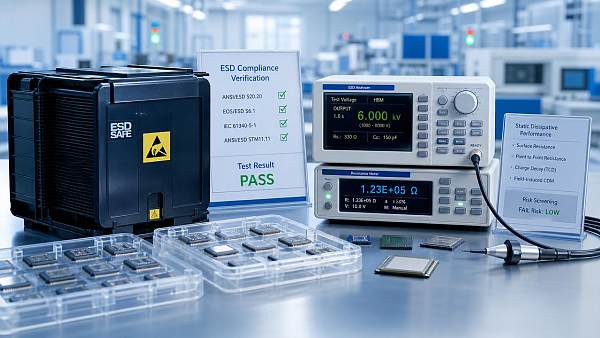
For technical evaluators, one overlooked issue is whether the factory environment itself supports the production of precision test systems. Review controls for temperature, humidity, particulate exposure, grounding verification, ESD flooring, personnel training, and workstation audits. Even if the final equipment performs well during FAT, poor factory discipline can shorten service life or reduce repeatability after deployment.
5. Reliability validation and life-cycle evidence
Do not accept “high reliability” as a marketing phrase. Ask what validation methods are used: thermal cycling, vibration checks, connector durability, motion cycle testing, power-on stress, and burn-in of sensitive assemblies. A mature semiconductor testing equipment factory should define failure criteria and keep records of failure mode trends. This gives evaluators a more realistic picture of uptime risk and maintenance burden.
Practical comparison table for technical evaluators
Use the table below as a fast screening framework when shortlisting a semiconductor testing equipment factory for stable yield programs.
Different scenarios require different factory priorities
Not every semiconductor testing equipment factory should be judged by the same weighting. The correct priority depends on your production context.
For new product introduction
Prioritize engineering responsiveness, software flexibility, debug support, and application expertise. Early-stage programs often need rapid fixture adjustment, test method optimization, and close interaction between process engineers and supplier specialists.
For high-volume mature production
Focus on MTBF evidence, spare-part interchangeability, preventive maintenance instructions, and multi-site consistency. Here, the best semiconductor testing equipment factory is the one that minimizes unplanned variation over time, not simply the one with the most feature-rich platform.
For regulated or export-sensitive programs
Examine documentation control, origin transparency for controlled components, cybersecurity practices for remote access, and the supplier’s ability to support audit trails. Compliance readiness can be as important as testing performance.
Commonly overlooked risks when choosing a semiconductor testing equipment factory
- Overreliance on FAT results without confirming repeatability after shipment, installation, and local utility variation.
- Ignoring sub-supplier quality for motion components, connectors, sensors, power modules, and thermal control assemblies.
- Failing to check how engineering changes are communicated across global service teams.
- Comparing nominal throughput without evaluating retest rate, changeover time, and diagnostic downtime.
- Accepting incomplete spare-part planning for long-life programs, especially where obsolescence risk is high.
- Not reviewing cybersecurity controls for software updates, remote support, and data export pathways.
These issues often surface only after line integration, when the cost of correction is much higher. A disciplined factory audit reduces the probability of hidden instability entering production.
Execution advice: how to run the evaluation process efficiently
A practical way to compare semiconductor testing equipment factory candidates is to use a staged review model. First, perform a document screening using the checklist above. Second, hold a technical clarification meeting focused on process controls, calibration, and service architecture. Third, conduct either an on-site audit or a structured virtual audit with evidence review. Finally, score suppliers using weighted criteria tied to your yield, uptime, and compliance priorities.
For technical evaluators, it helps to prepare a scoring sheet with separate ratings for manufacturing maturity, metrology reliability, software governance, traceability depth, field support, and supply resilience. Include both current capability and improvement commitment. Some factories are not yet fully mature, but they may still be viable if they can show credible corrective action plans, executive ownership, and measurable milestones.
Questions to raise before moving to quotation or supplier nomination
Before finalizing a commercial discussion with a semiconductor testing equipment factory, technical teams should align internally on the following questions:
- Which yield risks are most critical in our process: measurement drift, thermal instability, contact repeatability, or software inconsistency?
- What evidence do we require for calibration traceability and repeatability before approval?
- What service response time and spare-part coverage are mandatory for our sites?
- How will we validate performance after installation and after future upgrades?
- What documentation must be included for compliance, audit readiness, and long-term traceability?
By answering these points first, buyers can keep negotiations focused on operational value rather than superficial discounting.
Final takeaway for stable yield selection
The best semiconductor testing equipment factory is rarely the one with the most attractive headline specification alone. For stable yield, the stronger choice is the supplier that can prove disciplined manufacturing, traceable calibration, controlled software change, reliable field support, and transparent quality records. Technical evaluators should use a checklist-led review to separate true process capability from presentation-level claims.
If your team is preparing to compare factory options in detail, the most useful next step is to gather target device information, throughput goals, compliance requirements, validation criteria, regional service expectations, and life-cycle support needs. With those inputs defined early, discussions with any semiconductor testing equipment factory will be faster, more evidence-based, and more likely to support long-term manufacturing stability.
Recommended News
 May 28, 2026Machine Vision Software Supplier Checklist for Stable InspectionMachine vision software supplier checklist for stable inspection: compare architecture, integration, support, compliance, and total cost to choose a reliable partner with confidence.
 May 18, 2026Spindle Bearing OEM: Key Checks for Runout, Heat, and ReliabilitySpindle bearing OEM selection starts with the right checks. Learn how to verify runout, heat control, preload, and reliability to reduce risk and choose a proven supplier.
 May 09, 2026Impact of AI on Wafer Testing: Faster Defect Detection or More Noise?Impact of AI on wafer testing: discover how fabs use AI for faster defect detection, stronger yield control, and smarter decisions—without adding costly noise.
 May 08, 2026Wafer Inspection Sensitivity Metrics: Which Specs Actually Reduce Escape RiskWafer inspection sensitivity metrics that truly cut escape risk: learn which specs matter beyond headline sensitivity, from false alarms to edge coverage, for smarter semiconductor tool decisions.
 May 08, 2026Metrology Tool Resolution Benchmarks: What Matters More Than the Smallest NumberMetrology tool resolution benchmarks matter most when backed by repeatability, low noise, stability, and calibration integrity. Learn how to compare tools with confidence.
 May 07, 2026Wafer Dicing Precision Benchmarks: What to Review Before Expanding CapacityWafer dicing precision benchmarks explained for capacity expansion: review yield stability, cut quality, compatibility, and service value to reduce procurement risk.
 May 07, 2026CMP Slurry Particle Size Distribution: Key Checks Before Supplier ApprovalCMP slurry particle size distribution affects yield, defects, and supplier risk. Learn the key checks buyers should review before approval and compare vendors with more confidence.
 May 07, 2026How to Compare Wafer Carrier ESD Compliance Data Without Missing Failure RisksWafer carrier esd compliance data comparison helps quality teams uncover hidden failure risks, verify real test relevance, and choose suppliers with confidence before audits or yield loss hit.
 May 06, 2026Wafer Testing Throughput Benchmarks: When Higher Numbers Do Not Mean Better OutputWafer testing throughput benchmarks reveal more than speed. Learn how uptime, accuracy, coverage, and cost shape real output so you can compare suppliers with confidence.
 May 05, 2026Wafer Probe Station Wholesale Guide for Multi-Site Test Capacity PlanningWafer probe station wholesale guide for multi-site capacity planning. Compare platforms, improve uptime, standardize sourcing, and scale semiconductor test lines with lower risk.
 May 04, 2026Wafer Dicing Machine Manufacturer Shortlist: How to Balance Precision, Throughput, and ServiceWafer dicing machine manufacturer shortlist guide: learn how to balance precision, throughput, and service to reduce risk, improve yield, and choose a supplier with confidence.
 May 04, 2026How to Compare Semiconductor Testing Equipment Factory Options for Stable YieldSemiconductor testing equipment factory selection affects yield, compliance, and uptime. Learn a practical checklist to compare process control, calibration, traceability, and support.
 May 01, 2026Precision Manufacturing Solutions: How to Judge Capability Before Scaling OrdersPrecision Manufacturing solutions: learn how to verify supplier capability, process stability, and quality control before scaling orders—reduce sourcing risk and choose reliable partners.
 Apr 30, 2026Machine vision recognition rate drops for reasons teams missMachine vision recognition rate dropping despite good cameras and lighting? Discover the hidden process, software, and benchmarking issues that cut accuracy—and how teams can restore reliable performance fast.
![]() Apr 21, 2026Technical Benchmarking Gets Misleading When Test Conditions DifferTechnical Benchmarking in Industrial Software Solutions reveals why varying test conditions distort High-performance Bearings, EUV Lithography Systems, and Precision Motion Control decisions—click for smarter procurement.
Apr 21, 2026Technical Benchmarking Gets Misleading When Test Conditions DifferTechnical Benchmarking in Industrial Software Solutions reveals why varying test conditions distort High-performance Bearings, EUV Lithography Systems, and Precision Motion Control decisions—click for smarter procurement.