Search News
Industry Portal
Popular Tags
Metering Pump Dosing Precision: Tolerance vs Real Output
Author
Time
Click Count
For technical evaluators, metering pump dosing precision is not determined by catalog tolerance alone. The number printed on a datasheet is only a starting point.
Actual delivered volume depends on fluid viscosity, suction conditions, discharge pressure variation, pulsation behavior, stroke repeatability, valve performance, and installation quality.
That distinction matters because a pump that meets nominal tolerance in a factory test may still miss process targets in real service.
For industrial buyers and validation teams, the practical question is simple: how close is the real output to the required dose under operating conditions?
In high-demand chemical feed, water treatment, semiconductor utilities, and precision manufacturing environments, that answer determines process stability, compliance risk, and total operating confidence.
This article explains how to evaluate metering pump dosing precision by separating stated tolerance from real output performance, and by focusing on the variables that truly affect delivered dose.
Why catalog tolerance is not the same as real dosing performance
When manufacturers state dosing accuracy or repeatability, the figure is usually tied to defined test conditions rather than every possible field application.
Those conditions often include clean water, stable suction head, fixed discharge pressure, correct priming, standard ambient temperature, and properly sized accessories.
Under those controlled circumstances, a metering pump may achieve excellent tolerance. Yet real plants rarely operate under equally stable conditions for long periods.
Pressure may rise and fall with downstream equipment cycles. Fluid properties may change with temperature, concentration, or batch variation. Gas entrainment may appear unexpectedly.
As a result, technical evaluators should treat tolerance as a controlled performance indicator, not as a direct guarantee of actual in-process dose.
The more critical the application, the more important it becomes to verify the relationship between laboratory tolerance and field output under the exact duty point.
This is the central issue behind metering pump dosing precision: precision is meaningful only when the delivered quantity remains reliable in the installed system.
What technical evaluators are really trying to confirm
Most evaluators are not just asking whether a pump is accurate in principle. They are trying to confirm whether it will remain accurate enough in operation.
That concern usually breaks into four practical questions: output accuracy, output stability over time, sensitivity to operating changes, and ability to be verified in service.
First, they need to know whether the pump can deliver the target flow range without systematic underdosing or overdosing at the intended pressure.
Second, they need confidence that the output will remain stable across long operating cycles, not drift due to wear, check-valve behavior, diaphragm fatigue, or motor control variation.
Third, they want to understand how sharply performance changes when viscosity, suction lift, backpressure, or fluid compressibility moves away from ideal conditions.
Fourth, they need a validation path. If real output cannot be measured, calibrated, or monitored reliably, even a precise pump becomes difficult to trust.
For this audience, the purchase decision is less about headline specification and more about the size and manageability of performance uncertainty.
Which factors most often create the gap between tolerance and real output
The gap between specified tolerance and actual delivered volume is usually caused by a combination of hydraulic, mechanical, and installation-related effects.
Fluid viscosity is one of the first variables to review. Higher viscosity can alter filling efficiency on the suction side and change check-valve response.
Very low viscosity fluids create their own issues, especially when leakage paths, valve seating dynamics, or slip become significant in certain pump designs.
Fluid compressibility also matters. Liquids with dissolved gas, entrained air, or volatile components can absorb stroke energy and reduce effective discharge volume.
Suction conditions are another frequent source of error. Excessive suction lift, restricted piping, poor net positive suction conditions, or undersized strainers reduce chamber filling consistency.
Discharge pressure variation can shift the actual output even if nominal flow remains within a broad published range. Some pump types are more pressure-sensitive than others.
Stroke length and stroke frequency control quality also affect real precision. Fine turndown often looks attractive on paper, but micro-adjustments may not remain linear in practice.
Check-valve design, spring force, ball material, seat geometry, and contamination tolerance are often underestimated, despite having direct impact on repeatable metering behavior.
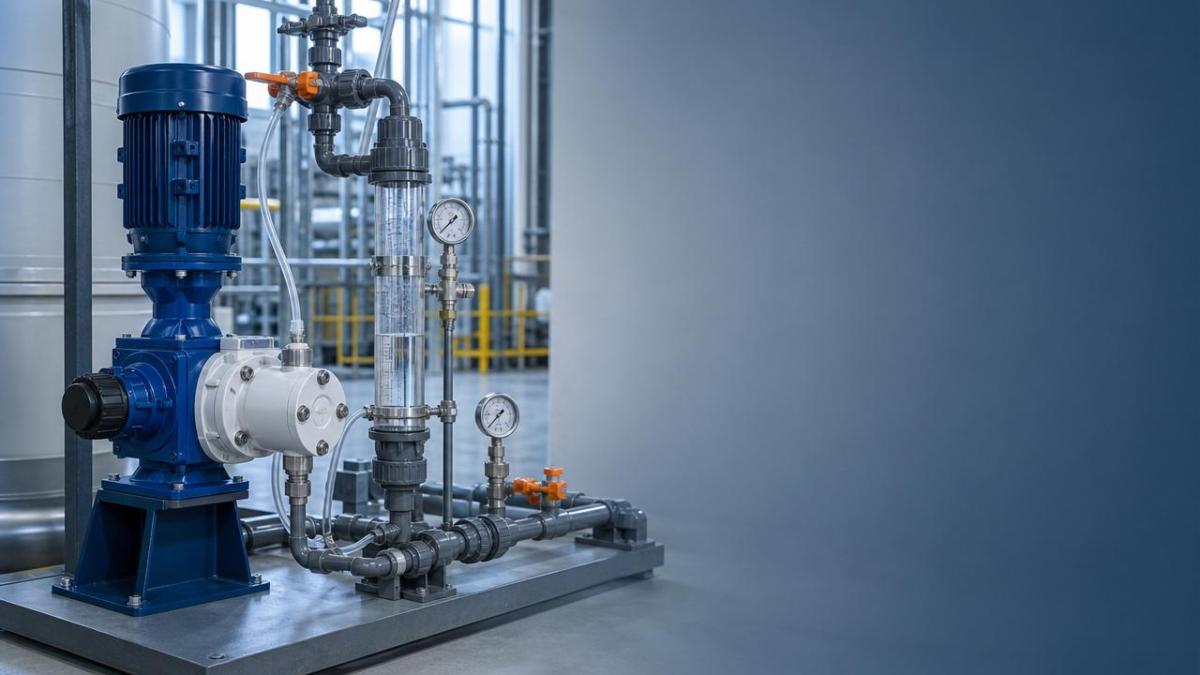
Finally, installation details such as pulsation dampeners, calibration columns, backpressure valves, pipe orientation, venting, and rigid mounting strongly influence stable output.
How pump technology influences metering pump dosing precision
Not all metering pump technologies respond the same way to process disturbances. Evaluators should compare mechanism behavior, not just capacity and pressure ratings.
Solenoid-driven diaphragm pumps are widely used for cost-sensitive dosing, but their real output can be more sensitive to pressure changes, fluid condition, and stroke frequency limits.
Motor-driven mechanical diaphragm pumps often provide better controllability and broader operating stability, especially where continuous duty and moderate precision are both required.
Hydraulic diaphragm metering pumps are typically selected when higher accuracy, stronger pressure capability, and more stable discharge behavior are needed in critical service.
Plunger and piston designs may provide excellent precision, but sealing, leakage risk, and maintenance considerations must be reviewed carefully for hazardous or purity-sensitive fluids.
Peristaltic pumps can perform well with difficult fluids, yet hose elasticity, temperature, and wear progression can change output consistency over time.
The right conclusion is not that one pump type is universally best. It is that technology selection must match the process sensitivity to output variation.
In technical evaluations, the most useful comparison is not just nameplate accuracy. It is output stability at the real flow range, pressure profile, and fluid condition.
What data should be requested from suppliers before selection
To evaluate real performance, technical teams should request test data that reflects application reality rather than relying only on catalog summaries.
Ask first how dosing accuracy is defined. Suppliers should specify whether the figure refers to linearity, repeatability, steady-state accuracy, or total system accuracy.
Next, ask under what test conditions the tolerance was measured. Water-based tests at constant pressure should not be assumed equivalent to viscous or gas-laden service.
Request performance curves across pressure range, not only a single nominal point. This helps reveal whether output changes materially under variable downstream resistance.
Ask for turndown behavior data. Many dosing applications run far below maximum capacity, and low-flow stability is often more important than maximum flow capability.
Where possible, request data for fluids similar in viscosity, density, temperature, and vapor behavior to the intended service. Proxy testing is better than generic assumptions.
Suppliers should also clarify calibration method, allowable deviation after installation, valve material options, and recommended accessories required to achieve stated precision.
For critical applications, factory acceptance testing or witnessed performance validation may be justified, especially when process consequence of misdosing is high.
How to verify actual output instead of assuming it
Verification is the most effective way to reduce uncertainty around metering pump dosing precision. Without measured output, evaluation remains partly theoretical.
The simplest method is a timed volumetric calibration using a calibration column or weigh tank under stable operating conditions representative of the actual process.
Where fluid density is known and control is strict, gravimetric testing can provide better resolution than volumetric observation alone.
Testing should be performed at several operating points, including normal load, minimum expected flow, and maximum expected discharge pressure.
If the system experiences cycling pressure or intermittent injection, testing should also include those dynamic conditions rather than only ideal steady-state runs.
For applications with aggressive chemicals or high-purity requirements, inline flow verification may require specialized Coriolis, thermal, or other compatible measurement technologies.
It is also important to separate pump error from system error. Air leaks on suction lines, poor venting, inaccurate instruments, and unstable backpressure can distort results.
A strong validation protocol documents fluid properties, temperature, suction arrangement, pressure, test duration, and acceptance criteria so later comparison remains meaningful.
Common evaluation mistakes that lead to poor selection decisions
One frequent mistake is comparing pumps based only on maximum capacity and published accuracy without considering where the actual duty point sits inside the control range.
If the required dose is near the lower limit of stable control, real performance may be weaker than the headline specification suggests.
Another mistake is assuming water-test data applies directly to chemical service. Viscous reagents, off-gassing liquids, and slurries behave differently in metering systems.
Some buyers also underestimate the importance of accessories. A backpressure valve, pulsation dampener, degassing arrangement, or foot valve may be essential to stable dosing.
Ignoring maintainability is another risk. A pump that starts precise but loses consistency quickly because valves foul or diaphragms drift may create hidden lifecycle cost.
Evaluation teams sometimes accept broad marketing terms such as high precision or stable output without pinning them to numerical definitions and acceptance conditions.
Finally, a pump may be technically capable yet still fail expectations if commissioning procedures, calibration intervals, and operator checks are not built into the operating plan.
How to judge value in high-demand industrial applications
For technical evaluators, value is not created by the tightest tolerance on paper alone. It comes from reliable dose delivery with manageable verification effort and acceptable risk.
In water treatment, small output deviations may affect reagent consumption, compliance margin, and downstream process chemistry over long operating periods.
In semiconductor utilities or advanced manufacturing support systems, chemical imbalance can create yield risk, contamination exposure, or unstable process control.
In infrastructure and continuous-process plants, output inconsistency may not fail immediately, but it can gradually erode quality, increase maintenance burden, and trigger troubleshooting costs.
That is why the best metering pump choice often balances precision, monitoring capability, serviceability, parts consistency, and documented application-specific performance.
If a supplier can show transparent test methodology, predictable pressure response, robust valve behavior, and field-verifiable calibration procedures, the value proposition is stronger.
For procurement and engineering teams alike, reduced uncertainty is itself an asset because it lowers commissioning risk and shortens time to stable operation.
A practical framework for evaluating metering pump dosing precision
A useful evaluation framework begins with defining the true dosing requirement rather than copying a nominal flow number from a process diagram.
Document the target dose, allowable deviation, minimum and maximum operating flow, discharge pressure range, fluid characteristics, temperature, and operating cycle pattern.
Then identify whether the application is mainly sensitive to average totalized output, instantaneous pulse behavior, short-term repeatability, or long-term drift.
Match those needs to pump technology and ask suppliers for performance evidence under comparable conditions. Do not rely on generalized tolerance language.
Review required accessories and installation constraints early, because actual precision may depend on them as much as on the pump core design.
Plan a verification method before purchase approval. If the output cannot be validated easily after installation, selection risk remains higher than it appears.
Finally, evaluate support quality, spare parts traceability, and calibration guidance. Precision in service depends not only on hardware but also on disciplined lifecycle control.
Conclusion: evaluate delivered dose, not just stated tolerance
The most important takeaway is clear: metering pump dosing precision should be judged by real delivered output under actual operating conditions, not by catalog tolerance alone.
Published tolerance remains useful, but only when its test basis, pressure dependence, fluid sensitivity, and installation assumptions are fully understood.
For technical evaluators, the strongest decisions come from combining specification review with application-specific data, realistic validation, and clear acceptance criteria.
When that approach is followed, pump selection becomes less vulnerable to hidden dosing error, unstable commissioning, and costly process deviation.
In critical industrial environments, precision is not a marketing claim. It is a measurable system outcome shaped by pump design, fluid behavior, and execution quality.
Choose the pump that can prove its real output, not simply the one that advertises the smallest tolerance figure.
Recommended News
 Oct 16, 2026How Do I Size a Pump System for Variable Production Demand?How do I size a pump system for variable production demand? Discover how to match flow, head, VFDs, and staged pumps to reduce energy waste and keep production reliable.
 Sep 27, 2026How valve pressure containment data supports safe system designValve pressure containment data helps engineers verify ratings, materials, tests, and temperature limits for safer system design. Explore practical selection insights.
![]() Oct 16, 2026Which Valve Specifications Help Prevent Chemical Media Leakage?Which valve specification prevents chemical media leakage? Explore sealing, materials, pressure ratings, and fugitive-emission features for safer chemical containment.
Oct 16, 2026Which Valve Specifications Help Prevent Chemical Media Leakage?Which valve specification prevents chemical media leakage? Explore sealing, materials, pressure ratings, and fugitive-emission features for safer chemical containment. Sep 20, 2026When strategic procurement reduces total cost without disrupting supplyStrategic Procurement lowers total cost without risking supply continuity. Learn how to compare delivered value, qualify suppliers, and prevent hidden rework.
 Sep 04, 2026When do oil and gas industrial valves require API 6D certification?Industrial Valves for oil and gas may require API 6D certification for pipeline isolation and transportation systems. Learn key compliance triggers, procurement checks, and safety standards before sourcing.
 Aug 27, 2026Industrial supply chain analysis for finding single-source riskIndustrial Supply Chain Analysis resilience helps uncover hidden single-source risks, map critical dependencies, and build practical mitigation plans for stronger operational continuity.
 Jul 21, 2026How to Evaluate an ISO Compliance Equipment ManufacturerISO compliance equipment manufacturer evaluation starts with more than certificates. Learn how to verify capability, traceability, documentation, and supply reliability.
 Jul 12, 2026Rotary Lobe Pump Exporter Checklist: Certifications, Materials, and Service RiskRotary lobe pump exporter checklist: verify certifications, wetted materials, traceability, and after-sales support to reduce compliance risk, hidden costs, and downtime before you buy.
 Jul 10, 2026ASME Certified Components Quotation: Cost Drivers and Hidden Review PointsASME Certified Components quotation explained: uncover real cost drivers, hidden review points, and supplier risks to compare quotes fairly and avoid costly approval delays.
 Jul 09, 2026How to Compare Global Water and Oil Valve Tenders Databases by Coverage and Update SpeedGlobal water and oil valve tenders database comparison starts with coverage and update speed. Learn how to spot faster, deeper tender intelligence before opportunities are missed.
![]() Jul 07, 2026Air Filters for Clean Processes: When Pressure Drop Becomes a Cost ProblemAir filters can quietly raise clean-process costs through pressure drop, energy loss, and downtime. Learn how to balance filtration efficiency, uptime, and lifecycle savings.
Jul 07, 2026Air Filters for Clean Processes: When Pressure Drop Becomes a Cost ProblemAir filters can quietly raise clean-process costs through pressure drop, energy loss, and downtime. Learn how to balance filtration efficiency, uptime, and lifecycle savings.![]() Jul 07, 2026Metering Pump Manufacturer Checklist for Accuracy and Lifecycle CostMetering pump manufacturer selection goes beyond flow accuracy. Learn how to compare lifecycle cost, reliability, materials, service support, and compliance before you buy.
Jul 07, 2026Metering Pump Manufacturer Checklist for Accuracy and Lifecycle CostMetering pump manufacturer selection goes beyond flow accuracy. Learn how to compare lifecycle cost, reliability, materials, service support, and compliance before you buy.![]() Jul 07, 2026CIP Rotary Lobe Pump Selection: Cleanability, Shear, and Downtime RiskCIP rotary lobe pump selection starts with cleanability, shear control, and downtime risk. Learn how to choose a hygienic, low-maintenance pump that protects product quality.
Jul 07, 2026CIP Rotary Lobe Pump Selection: Cleanability, Shear, and Downtime RiskCIP rotary lobe pump selection starts with cleanability, shear control, and downtime risk. Learn how to choose a hygienic, low-maintenance pump that protects product quality. Jul 06, 2026Food Grade Lobe Pump Shear: How It Affects Product TextureFood grade lobe pump shear directly affects texture, particle retention, and filling stability. Learn how to evaluate shear, protect product quality, and choose the right hygienic pump.
 Jun 30, 2026API Valve Tenders: Cost and Delivery Risks in Global ProjectsGlobal water and oil valve tenders for API valves often hide cost and delivery risks. Learn how to compare bids, spot exclusions, and avoid expensive project delays.
 Jun 27, 2026Slurry Pump for Mining: Common Wear Problems and FixesSlurry pump for mining wear issues explained: spot abrasive wear, cavitation, corrosion, seal leaks, and bearing damage early, with practical fixes to cut downtime and repair costs.
 Jun 25, 2026How to Use an Industrial Buyers Directory for Construction VendorsIndustrial buyers directory for construction: learn how to find, compare, and qualify vendors faster, reduce sourcing risk, and make smarter purchasing decisions for complex projects.
 Jun 23, 2026Radiators vs Heat Exchangers: Which Fits Industrial Cooling Better?Radiators or heat exchangers? Discover which industrial cooling solution delivers better efficiency, uptime, and cost control—and when radiators are the smarter choice.
 Jun 18, 2026Rotary Lobe Pump Factory Checklist: What to Verify Before OrderingRotary lobe pump factory checklist: verify application fit, quality control, material traceability, lead times, and support before ordering to reduce risk and buy with confidence.
 Jun 17, 2026How to Choose Dust Collectors for Fine Powder Controldustcollectors for fine powder control: learn how to compare collector types, filter media, safety, and lifecycle cost to choose a safer, more efficient system.
 Jun 15, 2026How to Compare Storage Solutions for Energy Density and RiskStorage solutions compared by energy density and risk: learn how to evaluate safety, compliance, lifecycle cost, and reliability to choose the right system with confidence.
 Jun 14, 2026Car Batteries Wholesale: Cost Factors, MOQ, and Warranty RisksCar batteries wholesale buying is about more than price. Learn key cost drivers, MOQ terms, landed cost, and warranty risks to choose safer suppliers and protect margins.
 Jun 11, 2026How to Evaluate an Air Compressors Supplier for UptimeAir compressors supplier selection directly affects uptime. Learn how to compare service, parts, data visibility, and technical fit to reduce risk and choose with confidence.
![]() Jun 09, 2026How to Read Centrifugal Pump Head and Flow Data CorrectlyLearn how to read centrifugal pump head and flow data correctly, avoid sizing mistakes, check BEP and NPSH, and make smarter pump selection decisions with confidence.
Jun 09, 2026How to Read Centrifugal Pump Head and Flow Data CorrectlyLearn how to read centrifugal pump head and flow data correctly, avoid sizing mistakes, check BEP and NPSH, and make smarter pump selection decisions with confidence.