Search News
Industry Portal
Popular Tags
PPE Selection Mistakes That Increase Safety Risk
Author
Time
Click Count
Where PPE Selection Starts to Fail in Real Operations
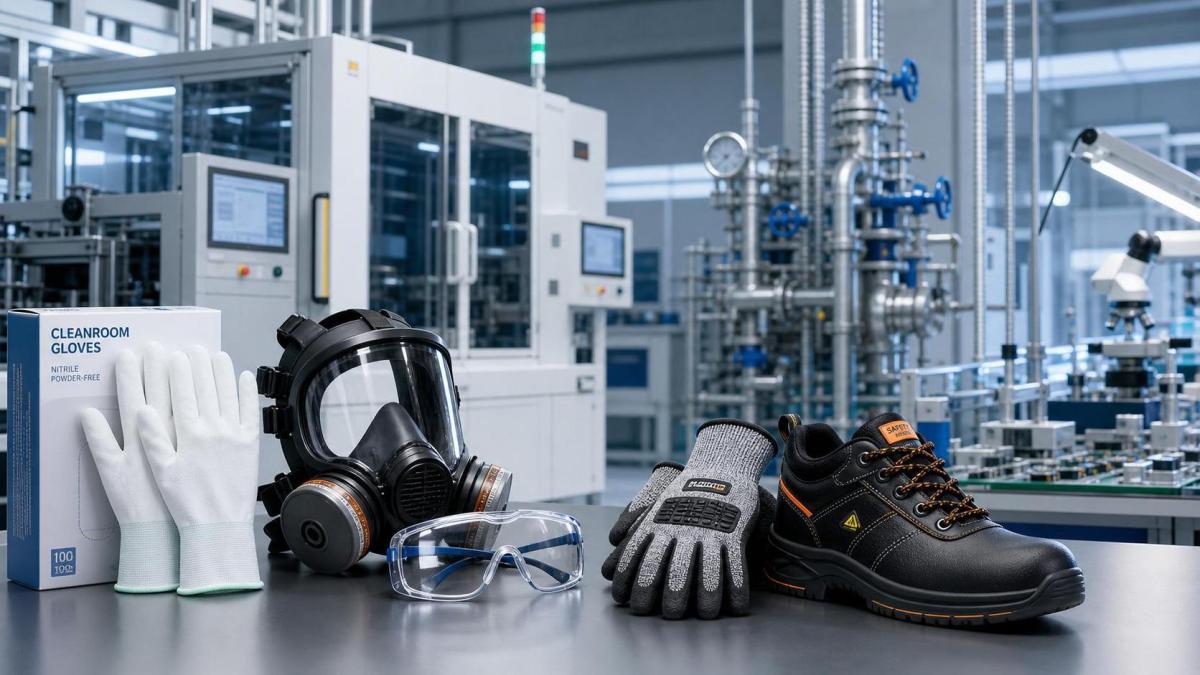
Personal protective equipment (PPE) is often treated as a final barrier. In practice, poor selection can introduce new exposure, slower response, and compliance weakness.
That problem becomes more serious in cross-industry environments. A cleanroom, a chemical transfer skid, a bearing assembly line, and a digital control room do not share the same risk logic.
The mistake is rarely the absence of PPE. It is choosing PPE by catalog category, price, or habit, without matching exposure pathways, task duration, and operating conditions.
In high-reliability sectors tracked through G-CST, safety decisions increasingly sit beside technical benchmarking, maintenance planning, and regulatory review. PPE selection now affects process stability as much as worker protection.
A glove that sheds particles, a visor that distorts visibility, or footwear that transfers static can disrupt quality control before anyone records a safety event.
Why Similar Tasks Can Need Different PPE Decisions
Two jobs may look similar on a procedure sheet and still require different Personal protective equipment (PPE). The difference usually comes from the environment, not the headline task.
Handling valves in a dry utility area is not the same as opening a chemically loaded pump train. Inspecting a motion-control housing is not the same as aligning a rotating assembly during test operation.
In actual use, four variables change the decision most often:
- The hazard form, such as splash, dust, arc, heat, impact, or contamination.
- The exposure pattern, including brief intervention, repeated handling, or continuous wear.
- The performance tradeoff, such as dexterity, visibility, breathability, or electrostatic control.
- The governing standard, which may come from ISO, SEMI, ASME, IEEE, or site-specific rules.
This is why the best PPE program does not begin with product names. It begins with task mapping, interface risks, and failure consequences.
Clean, Controlled, and High-Precision Areas Need More Than Basic Protection
In semiconductor fabrication equipment and advanced materials environments, PPE mistakes often come from over-focusing on worker safety while underestimating product sensitivity.
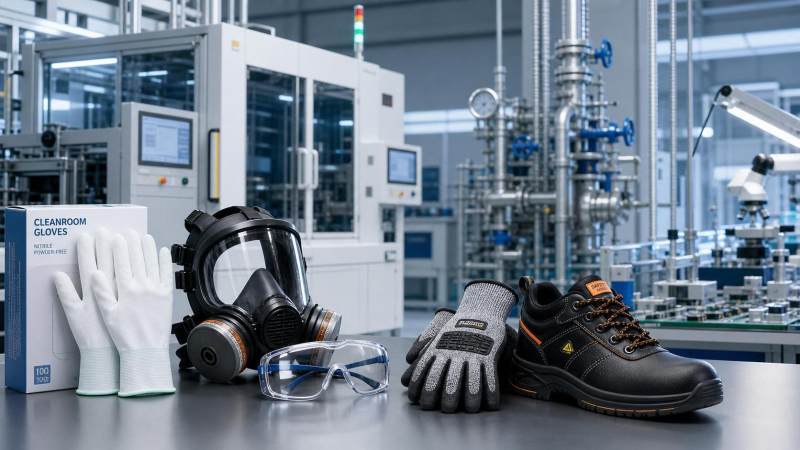
A standard glove may meet basic chemical resistance and still be wrong. It may generate particles, release extractables, or reduce tactile feedback during fine assembly.
Face protection has a similar issue. Anti-fog performance, optical clarity, and compatibility with microscopes or enclosed tooling can matter as much as impact rating.
The more reliable approach is to judge Personal protective equipment (PPE) against both human exposure and process contamination. Cleanliness, static behavior, and ergonomic stability should be reviewed together.
This matters in facilities where a minor contamination event can trigger scrap, requalification, or unplanned downtime. PPE selection here is part of yield protection.
Chemical Systems Change the Decision Beyond Material Compatibility
Specialized pump and valve systems create a different pattern of risk. Selection errors usually happen when material compatibility is treated as the only criterion.
Compatible gloves can still fail in use if cuff length is too short, sleeve interfaces gap during maintenance, or breakthrough time does not match the task duration.
Respiratory and face protection also need closer review. A brief sampling task near a sealed system is different from line breaking, flushing, or seal replacement.
More common failures include poor fit under helmets, reduced communication during emergency response, and limited visibility when operators need to read gauges or confirm leakage.
In these settings, Personal protective equipment (PPE) should be tested against movement, tool use, and decontamination steps. Static product data rarely captures those conditions.
Mechanical Work Often Fails at the Point of Dexterity
Precision motion control, bearings, and rotating assemblies create another frequent mismatch. PPE is sometimes selected for cut resistance or impact resistance alone.
That sounds reasonable until the glove reduces grip sensitivity, increases hand fatigue, or creates snagging hazards near moving parts. Protection then competes with control.
Footwear selection can be equally misleading. Heavy-duty soles may improve crush protection but reduce balance on oil-contaminated surfaces or ladders used during inspection.
Where alignment, torque control, and repetitive assembly matter, Personal protective equipment (PPE) should be validated through task trials. Wearability is not a comfort issue alone. It affects error rates.
Digital and Control Environments Still Have PPE Risks
Industrial software and digital twin environments seem lower risk, yet PPE mistakes still occur around commissioning, live testing, battery backup systems, and mixed access zones.
One recurring issue is treating control rooms and adjacent electrical spaces as one operating context. The access pattern may shift quickly from screen monitoring to energized equipment inspection.
In those moments, arc-rated clothing, eye protection, and insulated accessories need to match the actual intervention level, not the normal workstation appearance.
The broader lesson is simple. Personal protective equipment (PPE) cannot be assigned only by department. It must follow task transitions and temporary site conditions.
Different Operating Contexts Change What Good PPE Looks Like
A quick comparison makes the selection logic clearer:
The table also shows why generic issue lists miss the point. The right PPE choice depends on what failure would matter most in that setting.
The Most Common Misjudgments Usually Happen Before Purchase
Many PPE failures are locked in early, during specification or supplier comparison. Several patterns appear across industries.
- Treating one hazard rating as proof of overall suitability.
- Assuming similar facilities share the same Personal protective equipment (PPE) needs.
- Comparing unit price without counting training, replacement frequency, and fit-testing effort.
- Ignoring compatibility with helmets, harnesses, sensors, or communication devices.
- Reviewing standards once, then missing updates in regulatory or export-control contexts.
In sectors shaped by supply-chain volatility and tighter compliance review, these oversights have a wider effect. They delay qualification, complicate audits, and increase substitution risk.
A Better PPE Selection Process Looks More Like Technical Validation
The strongest PPE programs borrow from engineering verification. They compare field conditions, standards, and failure modes before final approval.
A practical review sequence usually includes:
- Map the task by contact type, duration, posture, and adjacent equipment.
- Check whether contamination control, ESD, thermal load, or visibility limits apply.
- Compare standards and supplier test data against actual site conditions.
- Run a wear trial during normal movement, not only at a bench.
- Record replacement triggers, cleaning limits, and exceptions for temporary tasks.
This method aligns with the broader G-CST view of operational integrity. Reliable decisions come from verifiable data, cross-disciplinary checks, and context-specific benchmarking.
What to Review Next Before Updating PPE Requirements
When PPE selection keeps producing exceptions, discomfort, or near misses, the answer is usually not another broad catalog search.
Start by separating tasks that only look alike. Then review exposure routes, interface points, and the operational cost of a poor fit.
Personal protective equipment (PPE) works best when it is matched to the real scene, the real duration, and the real consequences of failure.
The next useful step is to build a small comparison matrix for high-risk tasks, confirm the governing standards, and document where current PPE assumptions no longer match field conditions.
Recommended News
 Oct 19, 2026How local buckling affects the capacity of cold-formed steel sectionsSee how local buckling reduces the capacity of cold formed steel sections. Compare design methods, identify critical failure modes, and discover practical ways to improve performance.
 Oct 16, 2026How to vet a spark plug supplier to avoid counterfeit partsVet a spark plugs supplier with confidence. Learn how to verify authorization, trace stock, and inspect samples to avoid counterfeit parts, protect equipment, and buy smarter.
 Oct 14, 2026How thermal drift affects high-stability semiconductor equipmentSee how high stability semiconductor equipment is affected by thermal drift, and learn how targeted testing and validated compensation help protect production precision.
 Oct 12, 2026How to assess supplier reliability in consumer electronics wholesaleConsumer electronics wholesale guide: assess supplier reliability through quality control, compliance, production capability, resilience, and pilot orders.
 Sep 29, 2026What to assess before selecting wafer fab investment suppliersWafer fab investment suppliers: assess technical fit, lifecycle cost, service resilience, compliance, and execution risk to choose partners built for reliable semiconductor growth.
 Sep 25, 2026How to verify whether equipment is truly IEEE compliantIEEE compliant equipment verification guide: learn how to check standards, revisions, test evidence, configurations, and real-world compliance with confidence.
 Sep 22, 2026What drives sheet metal price changes in custom fabrication quotes?Sheet metal price changes explained: compare custom fabrication quotes by material, geometry, finishing, quantity, and total landed cost to source smarter.
 Sep 08, 2026What is driving demand in the Middle East semiconductor equipment market?Semiconductor equipment market Middle East demand is rising through AI infrastructure, digital sovereignty, power electronics, packaging, and specialty manufacturing opportunities.
 Sep 07, 2026How to compare lithography equipment suppliers beyond the quoted priceCompare lithography equipment suppliers beyond quoted price. Evaluate proven performance, uptime, service, lifecycle cost, compliance, and factory fit to make a smarter investment.
 Sep 02, 2026What factors are driving advanced materials price trends?Advanced materials price trends explained: discover how supply, processing capacity, specifications, energy, and trade risks shape costs and sourcing decisions.
 Aug 16, 2026What VR headset latency feels unacceptable in daily use?VR headset latency feels unacceptable when head turns, hand tracking, and UI response stop feeling natural—often around 20–30 ms. Learn the real warning signs before daily VR use hurts comfort and performance.
 Aug 15, 2026What drives semiconductor standards pricing for contract manufacturers?Semiconductor standards pricing depends on qualification scope, material verification, cleanliness, traceability, and change control. Learn what raises costs for contract manufacturers.
 Aug 11, 2026How to Evaluate Automated Semiconductor Fabrication Equipment for Throughput, Yield, and Cleanroom IntegrationAutomated semiconductor fabrication equipment evaluation made practical: learn how to compare throughput, yield impact, cleanroom integration, reliability, and software fit for smarter fab investments.
 Aug 10, 2026How to Evaluate Technical Drawing Quality Before Requesting Supplier QuotesTechnical drawing quality can make or break supplier quotes. Learn how to review tolerances, materials, standards, and revisions to reduce sourcing risk and compare bids with confidence.
 Aug 08, 2026How to Evaluate a Semiconductor Equipment Supplier in Europe for Lead Time and ComplianceSemiconductor equipment supplier Europe selection starts with lead time and compliance clarity. Learn how to verify schedules, CE/RoHS readiness, FAT scope, and documentation before you buy.
 Aug 05, 2026What Slows Wafer Fab Capital Spending During Capacity Downcycles?Wafer fab capital spending slows for more than weak demand. Discover the real approval blockers in downcycles, from utilization and ROI to inventory, financing, and tech timing.
 Aug 03, 2026Air Freight vs Sea Freight: When Speed Justifies the Higher CostAir freight vs sea freight: learn when air freight is worth the higher cost by comparing delay risk, cargo value, and schedule impact to make smarter shipping decisions.
 Aug 02, 2026Technical Benchmarking Comparison Chart: Which Metrics Matter Most?Technical Benchmarking comparison chart guide: discover which metrics truly predict performance, compliance, and lifecycle value so you can compare smarter and choose with confidence.
 Fail to Control Exposure Risks?") Aug 01, 2026When Does Personal Protective Equipment (PPE) Fail to Control Exposure Risks?Personal protective equipment (PPE) fails when it is overused as the main control. Learn the warning signs, limits, and smarter ways to reduce exposure risks effectively.
Aug 01, 2026When Does Personal Protective Equipment (PPE) Fail to Control Exposure Risks?Personal protective equipment (PPE) fails when it is overused as the main control. Learn the warning signs, limits, and smarter ways to reduce exposure risks effectively. Jul 23, 2026Residential Photovoltaic Solar Panels: Cost, Output, and Payback BasicsPhotovoltaic solar panels for residential use explained: compare cost, output, roof fit, and payback basics to choose a smarter home energy system with confidence.
 Jul 20, 2026Semiconductor Supply Chain Resilience: Key Risks and 2026 OutlookSemiconductor supply chain resilience is redefining 2026 strategy. Explore key risks, policy shifts, qualification barriers, and practical actions to protect output and stay ahead.
 Jul 15, 2026Benchmarking Standards Explained: Which Metrics Actually MatterBenchmarking standards explained clearly: learn which metrics truly matter for industrial selection, risk reduction, compliance, and lifecycle performance before you buy.
 Jul 13, 2026ASML vs Nikon Revenue Share: What Changed in 2026ASML Nikon revenue share in 2026 reveals what changed in advanced lithography, services, and export controls. See the key drivers, risks, and why the gap matters now.
 Jul 09, 2026Wafer Fab Capital Spending in 2026: Which Tools Are Getting PriorityWafer fab capital spending in 2026 is shifting toward lithography, metrology, etch, deposition, and automation. Discover which tools get priority and what that signals for yield, risk, and fab strategy.