Search News
Industry Portal
Popular Tags
Wafer Inspection Sensitivity Benchmark: What Actually Matters

Author
Time
Click Count
Wafer Inspection Sensitivity Benchmark: What Actually Matters

For technical evaluators, a wafer inspection sensitivity benchmark only matters when it reflects real process value.
That sounds obvious, yet many comparisons still focus on one headline number.
Usually, that number is the smallest detectable defect size under ideal lab conditions.
In real fabs, that number is only the starting point.
A credible wafer inspection sensitivity benchmark must connect sensitivity with yield relevance, recipe stability, throughput, and nuisance performance.
If it does not, procurement teams may buy apparent capability instead of usable capability.
That gap becomes expensive during node migration, process qualification, and ramp.
From a technical standpoint, the right benchmark asks a different question.
Not simply, “How small can the tool see?”
Instead, “What can the tool detect consistently, at production speed, with decision-grade signal quality?”
Why a Wafer Inspection Sensitivity Benchmark Often Misleads
Vendor data sheets usually present sensitivity under tightly optimized conditions.
Those conditions may involve clean pattern regions, tuned illumination, low wafer variation, and limited throughput constraints.
That is useful technical information, but it is not a complete wafer inspection sensitivity benchmark.
The problem becomes clearer in patterned wafer inspection.
Background noise rises as layouts become denser and process windows tighten.
At that point, sensitivity without stability creates more review burden than process insight.
A better benchmark considers how performance changes across layers, products, and process maturity stages.
This also means comparing tools on the same nuisance tolerance and throughput target.
Otherwise, one tool may look more sensitive simply because it floods the system with non-actionable events.
The Core Metrics Behind a Credible Benchmark
A useful wafer inspection sensitivity benchmark needs a small set of linked metrics.
Each one answers a different procurement or process-control question.
1. Detection threshold at defined capture rate
The smallest reported defect size is meaningful only with a stated capture probability.
For example, 90% capture and 60% capture are very different operating realities.
2. Nuisance or false signal rate
This is where many benchmark claims fall apart.
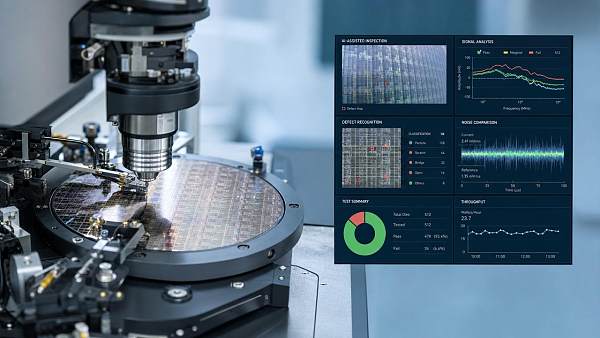
A wafer inspection sensitivity benchmark should state detections per wafer, review load, and nuisance composition.
If nuisance counts spike on dense patterns, effective sensitivity is lower than advertised.
3. Throughput at benchmark settings
Sensitivity tested at impractical scan speed is not production sensitivity.
Benchmark reports should pair defect capture with wafers per hour and tool utilization assumptions.
4. Repeatability and matching
One successful run proves little.
A solid wafer inspection sensitivity benchmark includes wafer-to-wafer repeatability and tool-to-tool matching.
That matters when fabs scale recipes across fleets and sites.
5. Yield correlation
The strongest benchmark links detected events to known yield loss mechanisms.
Without that link, sensitivity may improve dashboards but not business outcomes.
What Good Benchmark Data Should Look Like
In practice, benchmark quality depends on test design as much as tool design.
A credible wafer inspection sensitivity benchmark should document the following conditions clearly.
- Wafer type, layer type, and pattern density.
- Defect classes, including particles, bridges, opens, scratches, and process residues.
- Reference truth method, such as review SEM, e-beam inspection, or defect library validation.
- Recipe tuning effort and optimization time.
- Scan speed, sampling plan, and review strategy.
- Environmental assumptions, including vibration, contamination, and operator variability.
More importantly, the benchmark should show sensitivity curves, not a single point value.
Curves reveal the trade-off between capture rate, nuisance rate, and throughput.
That is where procurement decisions become more defensible.
A Simple Comparison Framework for Evaluators
When comparing suppliers, it helps to normalize the wafer inspection sensitivity benchmark into a decision table.
This structure keeps a wafer inspection sensitivity benchmark grounded in operational relevance.
Common Procurement Mistakes
Several evaluation mistakes show up repeatedly across equipment sourcing cycles.
- Using vendor best-case sensitivity as the main ranking criterion.
- Ignoring review system bottlenecks created by higher nuisance output.
- Comparing unpatterned and patterned results as if they were interchangeable.
- Underestimating recipe engineering time during technology transfer.
- Treating all defect classes as equally yield-critical.
More recently, another mistake has become harder to ignore.
Some teams benchmark sensitivity without considering export controls, service access, and parts continuity.
In advanced fabs, benchmark credibility now includes lifecycle support resilience.
How to Build a More Defensible Wafer Inspection Sensitivity Benchmark
A practical approach is to benchmark in layers.
Start with controlled sensitivity characterization, then move into process-representative production scenarios.
- Define the defect classes that actually threaten yield or reliability.
- Set an acceptable nuisance ceiling before comparing tools.
- Lock benchmark throughput targets to realistic fab planning assumptions.
- Validate recipe portability across at least two tools or two product families.
- Correlate sampled detections with review SEM and downstream electrical outcomes.
- Document operator effort, tuning time, and exception handling load.
This method produces a wafer inspection sensitivity benchmark that can survive management review and supplier negotiation.
It also reduces the risk of buying sensitivity that disappears under actual line conditions.
For organizations tracking broader industrial risk, that discipline matters beyond semiconductors.
It aligns with the wider G-CST view of technical benchmarking.
The point is not to chase the sharpest claim.
The point is to verify which capability remains stable, transferable, and commercially useful.
That is what separates a marketing number from a real wafer inspection sensitivity benchmark.
In practical business terms, the best benchmark is the one that predicts fewer surprises after installation.
Use that standard, and the comparison becomes much clearer.
Anchor every wafer inspection sensitivity benchmark to yield relevance, stable operation, and scalable deployment. That is what actually matters.
Recommended News
 Oct 06, 2026How to assess a wedge bonder supplier’s process capabilityWedge bonder supplier assessment guide: evaluate process capability, Cp/Cpk, material compatibility, traceability, and reliability evidence for confident approval.
 Sep 13, 2026How ion implant dose data helps control sheet resistanceIon implant dose data helps semiconductor teams control sheet resistance, improve process correlation, and reduce electrical variation. Explore practical benchmarking insights.
 Aug 25, 2026How to compare testing equipment when repeatability matters mostTesting equipment comparison starts with repeatability. Learn how to evaluate drift, fixtures, software, and lifecycle risk to choose a system that delivers consistent, defensible results.
 Aug 09, 2026What CE Marking Means for Semiconductor Testing Equipment SelectionSemiconductor testing equipment CE requirements affect safety, market access, and supplier risk. Learn how to compare vendors, verify documents, and choose compliant systems with confidence.
 Jul 26, 2026OEM Metrology Tools Standards: Key Checks Before QualificationMetrology tools OEM standards explained: learn the key checks before qualification, from traceability and repeatability to software integrity and lifecycle risk.
 Jul 15, 2026Wafer Probe Station for Failure Analysis: Key Specs That Affect AccuracyWafer probe station for failure analysis: learn which specs most affect accuracy, from motion and thermal stability to vibration control, optics, and software traceability.
 Jul 12, 2026Back End Equipment 2026: Automation Shifts Reshaping Assembly and TestBack end equipment 2026 is redefining assembly and test with smarter automation, traceability, and resilient capacity planning. See the shifts shaping yield, compliance, and competitive advantage.
 Jul 10, 2026Wafer Dicing Accuracy Benchmark: What Tolerance Really Affects YieldWafer dicing accuracy benchmark insights: learn which tolerances truly affect yield, reliability, chipping, kerf, and cut depth—so you can reduce hidden losses and improve process control.
 Jul 03, 2026Wafer Transport ESD Protection: Key Failure Risks to CheckWafer transport ESD protection: discover the key failure risks in carriers, grounding, humidity, ionization, and handling to reduce hidden defects and protect wafer yield.
 Jun 30, 2026Wafer Inspection Sensitivity Benchmark: What Actually MattersWafer inspection sensitivity benchmark explained: learn which metrics truly matter—capture rate, nuisance performance, throughput, repeatability, and yield correlation—to choose tools that deliver real fab value.
 Jun 28, 2026How to Improve AI Wafer Testing Throughput Without More RetestAI wafer testing throughput improvement starts with smarter program design, contact stability, and data-led diagnostics—not more retest. Learn practical ways to raise output with higher first-pass confidence.
 Jun 08, 2026Technical Benchmarking Methods for Fair Performance ComparisonTechnical Benchmarking methods for fair performance comparison: learn how to standardize test conditions, validate metrics, and compare lifecycle value for smarter industrial decisions.
 May 30, 2026Spectrophotometers: Key Specs That Affect Measurement AccuracySpectrophotometers accuracy starts with the right specs. Learn how wavelength, stray light, bandwidth, stability, and calibration impact quality, compliance, and risk control.
 May 28, 2026Machine Vision Software Supplier Checklist for Stable InspectionMachine vision software supplier checklist for stable inspection: compare architecture, integration, support, compliance, and total cost to choose a reliable partner with confidence.
 May 18, 2026Spindle Bearing OEM: Key Checks for Runout, Heat, and ReliabilitySpindle bearing OEM selection starts with the right checks. Learn how to verify runout, heat control, preload, and reliability to reduce risk and choose a proven supplier.
 May 09, 2026Impact of AI on Wafer Testing: Faster Defect Detection or More Noise?Impact of AI on wafer testing: discover how fabs use AI for faster defect detection, stronger yield control, and smarter decisions—without adding costly noise.
 May 08, 2026Wafer Inspection Sensitivity Metrics: Which Specs Actually Reduce Escape RiskWafer inspection sensitivity metrics that truly cut escape risk: learn which specs matter beyond headline sensitivity, from false alarms to edge coverage, for smarter semiconductor tool decisions.
 May 08, 2026Metrology Tool Resolution Benchmarks: What Matters More Than the Smallest NumberMetrology tool resolution benchmarks matter most when backed by repeatability, low noise, stability, and calibration integrity. Learn how to compare tools with confidence.
 May 07, 2026Wafer Dicing Precision Benchmarks: What to Review Before Expanding CapacityWafer dicing precision benchmarks explained for capacity expansion: review yield stability, cut quality, compatibility, and service value to reduce procurement risk.
 May 07, 2026CMP Slurry Particle Size Distribution: Key Checks Before Supplier ApprovalCMP slurry particle size distribution affects yield, defects, and supplier risk. Learn the key checks buyers should review before approval and compare vendors with more confidence.
 May 07, 2026How to Compare Wafer Carrier ESD Compliance Data Without Missing Failure RisksWafer carrier esd compliance data comparison helps quality teams uncover hidden failure risks, verify real test relevance, and choose suppliers with confidence before audits or yield loss hit.
 May 06, 2026Wafer Testing Throughput Benchmarks: When Higher Numbers Do Not Mean Better OutputWafer testing throughput benchmarks reveal more than speed. Learn how uptime, accuracy, coverage, and cost shape real output so you can compare suppliers with confidence.
 May 05, 2026Wafer Probe Station Wholesale Guide for Multi-Site Test Capacity PlanningWafer probe station wholesale guide for multi-site capacity planning. Compare platforms, improve uptime, standardize sourcing, and scale semiconductor test lines with lower risk.
 May 04, 2026Wafer Dicing Machine Manufacturer Shortlist: How to Balance Precision, Throughput, and ServiceWafer dicing machine manufacturer shortlist guide: learn how to balance precision, throughput, and service to reduce risk, improve yield, and choose a supplier with confidence.