Search News
Industry Portal
Popular Tags
Linear Rail Parallelism Standards That Prevent Binding

Author
Time
Click Count
Binding in precision motion systems often begins with alignment error that seems too small to matter. In practice, tiny deviations between rails can increase preload, distort carriage travel, and accelerate wear. Understanding linear rail parallelism standards helps control friction, improve repeatability, and reduce unplanned stoppages in automation, metrology, semiconductor support equipment, and heavy-duty positioning assemblies.
Across the broader industrial landscape, rail parallelism is rarely an isolated machining issue. It affects assembly stability, vibration behavior, motor sizing, lubrication life, thermal drift, and long-term service intervals. A checklist-based approach makes verification faster and more consistent, especially when installation teams must compare drawing intent, mounting surface quality, and measured rail behavior under real operating conditions.
Why Linear Rail Parallelism Standards Matter Before Binding Appears

Most systems do not fail the moment rails become slightly non-parallel. Instead, the carriage starts showing uneven drag, localized noise, edge loading, or changing torque demand across the stroke. These are early warnings that the installed geometry no longer matches the allowable error range defined by the rail maker or machine design.
Good linear rail parallelism standards protect more than travel smoothness. They support positioning accuracy, maintain rolling element contact patterns, and prevent the false assumption that lubrication or motor tuning can solve a structural alignment problem. In high-value equipment, correcting rails early is far less expensive than replacing blocks, balls, seals, couplings, or damaged mounting bases.
Core Checklist for Verifying Linear Rail Parallelism Standards
Use the following checklist when installing, auditing, or troubleshooting rail systems. Each point helps translate linear rail parallelism standards into measurable shop-floor actions.
- Confirm manufacturer tolerance first, because allowable parallelism changes with rail size, preload class, block length, and the number of carriages sharing the load.
- Measure mounting surface flatness before rail placement, since a perfectly parallel setup is impossible when the reference base already contains twist, dip, or burrs.
- Establish one master rail and one floating rail, then constrain only the datum side fully to avoid forcing both rails into conflict.
- Check rail spacing at multiple stroke positions, not only at the ends, because base distortion often creates a localized pinch near the center.
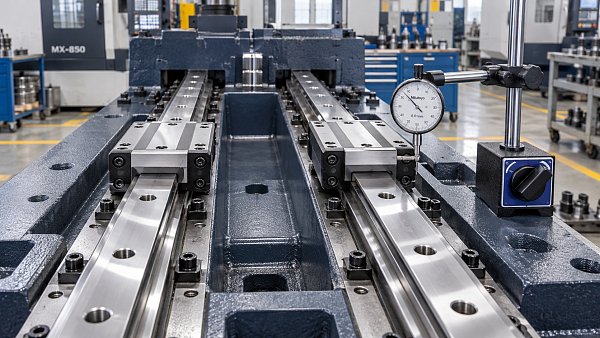
- Use a dial indicator, laser alignment tool, or calibrated straightedge suited to the machine accuracy level and expected travel length.
- Tighten bolts in sequence and in stages, because final torque can shift rail position enough to exceed practical parallelism limits.
- Move the carriage manually after each tightening stage to feel rising resistance, intermittent sticking, or asymmetrical drag across the stroke.
- Inspect shoulder contact or locating edges carefully, since paint, chips, oxide, and damaged corners can create hidden offset.
- Compare unloaded motion with loaded motion, because frame deflection under process load may violate linear rail parallelism standards only during operation.
- Record baseline readings for future maintenance, including rail gap variation, torque trend, and carriage feel at fixed travel points.
Practical Tolerance Thinking
There is no single universal number for acceptable parallelism. Rail makers publish values based on rail family, preload, and permissible mounting error. As a practical rule, longer strokes, higher preload, and paired-rail layouts demand tighter control. Light-duty transport axes may accept larger deviation than precision inspection stages or semiconductor-adjacent modules.
When documentation is incomplete, use system behavior as a secondary filter. If block running force changes significantly across travel, if servo current rises at one zone, or if wear marks appear on one side, the installed condition is already outside healthy functional tolerance, even before formal failure occurs.
Application Notes Across Different Industrial Scenarios
Precision Automation and Inspection Systems
In compact automation cells and inspection platforms, slight rail non-parallelism often appears as repeatability drift rather than obvious binding. Travel may remain possible, but settling time increases and positional scatter grows. Here, linear rail parallelism standards should be tied to encoder resolution, payload center of gravity, and acceleration profile.
Short-travel systems also deserve careful attention. Because the stroke is limited, localized mounting defects occupy a larger percentage of the working range. A small machining ridge can dominate the full motion path and create misleading assumptions about block quality or motor tuning.
Semiconductor Support Equipment and Clean Process Modules
In semiconductor-related motion platforms, binding creates more than wear. It can generate particles, disturb cable management, and introduce unstable force into highly controlled process steps. That makes linear rail parallelism standards directly relevant to contamination control and uptime integrity.
Thermal behavior is especially important in these environments. Rails installed correctly at ambient conditions may shift when heat sources, vacuum interfaces, or enclosed electronics change the frame temperature. Verification should include warm-state checks when the machine architecture allows it.
Heavy Industrial Slides and Material Handling Axes
Larger gantries and transfer systems usually tolerate more visible structural deflection, yet they still suffer from rail conflict. The problem often hides under load, where one side of the frame twists enough to overload a block set. In these cases, checking empty travel alone can produce a false pass.
For long axes, divide measurements into zones and compare them with support spacing, weld locations, and anchor points. Distortion frequently aligns with structural transitions rather than rail manufacturing error. Correcting the base may matter more than replacing the rails.
Commonly Overlooked Risks That Violate Linear Rail Parallelism Standards
Ignoring bolt sequence: Rails can move during tightening, especially on lightly constrained surfaces. A good initial reading means little if torque progression pulls the floating rail inward.
Trusting machined surfaces without rechecking: A recent machining operation does not guarantee usable geometry. Transport damage, burr formation, coating thickness, and trapped debris can all alter installed rail position.
Overlooking carriage preload: Higher preload improves stiffness, but it reduces tolerance for mounting error. A setup that runs smoothly with standard preload may bind immediately with a heavier preload class.
Misreading lubrication symptoms: Technicians may add grease to quiet a noisy block, when the actual cause is rail non-parallelism creating abnormal rolling contact and seal drag.
Skipping loaded verification: Dynamic process forces, cable chain pull, and offset payload mass can distort the axis enough to exceed acceptable alignment during real duty cycles.
Using only end-point measurements: A rail pair can appear correct at both ends while pinching near the center. Intermediate checks are essential for meaningful compliance.
Execution Tips for Reliable Setup and Inspection
- Clean the base thoroughly and stone off raised nicks before any alignment work begins.
- Install the datum rail first against its locating shoulder and torque it progressively.
- Mount the opposite rail loosely, then use a bridge fixture, spacer method, or guided carriage to establish spacing.
- Sweep the rail pair with an indicator at several positions and note any convergence or divergence trend.
- Cycle the assembly by hand and under low-power drive to compare force signature across the full travel.
- Recheck after full torque, after payload installation, and after thermal stabilization when relevant.
If repeated adjustment does not restore smooth motion, stop forcing the rail pair into place. Reinspect base straightness, mounting shoulder accuracy, and support structure rigidity. Persistent binding usually indicates a geometry problem outside the rail itself.
Summary and Next-Step Action
Linear rail parallelism standards are essential because binding is often the final symptom, not the first. By checking surface quality, establishing a true master rail, measuring across the full stroke, and validating under load, motion systems maintain smoother travel and longer component life.
The most effective next step is to convert these checks into a repeatable installation and maintenance record. A simple worksheet covering rail spacing, torque sequence, drag feel, and loaded verification can prevent small alignment errors from becoming chronic reliability losses.
Recommended News
 Oct 19, 2026How Do I Validate Replacement Linear Guides for an Existing Machine?How do I validate replacement parts for an existing machine? Discover essential linear guide checks for fit, load capacity, accuracy, and safe commissioning before approving a replacement.
 Sep 19, 2026When does a longer travel range raise linear motion stage wholesale costs?Linear motion stage travel range wholesale costs rise when longer strokes demand stronger structures, upgraded drives, precision feedback, and shipping support. Compare smarter before you buy.
 Jul 12, 2026How to Compare Miniature Motion Systems Suppliers for Precision and Lead TimeMiniature motion systems suppliers should be compared on precision, lead time, compliance, and lifecycle support. Learn how to shortlist reliable partners and reduce sourcing risk.
 Jul 04, 2026Linear Guide Rail for CNC: How to Choose Load, Accuracy, and Service LifeLinear guide rail for CNC selection made simple: learn how to balance load, accuracy, preload, sealing, and service life to cut downtime and choose the right rail with confidence.
 Jun 30, 2026Cross Roller Bearing Supplier Checklist for Stable PrecisionCross roller bearing supplier checklist for buyers who need stable precision. Learn how to verify quality, traceability, engineering support, and delivery reliability before you commit.
 Jun 19, 2026Linear Guide Rail Supplier Checklist for Load Accuracy and Service LifeLinear guide rail supplier checklist for better load accuracy and longer service life. Compare quality control, preload, lubrication, and support before you buy.
 Jun 16, 2026Telescopic Rail OEM Checklist: Load, Tolerance, and Lead TimeTelescopic rail OEM checklist covering load, tolerance, finish, and lead time. Learn how to compare suppliers, reduce sourcing risk, and choose rails that perform reliably at scale.
 Jun 06, 2026How to Choose a Measuring Tape for Accurate Site WorkMeasuringtape selection affects accuracy, speed, and rework on site. Learn the key features, common mistakes, and how to choose the right tape for reliable results.
![]() Jun 04, 2026Linear Guide Frictional Resistance: When Maintenance Solves DriftLinear guide frictional resistance causes drift, positioning errors, and unstable motion. Learn how targeted maintenance restores accuracy, cuts downtime, and prevents repeat service issues.
Jun 04, 2026Linear Guide Frictional Resistance: When Maintenance Solves DriftLinear guide frictional resistance causes drift, positioning errors, and unstable motion. Learn how targeted maintenance restores accuracy, cuts downtime, and prevents repeat service issues.![]() Jun 04, 2026How Linear Guide Frictional Resistance Affects Positioning StabilityLinear guide frictional resistance directly impacts positioning stability, repeatability, and servo response. Learn how preload, lubrication, and mounting affect precision performance.
Jun 04, 2026How Linear Guide Frictional Resistance Affects Positioning StabilityLinear guide frictional resistance directly impacts positioning stability, repeatability, and servo response. Learn how preload, lubrication, and mounting affect precision performance. May 23, 2026Next-Gen Linear Motor Technology for Faster PositioningNext-gen linear motor technology drives faster positioning, smoother motion, and higher repeatability. Discover where it delivers the biggest gains in automation performance.
 May 22, 2026Linear Motion Market Growth Report: Where Demand Is ShiftingLinear motion market growth report: discover where demand is shifting across automation, semiconductors, precision manufacturing, and infrastructure to identify high-fit growth opportunities.
 May 22, 2026Linear Rail Parallelism Standards That Prevent BindingLinear rail parallelism standards explained with a practical checklist to prevent binding, cut wear, improve accuracy, and keep motion systems running smoothly.
 May 21, 2026Stiffness and Damping in Guides: Selection MistakesStiffness and damping in guides directly affect accuracy, vibration control, and lifecycle cost. Learn the most common selection mistakes and make smarter, lower-risk purchasing decisions.
 May 20, 2026Linear Guide Frictional Resistance and Its Impact on MotionLinear guide frictional resistance directly affects motion accuracy, wear, and uptime. Learn key causes, maintenance checks, and practical ways to reduce friction issues fast.
 May 20, 2026Ball Screw Lead Precision Data: Tolerance vs PositioningBall screw lead precision data explained: learn how tolerance differs from real positioning accuracy, avoid costly spec mistakes, and choose motion systems with more confidence.
 May 20, 2026Linear Module Factory Selection for Fast Project DeliveryLinear module factory selection affects project speed, quality, and risk. Discover how to compare lead time, engineering support, and precision capability for faster delivery.
 May 19, 2026Telescopic Rail OEM Options for Cleanroom Tool AccessTelescopic rail OEM solutions for cleanroom tool access: compare materials, load stability, customization, and compliance factors to reduce downtime and choose the right supplier.
 May 19, 2026Linear Motion Stage Wholesale: Accuracy Costs ExplainedLinear motion stage wholesale costs explained: see how accuracy grades, materials, load stability, and supplier validation shape pricing, risk, and long-term ROI.
 May 18, 2026How to Evaluate a Linear Guide Rail Supplier for Cleanroom Motion SystemsLinear guide rail supplier selection for cleanroom motion systems starts with contamination control, lubrication, traceability, and quality data. Learn how to compare suppliers and avoid costly risks.
 May 03, 2026How to Evaluate a Precision Manufacturing Supplier for Stable QualityPrecision Manufacturing supplier evaluation starts with scenario fit. Learn how to assess quality stability, traceability, compliance, and supply resilience for smarter sourcing.
 Apr 21, 2026Precision Motion Control Problems That Look Like VibrationPrecision Motion Control issues often mimic vibration in Semiconductor Fabrication Equipment. Learn how Industrial Software Solutions, High-performance Bearings, and Technical Benchmarking reduce downtime and risk.
 Apr 21, 2026Why Precision Manufacturing Still Misses Tight TolerancesPrecision Manufacturing still misses tight tolerances—learn how Digital Twin Technology, Reliability Engineering, Strategic Procurement, and Material Innovation improve repeatability and supplier confidence.