Search News
Industry Portal
Popular Tags
Precision Motion Control: The Tuning Errors That Hurt Yield
Author
Time
Click Count
Precision Motion Control failures rarely begin with hardware—they start with tuning errors that quietly erode yield, stability, and uptime. Across Semiconductor Fabrication Equipment, EUV Lithography Systems, and High-tech Infrastructure, even minor misalignment between control logic, High-performance Bearings, and Industrial Software Solutions can trigger costly drift. This article examines the hidden tuning mistakes operators and researchers must benchmark to improve reliability, Technical Benchmarking accuracy, and long-term compliance.
For information researchers and equipment operators, the practical challenge is rarely identifying whether a motion issue exists. The harder task is determining which tuning mistake is creating unstable settling time, axis coupling, thermal drift, or premature bearing stress before those symptoms become scrap, rework, or unplanned maintenance. In high-value manufacturing environments, even a repeatability deviation of ±1–3 µm can materially affect throughput, overlay quality, and inspection confidence.
This is where multidisciplinary benchmarking matters. Precision motion performance is not governed by servo parameters alone. It depends on the interaction between mechanics, feedback devices, lubrication condition, software logic, vibration environment, and acceptance criteria. For organizations using G-CST as a technical benchmarking and procurement intelligence reference, understanding these hidden tuning errors supports better specification writing, commissioning discipline, and supplier evaluation across global high-tech programs.
Why Tuning Errors Damage Yield Faster Than Obvious Hardware Faults
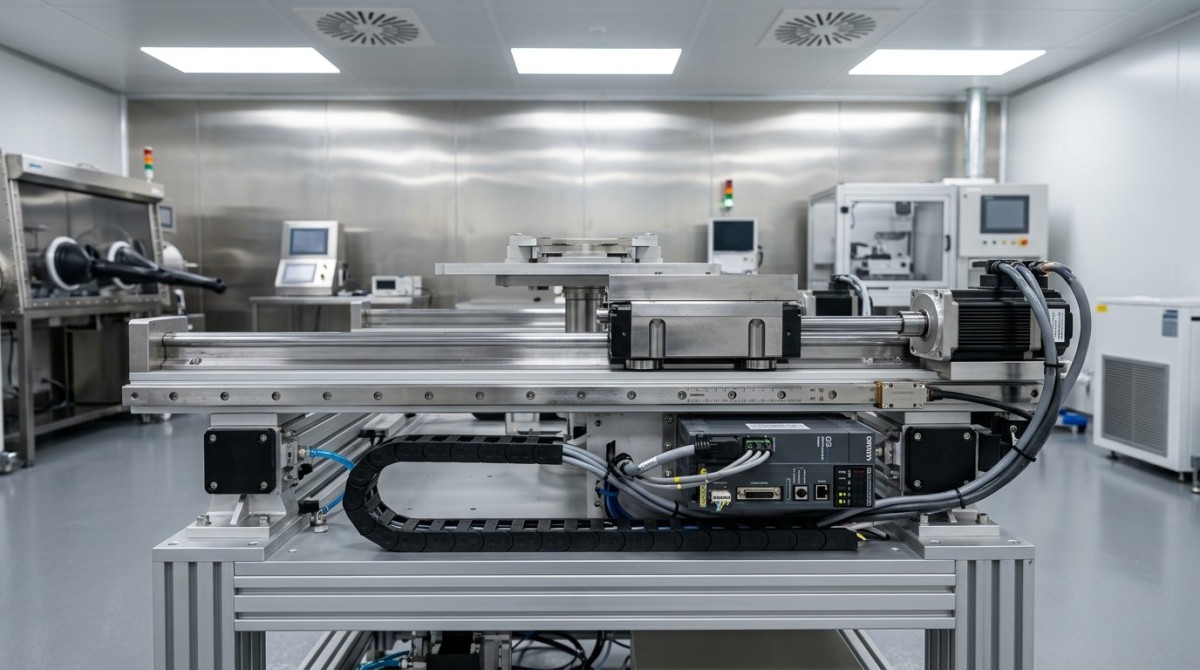
A failed drive, cracked coupling, or contaminated encoder usually produces a visible alarm. Tuning errors are more dangerous because they often stay within the operating envelope long enough to pass basic startup checks while still degrading process quality. A stage may complete motion in the commanded 250 ms window, yet oscillate for the final 20–40 ms and compromise placement accuracy at the exact point where process exposure, metrology, or dispensing occurs.
In semiconductor and advanced infrastructure environments, that hidden instability directly affects yield. When a motion axis is tuned too aggressively, overshoot may increase from less than 1% to 3%–5%. That seems small on paper, but on sub-micron positioning tasks it can enlarge correction cycles, generate extra settling delays, and create inconsistent results across temperature shifts from 20°C to 26°C. The result is not always immediate failure; it is usually slow erosion of process confidence.
Operators also face a false sense of security when average cycle time looks acceptable. A line can still meet nominal takt time while hiding axis-to-axis variability, intermittent resonance, or elevated bearing preload stress. In facilities running 2 shifts or 24/7 schedules, these tuning defects accumulate into shortened maintenance intervals, more recalibration events, and increased dependency on manual offsets.
From a procurement and technical review perspective, this means yield loss should be assessed as a system-level issue. It is not enough to ask whether the stage can reach a top speed of 1 m/s or whether the encoder resolution is high. Teams must examine tuning robustness under changing loads, software revisions, lubrication age, and ambient vibration conditions.
The hidden cost chain behind poor tuning
The following table summarizes how common tuning errors translate into operational loss across different decision layers, from operator response to strategic sourcing review.
The key conclusion is that motion tuning errors rarely stay isolated within the control cabinet. They spread into quality assurance, maintenance planning, spare parts consumption, and supplier accountability. That is why technical benchmarking should measure performance under realistic conditions rather than relying only on nominal specifications.
The Most Common Tuning Mistakes in Precision Motion Control Systems
The most damaging tuning mistakes usually occur during commissioning, retrofit, or software updates. Teams often inherit a machine that “works” and then modify gains to reduce cycle time without rechecking payload changes, bearing friction behavior, or controller scan interactions. In integrated systems such as lithography subassemblies, wafer handling modules, precision dispensing lines, or inspection stages, one parameter change can affect 3 to 5 related motion behaviors at once.
Mistake 1: Tuning for speed before tuning for stability
A frequent error is optimizing acceleration and move completion time before establishing a stable base loop. This often produces attractive short-run data but poor repeatability over 8-hour or 12-hour operating windows. If a stage is pushed to maximum responsiveness while damping margins remain narrow, slight temperature shifts, cable drag variation, or lubrication changes can move the system into oscillatory behavior.
What operators should verify
- Whether settling time stays consistent across at least 3 payload conditions: empty, nominal, and upper operating range.
- Whether repeatability remains within the required band, such as ±1 µm, ±3 µm, or application-specific limits, after 100 to 500 cycles.
- Whether cycle optimization introduced new vibration peaks at specific travel speeds or stroke lengths.
Mistake 2: Treating bearings as passive components
High-performance bearings influence friction, preload, stiffness, and thermal response. Yet many tuning routines assume mechanical behavior is constant. In reality, ceramic or hybrid bearing assemblies, crossed-roller systems, and air-bearing alternatives respond differently to load distribution, contamination, and lubrication state. A tune that is stable on day 1 may drift after 4–6 weeks if friction changes and the controller has no compensation margin.
Mistake 3: Overlooking software-side timing and filters
Industrial Software Solutions can improve motion smoothness, but they can also conceal root causes. Poorly chosen digital filters may suppress visible noise while adding phase lag. Mismatched PLC, IPC, or fieldbus timing can create command jitter measured in milliseconds, which is enough to disturb precision triggers in synchronized processes. A 2 ms delay may be irrelevant for general automation, but unacceptable for exposure, bonding, or high-speed inspection tasks.
Mistake 4: Ignoring cross-axis interaction
In multi-axis systems, one axis rarely moves in isolation. Gantry structures, stacked stages, and synchronized transfer modules can exhibit coupling effects that a single-axis tune will not capture. If X-axis gains are increased without reviewing Y-axis structural resonance or Z-axis timing, the result may be contour errors, skewed alignment, or increased vibration during diagonal moves.
These mistakes become especially costly when researchers or operators rely on pass/fail startup checks instead of trend-based benchmarking. A system can pass its first acceptance window yet still show rising following error, rising motor current, or rising positional variance over the next 30 days. Continuous verification is therefore as important as initial tuning.
Benchmarking Parameters That Reveal Hidden Instability
To improve yield, teams need a benchmarking method that goes beyond simple move success. Useful benchmarking compares command response, final position stability, environmental sensitivity, and mechanical load behavior. For B2B buyers and technical evaluators, this creates a stronger basis for vendor comparison and acceptance planning across Semiconductor Fabrication Equipment, motion platforms, and infrastructure automation packages.
A practical benchmark should cover at least 4 layers: dynamic response, steady-state accuracy, environmental robustness, and maintainability. In many applications, the target is not merely fast movement but predictable movement over 6 months to 24 months of use. That requires logging actual trends, not only reading manufacturer brochure values.
Recommended technical benchmarking set
The table below provides a practical set of benchmark items for operators, commissioning teams, and sourcing managers evaluating precision motion control behavior.
These values are not universal pass/fail limits, but they are useful screening thresholds. The main insight is to compare performance under fixed test conditions and to trend changes over time. A 15% increase in following error or a 20% rise in current draw may reveal a developing issue long before alarms appear.
How to structure a repeatable benchmark routine
- Define 3 operating states: cold start, steady-state production, and warmed system after several hours.
- Test at least 2 motion profiles, such as short indexing moves and full-stroke moves, because resonance may only appear in one profile.
- Capture 4 signals together: command position, actual position, following error, and motor current.
- Repeat after any software patch, bearing replacement, lubrication interval change, or payload change greater than 10%.
For researchers, this structure improves comparability across systems. For operators, it creates a stable troubleshooting baseline. For sourcing teams, it helps turn supplier claims into measurable acceptance items instead of verbal assurances.
Implementation and Correction: How Operators Can Reduce Tuning Risk
Correcting tuning errors requires more than changing gain values. The most effective recovery plans combine motion diagnostics, mechanical inspection, software review, and process validation. In many facilities, the fastest route to stability is to slow the system temporarily, verify root cause, and then retune with controlled performance targets rather than pushing immediately back to peak throughput.
A structured correction process is especially important in regulated or tightly validated environments. When a motion system influences inspection traceability, alignment quality, or exposure precision, undocumented tuning changes can create compliance gaps. Change control should therefore include parameter versioning, retest criteria, and clear ownership across controls, maintenance, and process engineering functions.
Five-step correction workflow
- Stabilize the operating window by reducing acceleration, jerk, or contour speed to a known safe baseline.
- Inspect mechanical contributors including bearing preload, lubrication condition, cable drag, coupling alignment, and stage contamination.
- Review controller timing, filter settings, feedforward parameters, and trigger synchronization with industrial software.
- Retune under documented payload and temperature conditions, then validate over a defined sample size such as 100, 300, or 500 cycles.
- Release only after quality metrics, not just motion metrics, show improvement in yield and repeatability.
When to suspect a system-level issue instead of a tuning-only issue
Not every unstable axis can be fixed through tuning. If current draw keeps rising after retuning, if resonance appears in a narrow speed band, or if positional drift tracks with temperature change, the root cause may include structural compliance, bearing degradation, thermal growth, or sensor mounting issues. In such cases, repeated parameter changes can waste valuable engineering hours and actually widen performance variation.
Operational warning signs
- More than 2 retuning attempts within 30 days for the same axis without stable improvement.
- Yield loss occurs only after 2–3 hours of operation, suggesting thermal or lubrication interaction.
- Machine passes dry run but fails under real process load, indicating incomplete benchmark conditions.
- Motion alarms disappear after software filtering, but metrology or process variance continues to rise.
For organizations managing multi-site equipment fleets, standardized correction workflows also improve cross-facility comparability. This supports spare parts planning, maintenance training, and vendor escalation with better evidence. G-CST-style benchmarking is valuable here because it connects component behavior, software interaction, and standards-aware technical review into one decision framework.
Procurement, Compliance, and Long-Term Reliability Decisions
Precision motion control is often sourced based on speed, encoder resolution, and initial capex. That is incomplete. Buyers in semiconductor, advanced manufacturing, and critical infrastructure should examine whether a supplier can support stable tuning over the actual lifecycle of the machine. A lower-cost platform that needs retuning every 6–8 weeks may become more expensive than a higher-spec option with stable performance across 12 months of operation.
This is also where regulatory and standards awareness matters. Motion components are deployed inside larger systems that may be audited against ISO, SEMI, ASME, IEEE, or internal validation protocols. If tuning procedures, acceptance thresholds, and software change records are poorly controlled, risk increases during audits, equipment qualification, and supplier disputes.
Key supplier evaluation criteria
The table below can be used by procurement directors, technical researchers, and operations teams to compare motion-control suppliers or retrofit partners beyond headline performance claims.
The strongest buying decision is usually the one that links motion performance to measurable lifecycle behavior. That includes support for periodic benchmarking, transparent tuning documentation, and realistic acceptance standards. For complex B2B projects, these criteria are often more valuable than a marginal speed advantage on a datasheet.
FAQ for researchers and operators
How often should precision motion systems be retuned?
There is no universal interval. Stable systems may run 6–12 months without major retuning, while high-load or contamination-sensitive systems may require review every 4–8 weeks. The better practice is event-driven review after payload changes, bearing service, software updates, or trending shifts such as more than 15% growth in following error.
Can software filtering solve most motion instability problems?
Filtering can reduce visible noise, but it cannot correct structural resonance, poor preload, or thermal distortion. Excessive filtering may also add phase delay and worsen trigger accuracy. It should be used as part of a controlled solution, not as a substitute for mechanical and control-loop diagnosis.
What is the most overlooked acceptance criterion during procurement?
Many teams overlook trend stability over time. A machine that meets repeatability targets on day 1 may still be a weak investment if it needs frequent retuning or loses accuracy after thermal soak. Asking for benchmark data across cold start, steady state, and extended run conditions gives a more reliable view of real performance.
Precision Motion Control tuning is not a narrow controls task; it is a yield, reliability, and compliance issue that spans bearings, software, machine structure, and operational discipline. By benchmarking overshoot, settling time, following error, current stability, and lifecycle drift under realistic conditions, operators and researchers can detect hidden tuning errors before they become quality losses or procurement disputes.
For organizations evaluating high-precision equipment, G-CST provides a stronger basis for technical comparison by connecting motion behavior with standards-aware benchmarking, software traceability, and supply-chain intelligence. If you need help assessing motion-control risk, comparing supplier readiness, or building a more reliable technical evaluation framework, contact us to discuss a tailored benchmarking or sourcing support plan.
Recommended News
 Jun 14, 2026LED Commercial Lighting: How to Compare ROI, Lifespan, and MaintenanceLED commercial lighting comparison starts with ROI, lifespan, and maintenance. Learn how to assess lifecycle cost, failure risk, and supplier claims for smarter facility decisions.
 Jun 12, 2026Best Pet Grooming Clippers for Coat Type and Daily Usepetgroomingclippers guide: discover how to choose the best clipper by coat type, power, blade control, and daily grooming needs for smoother, safer, more reliable results.
 Jun 07, 2026Audio Equipment Setup Mistakes That Hurt Sound QualityAudio equipment not delivering the sound you expected? Discover the most common setup mistakes in placement, signal flow, power, and room acoustics—and how to fix them fast.
 May 27, 2026Robotic Programming Software Wholesale: Key Integration ChecksRobotic programming software wholesale: compare PLC, SCADA, digital twin, and compliance integration checks to reduce risk, improve uptime, and choose scalable software with confidence.
 May 23, 2026Impact of EV on Motor Precision in 2026 ApplicationsImpact of EV on motor precision in 2026: discover a practical checklist for evaluating thermal drift, torque ripple, encoder accuracy, and control stability across key industries.
 May 23, 2026Miniaturization of Motion Systems: Key Design Trade-OffsMiniaturization of motion systems explained: explore the key design trade-offs in stiffness, thermal stability, load capacity, and control accuracy to evaluate compact platforms with confidence.
 May 23, 2026Industrial Automation Motion News: 2026 Trends to WatchIndustrial automation motion news for 2026 reveals key trends in precision, resilience, and smart integration. Discover scenario-based insights to guide compliant, scalable investment decisions.
 May 22, 2026Motion Control System Latency and Its Impact on Cycle TimeMotion control system latency directly affects cycle time, accuracy, and throughput. Learn where delays hide, how to diagnose them, and practical ways to boost performance.
 May 21, 2026Servo Drive Frequency Response: What Limits ControlServo drive frequency response explained: learn what limits control bandwidth, from motor physics and encoders to stiffness and backlash, and how to choose the right tradeoff for real-world performance.
 May 21, 2026Linear Motor Peak Force Data for Safe SizingLinear motor peak force data explained for safe sizing: learn how to verify duration, duty cycle, cooling, and drive limits to reduce risk and choose the right motion system.
 May 21, 2026How to Verify Linear Actuator Positioning AccuracyLinear actuator positioning accuracy explained with practical test steps, tools, and troubleshooting tips to reduce drift, improve repeatability, and keep motion systems reliable.
 May 20, 2026Choosing a Cam Follower OEM Manufacturer for Lower FailuresCam follower OEM manufacturer selection impacts uptime, failure rates, and lifecycle cost. Learn how to identify a reliable partner with proven quality, traceability, and engineering support.
 May 20, 2026How to Evaluate a Precision Rack and Pinion Supplier in 2026Precision rack and pinion supplier evaluation in 2026: learn how to compare accuracy, traceability, quality systems, and supply resilience to choose a reliable partner.
 May 19, 2026Linear Motor Supplier Red Flags in High-Speed AutomationLinear motor supplier warning signs can make or break high-speed automation. Discover the key red flags in validation, compliance, supply stability, and support before you buy.
 May 19, 2026How to Vet a Stepper Motor Factory for Stable OutputStepper motor factory selection starts with stable output. Learn how to audit capacity, quality control, traceability, and delivery performance to reduce sourcing risk.
 May 19, 2026Direct Drive Motor OEM: Precision vs Heat Trade-OffsDirect drive motor OEM evaluation starts with precision vs heat. Learn what to verify in torque, cooling, encoder drift, and long-duty accuracy before choosing a reliable supplier.
 May 18, 2026Linear Actuator Supplier Guide for Load, Speed, and Duty Cycle FitLinear actuator supplier guide: learn how to match load, speed, and duty cycle for reliable performance, lower risk, and smarter supplier selection.
 May 18, 2026Precision Ball Screw Factory Audit Checklist Before Volume OrdersPrecision ball screw factory audit checklist for volume buyers: verify process control, traceability, quality systems, capacity, and delivery reliability before costly sourcing mistakes.
 May 18, 2026Servo Motor OEM Manufacturer Selection for Stable High-Speed AutomationServo motor OEM manufacturer selection is critical for stable high-speed automation. Learn how to compare reliability, integration support, and lifecycle value before you buy.
 May 16, 2026How to Read Solenoid Valve Cycle Life Data CorrectlySolenoid valve cycle life data explained clearly: learn how to compare test claims, spot hidden limits, and choose valves more confidently for reliable performance.
 May 15, 2026Valve Actuator Response Time: What Delays Really MeanValve actuator response time explained: discover what delays really mean for process stability, safety, and control accuracy—and how to evaluate suppliers with confidence.
 May 14, 2026Pneumatic Actuator Supplier Checklist for Control Accuracy and MaintenancePneumatic actuator supplier checklist for better control accuracy and lower maintenance risk. Compare torque data, seals, materials, and support before you buy.
 May 13, 2026Actuated Ball Valve Supplier: 5 Failure Points to CheckActuated ball valve supplier guide: discover 5 critical failure points to check, from actuator delay to seal wear, to reduce downtime, improve troubleshooting, and extend valve life.
 May 13, 2026Butterfly Valve OEM Factory Selection for Fast Cycle ControlButterfly valve OEM factory selection for fast cycle control: compare response speed, sealing stability, torque consistency, and traceable quality to source reliable, high-performance valves.