Search News
Industry Portal
Popular Tags
BMS Integration Issues: Common Faults and Faster Fixes
Author
Time
Click Count
Why BMS integration issues escalate faster in real operations
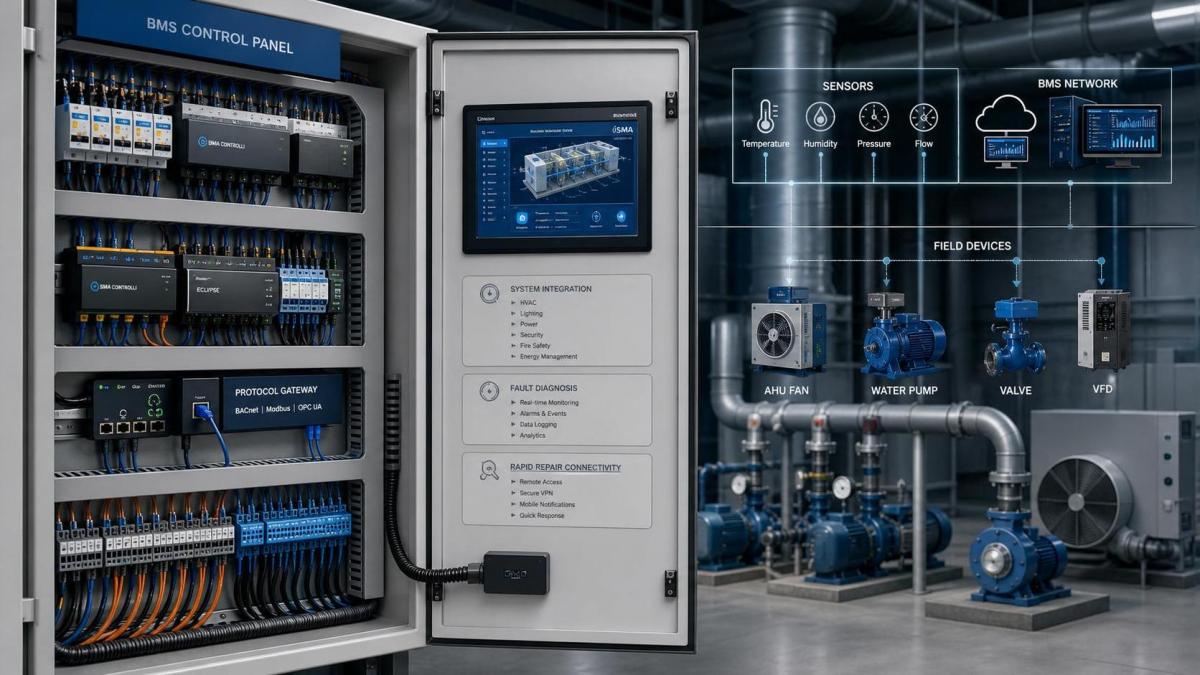
BMS integration issues rarely begin as a single fault. They usually surface where software logic, field wiring, sensors, and protocol gateways meet.
That is why a minor alarm mismatch can become ventilation instability, pump short cycling, or energy reporting errors across an entire facility.
In practice, the faster fix is not always the fastest reset. It is the quickest route to the real failure point.
This matters even more in high-value environments tied to industrial software, digital twins, precision utilities, and compliance-driven infrastructure.
Across sectors tracked by G-CST, the common pattern is clear. Downtime costs rise sharply when building systems interact with process-critical assets.
A BMS fault in a commercial tower may affect comfort and scheduling. The same integration fault near cleanrooms or utility skids can disrupt validated conditions.
So the first judgment is contextual. Before replacing devices, confirm what the BMS is controlling, what it is only monitoring, and what cannot tolerate drift.
The same BMS fault behaves differently across sites
Different sites create different integration priorities. The fault tree changes with response time, environmental tolerance, and interoperability depth.
A hospital plantroom, a semiconductor support building, and a logistics hub may all run BACnet devices, yet the troubleshooting order should not be identical.
More often, stable recovery depends on three questions:
- Is the issue caused by bad data, delayed data, or missing commands?
- Does the fault sit in the controller, the network, or the field device?
- Will a temporary bypass create hidden safety, energy, or compliance risks?
That approach prevents a common mistake: treating all BMS integration issues as software bugs when many are physical-layer or sequencing problems.
When HVAC zones drift without obvious alarms
This is one of the most frequent service calls. Rooms run too warm, too cold, or recover too slowly after occupancy changes.
In office, laboratory, and mixed-use facilities, the real cause is often not the thermostat. It is usually point mapping, stale trend data, or PID tuning conflicts.
A quick fix may restore temperature briefly. But if sensor scaling differs between the controller and the supervisory BMS, alarms will return.
The better check is to compare field readings, controller values, and front-end graphics at the same timestamp.
When pumps, valves, or dampers respond late
Here, BMS integration issues often hide inside command priority, feedback confirmation, or gateway translation delays.
This is especially relevant in sites with specialized pump and valve systems, where zero-leakage performance and timing consistency matter.
If the BMS shows a command sent but the actuator moves late, check three layers before replacing hardware.
- Network latency between front end and local controller
- Priority array conflicts inside BACnet objects
- Feedback wiring or end-switch validation problems
In actual field work, delayed motion is often blamed on the valve. The fault frequently begins in command logic or object write permissions.
Communication faults are common, but the root cause is not always the protocol
Many teams jump straight to BACnet, Modbus, or SCADA compatibility. Sometimes that is correct. Often it is only part of the story.
In multi-vendor environments, BMS integration issues usually appear when standards are nominally supported but implemented differently.
This is where G-CST-style benchmarking logic becomes useful. The interface may pass conformance checks yet still fail under real traffic, polling loads, or alarm bursts.
The useful distinction is between protocol support and operational compatibility. A device can speak the right language and still fail the job.
Where digital twins and analytics create hidden noise
As digital twins and analytics platforms expand, more points are mirrored, normalized, and republished.
That creates value, but it also creates new BMS integration issues. Data latency, tag mismatch, and duplicated logic become harder to spot.
A field technician may see perfect device health while the operations team sees unstable dashboards. Both observations can be true.
In this scenario, check whether the fault is operational or representational. The fix may belong in data modeling, not controls hardware.
Faster fixes depend on isolating the right layer
Speed improves when troubleshooting follows system layers instead of symptoms alone. This reduces repeat visits and avoids replacing healthy components.
A practical sequence usually works better than broad fault hunting.
- Confirm the operational impact, not just the alarm text.
- Check live field status at the device level.
- Compare controller logic against front-end display values.
- Review network traffic, write priorities, and time synchronization.
- Validate recent changes, including firmware, graphics, and point naming.
This sequence is especially effective in environments where reliability standards matter, including ISO-aligned facilities and IEEE-driven automation frameworks.
It also helps when maintenance records are fragmented across contractors, software vendors, and operations platforms.
What gets misdiagnosed most often
Several patterns appear again and again in BMS service work.
- Assuming sensor failure when the real issue is trend interval or scaling mismatch
- Replacing controllers before checking power quality or grounding noise
- Treating similar sites as identical, despite different load profiles and control sequences
- Focusing on purchase specifications while ignoring service access and future expansion limits
These errors usually come from looking at isolated parameters instead of the operating context.
Different facilities need different BMS recovery priorities
Not every site should aim for the same repair path. Recovery priorities depend on what the BMS supports and what failure costs look like.
In comfort-led buildings, temporary workarounds may be acceptable if trend visibility remains intact.
In process-adjacent infrastructure, temporary overrides can hide risks that appear hours later in utilities, air balance, or asset wear.
That difference is why industrial benchmarking matters. Systems connected to precision motion, engineered materials handling, or semiconductor support utilities need tighter verification.
A practical way to compare site needs is to map faults against four conditions:
- Tolerance for delay before corrective action
- Need for audit trails and validated records
- Complexity of third-party device integration
- Cost of hidden drift after apparent recovery
Once these are clear, the right BMS fix is easier to prioritize and justify.
Before the next service event, tighten the conditions around BMS troubleshooting
The most useful improvement is not a larger alarm list. It is a cleaner troubleshooting standard built around the site’s actual integration risks.
That usually means documenting device ownership, approved write paths, sensor validation methods, and acceptable fallback modes.
It also helps to compare new devices against proven references, especially where export controls, compliance updates, or supply-chain substitutions change component behavior.
For teams dealing with recurring BMS integration issues, the next step is practical. Sort recent faults by layer, operating scenario, and recurrence pattern.
Then review which failures were truly device-driven and which came from mapping, timing, compatibility, or control ownership.
That kind of structured review reduces guesswork, shortens recovery time, and makes future BMS changes easier to validate before they disrupt operations again.
Recommended News
 Oct 18, 2026How to reduce nuisance alarms in water treatment SCADA systemsOptimize SCADA systems for water treatment. Discover proven ways to reduce nuisance alarms, tune alarm logic, and improve operator focus without compromising treatment safeguards.
 Oct 15, 2026Can digital manufacturing solutions work with legacy factory PLCs?Explore digital manufacturing solutions for factories that work with legacy PLCs. Learn how to assess connectivity, data quality, and security before investing in integration.
 Oct 14, 2026Why Does SCADA Data Differ from Field Device Readings?Why does SCADA data fail to match field device readings? Discover common scaling, timing, and communication errors, plus practical checks to pinpoint mismatches and avoid unnecessary calibration.
 Oct 03, 2026How IoT integration for smart agriculture reduces irrigation wasteIoT integration for smart agriculture cuts irrigation waste with soil, weather, flow, and pressure data—helping farms automate smarter watering and detect leaks early.
 Sep 24, 2026How Zigbee mesh latency affects smart hotel guest room controlsSmart hotel Zigbee mesh latency can shape guest comfort and system reliability. Learn how to design, test, and optimize responsive hotel room controls.
![]() Oct 15, 2026How Much Does Industrial Automation Software Implementation Cost?How much does industrial automation software implementation cost? Explore project pricing, key cost drivers, hidden expenses, and smart budgeting strategies.
Oct 15, 2026How Much Does Industrial Automation Software Implementation Cost?How much does industrial automation software implementation cost? Explore project pricing, key cost drivers, hidden expenses, and smart budgeting strategies. Sep 11, 2026How edge processing latency affects real-time SCADA alarmsEdge processing latency can make or break real-time SCADA alarms. Learn how to benchmark delay, improve alarm integrity, and build resilient response paths.
 Sep 09, 2026How energy management analytics uncovers avoidable peak-demand costsEnergy management analytics reveals avoidable peak-demand costs, identifies controllable load spikes, and helps finance teams cut utility charges with confidence.
 Aug 31, 2026How SCADA data polling frequency affects alarm response timeSCADA data polling frequency directly shapes alarm response time. Learn how scan rates, latency, delays, and network behavior affect reliable detection.
 Aug 29, 2026When open source industrial OPC UA is the right fit for SCADA integrationOpen source industrial OPC UA for SCADA integration: explore interoperability, security, lifecycle ownership, and evaluation steps for scalable multi-vendor operations.
 Aug 12, 2026How to Scope an Industrial Cybersecurity Risk Assessment for SCADA and IIoT SystemsIndustrial cybersecurity risk assessment for SCADA and IIoT starts with the right scope. Learn how to define boundaries, map consequences, and uncover hidden attack paths.
 Aug 06, 2026How to Evaluate Data Historian Software for Automation Integration and ScalingData historian software for automation: learn how to evaluate integration, scalability, data integrity, and security to choose a platform that supports growth and smarter decisions.
 Jul 31, 2026How Smart Hotel AI Helps Reduce Energy Costs Without Hurting Guest ExperienceSmart hotel AI helps hotels cut energy costs by controlling HVAC, lighting, and occupancy-based settings—without hurting guest comfort. Learn what to check before you buy.
 Jul 30, 2026How Industrial Digitization for Electronics Cuts Downtime in High-Mix ProductionIndustrial Digitization for electronics helps high-mix manufacturers cut downtime by improving changeovers, traceability, maintenance response, and line decisions. Learn where digital tools deliver the fastest ROI.
 Jul 22, 2026Supply Chain Resilience Risk Management: Key Metrics and Response PlansSupply Chain Resilience risk management explained with key metrics, scenario-based thresholds, and response plans to reduce disruption, qualification delays, and hidden supply risk.
 Jul 15, 2026Energy Software for Manufacturing Plants: Cost Savings vs Integration RiskEnergy software for manufacturing plants can cut utility waste, but only if savings outweigh integration risk. Learn how to evaluate ROI, data quality, cybersecurity, and rollout fit.
 Jul 14, 2026Fintech in 2026: Which Operating Trends Matter Most for Growth PlanningFintech in 2026 is shifting from rapid expansion to governed scale. Explore the key trends shaping growth planning, from embedded finance and AI risk controls to resilience and compliance.
 Jul 13, 2026When Data Historian Software for Manufacturing Delivers ROIData historian software for manufacturing delivers ROI by reducing downtime, improving quality, and speeding compliance. See how to evaluate value before you buy.
 Jul 13, 20265G IIoT Gateway Wholesale: Key Specs That Affect Deployment Cost5g iiot gateway wholesale decisions should go beyond unit price. Learn which specs cut deployment cost, reduce integration risk, and improve long-term industrial ROI.
 Jul 11, 2026SCADA Systems in the Middle East: Key Compliance and Integration ChecksSCADA Systems Middle East projects need more than features. Discover key compliance, cybersecurity, and integration checks to reduce risk, protect uptime, and choose the right platform.
 Jul 09, 2026Industrial Technology Platform Pricing: What Drives Total Cost Beyond the LicenseIndustrial technology platform pricing goes far beyond the license. Learn the hidden cost drivers—integration, compliance, scalability, and support—to make smarter buying decisions.
 Jul 09, 2026Industrial Standards Compliance for Electronics: Key Gaps That Delay Market AccessIndustrial standards compliance for electronics often stalls market access due to hidden gaps in testing, traceability, supplier records, and regional rules. Learn how to spot risks early and accelerate certification.
 Jul 08, 2026IT Infrastructure Gaps That Slow Industrial GrowthIT infrastructure gaps can quietly slow industrial growth, raise risk, and weaken supply chains. Learn which issues matter most and how to fix them for faster, smarter scaling.
 Jul 06, 2026Open Source Industrial SCADA: Key Risks, Benefits, and FitOpen source industrial SCADA: explore key benefits, cybersecurity risks, costs, and best-fit use cases to see if it can support reliable, scalable industrial operations.