Search News
Industry Portal
Popular Tags
How Linear Guide Frictional Resistance Affects Positioning Stability

Author
Time
Click Count
For technical evaluators, understanding how linear guide frictional resistance influences positioning stability is essential to reducing motion error, vibration, and long-term performance drift. In high-precision systems, even small variations in preload, lubrication, or surface condition can affect repeatability and reliability. This article examines the core mechanisms behind frictional behavior and its direct impact on stable, accurate positioning.
When buyers or evaluators search for linear guide frictional resistance, they usually want a practical answer: how much friction is acceptable, how it affects positioning stability, and what signals indicate risk.
The short answer is that friction is never just a loss term. In precision motion systems, it shapes servo response, low-speed smoothness, settling behavior, thermal generation, and long-term repeatability.
For technical assessment teams, the real task is not simply choosing the lowest-friction guide. It is selecting a friction profile that matches load, speed, control architecture, cleanliness, and positioning tolerance.
Why linear guide frictional resistance matters more than many specifications suggest
Many datasheets emphasize dynamic load rating, rigidity, and service life. These are important, but they do not fully predict whether an axis will stop consistently at the commanded position.
Positioning stability depends on how predictably the carriage moves from rest, through low-speed travel, into final settling. Frictional resistance directly affects each of those motion phases.
If friction is too high or too variable, the axis may hesitate at startup, move in micro-jumps, or force the servo loop to overcompensate. That creates overshoot, hunting, or unstable settling.
Even when a system meets nominal travel accuracy, unstable friction can still degrade repeatability. This is especially critical in metrology equipment, semiconductor tools, assembly platforms, and inspection stages.
Technical evaluators should therefore treat friction as a system-level behavior, not only a component-level parameter. The concern is not just average resistance, but consistency over time, stroke, temperature, and operating conditions.
What frictional resistance actually includes in a linear guide system
Linear guide frictional resistance is not a single cause. It usually combines rolling contact losses, seal drag, lubricant shear, preload-related contact forces, and surface interaction effects.
In recirculating ball guides, rolling friction is relatively low, but resistance can rise due to preload, contamination, seal contact, or uneven raceway conditions. At low speed, these influences become more visible.
In roller guides, higher rigidity often comes with different contact behavior. The friction profile may remain acceptable, but sensitivity to preload and mounting precision can become more important.
Lubrication adds another layer. Proper lubrication reduces metal-to-metal interaction and wear, but lubricant viscosity also changes drag, especially during startup or under low-temperature conditions.
Seals are often overlooked in evaluation. They improve contamination control, but they can contribute meaningful drag, particularly on small axes where seal force becomes a larger share of total resistance.
Because several mechanisms act together, comparing two products by one friction number alone can be misleading. Evaluators need to ask how resistance was measured and under what test conditions.
How friction affects positioning stability at low speed and during final approach
Positioning instability often appears most clearly in low-speed motion. During fine approach to a target position, the axis may be commanded to move extremely small increments with minimal velocity.
At this stage, static friction and the transition to dynamic friction become critical. If breakaway force is inconsistent, the carriage may resist motion, then release suddenly, causing a small jump.
This stick-slip behavior is one of the most direct links between linear guide frictional resistance and poor positioning stability. It can create contour error, settling delay, and inconsistent bidirectional repeatability.
In servo-driven systems, the controller attempts to correct these deviations. But if friction variation exceeds tuning assumptions, the loop may alternate between under-response and aggressive correction.
The result can be higher following error, audible vibration, or longer settling times near the target point. In ultra-precision systems, that can undermine throughput as much as accuracy.
For evaluators, the key question is whether the guide maintains smooth micro-motion under realistic load and environmental conditions. Published specifications rarely answer that by themselves.
Why preload is often the turning point in stability trade-offs
Preload is commonly used to increase rigidity, reduce clearance, and improve response under changing load. However, higher preload almost always raises frictional resistance to some degree.
That trade-off is not automatically negative. In many applications, moderate preload improves positioning stability by suppressing microscopic play and making motion more structurally consistent.
Problems arise when preload is selected mainly for stiffness without considering actuator force margin, servo tuning range, or low-speed motion sensitivity. Then friction becomes a hidden destabilizing factor.
An over-preloaded guide can raise starting resistance, increase heat, and magnify sensitivity to mounting error. These effects are especially problematic on long strokes or compact high-accuracy stages.
Under-preload creates the opposite risk. Lower friction may look attractive in testing, but insufficient stiffness can allow displacement variation under load reversal, vibration, or moment loading.
Technical evaluators should not ask whether preload is high or low in isolation. They should ask whether the preload class is suitable for the application’s stability target and control behavior.
How lubrication condition changes friction behavior over time
Friction is not fixed at installation. Lubrication condition changes with time, speed, contamination exposure, temperature, and maintenance discipline. That is why initial acceptance data may not predict field stability.
Fresh lubrication may produce a stable friction signature, but depletion, migration, or chemical breakdown can increase drag variation and promote stick-slip, especially in intermittent or low-duty axes.
Excess lubrication can also be a problem. It may raise viscous resistance, attract contamination, or create uneven motion feel at low speed, depending on the guide design and lubricant type.
For cleanroom, semiconductor, or advanced materials environments, lubricant selection may also be constrained by outgassing, compatibility, or particle generation requirements. These constraints affect friction performance.
Evaluators should verify relubrication intervals, approved lubricant grades, seal compatibility, and expected friction change across maintenance cycles. Stable positioning depends on retained performance, not just initial smoothness.
When possible, request life-cycle friction data or accelerated testing that reflects real duty conditions. This gives a better basis for judging long-term positioning stability risk.
Surface condition, contamination, and mounting quality can outweigh nominal design advantages
Even a well-designed guide can perform poorly if raceways are contaminated, mounting surfaces are not flat, or alignment error introduces localized stress. These issues often show up first as unstable friction.
Small particles can disrupt rolling contact, increase resistance, and generate irregular motion signatures. In precision environments, contamination can produce intermittent errors that are difficult to diagnose from control data alone.
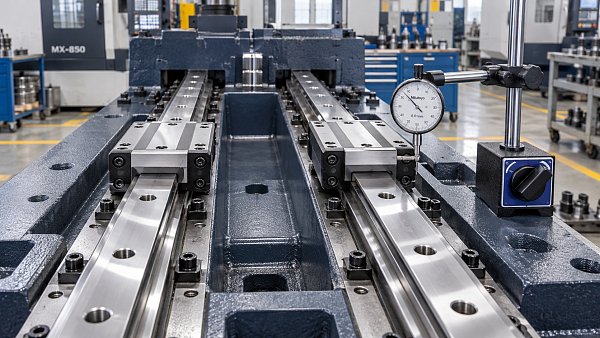
Mounting quality is equally important. If parallelism or base flatness is out of tolerance, preload distribution becomes uneven. That can create zones of higher drag and position-dependent instability.
Surface finish on adjacent mechanical interfaces also matters. Vibration from poor structural surfaces can interact with frictional effects, making settling behavior look like a servo problem when it is partly mechanical.
For technical evaluators, this means supplier assessment should include installation sensitivity. A guide that performs well only under ideal assembly conditions may carry higher implementation risk.
What to ask suppliers when evaluating linear guide frictional resistance
Suppliers often provide friction values, but evaluators should dig deeper into how the values were obtained. Ask whether resistance was measured unloaded, under nominal preload, or under application-relevant external load.
It is also useful to ask for static versus dynamic friction characteristics, low-speed motion data, and resistance variation along the stroke. Average values alone do not reveal stability-critical behavior.
Request information on seal drag contribution, recommended lubricant viscosity range, and friction change over service life. These factors are important for comparing alternatives with similar headline specifications.
If the application is sensitive, ask for repeatability data under slow incremental motion and after thermal stabilization. This is often more relevant than general-purpose travel tests.
Where possible, review whether the supplier has data tied to recognized test frameworks or internal protocols that can be audited. Verifiable data is especially important for high-value procurement decisions.
For multinational projects, evaluators should also check whether documentation aligns with the reliability, cleanliness, and compliance expectations of the target industry, not only basic mechanical performance.
Practical evaluation criteria for technical assessment teams
A useful assessment framework combines friction behavior, rigidity, environmental fit, maintenance burden, and control compatibility. No single parameter should drive the final decision.
First, compare friction consistency rather than only minimum resistance. Stable, predictable friction often supports better positioning stability than a lower-friction guide with larger variation.
Second, evaluate breakaway behavior at low speed. If the axis must perform fine interpolation or short-step indexing, startup smoothness matters more than catalog-level efficiency.
Third, assess thermal implications. Friction generates heat, and heat changes dimensional behavior. In precision assemblies, thermal drift can become a positioning issue even when friction appears mechanically tolerable.
Fourth, review maintenance sensitivity. A guide that requires narrow lubrication control or highly disciplined relubrication may present greater operational risk in distributed manufacturing environments.
Fifth, test under real mounting and load conditions whenever possible. Bench comparisons can hide issues that emerge only when moments, cable forces, or structural compliance are introduced.
Common misjudgments in procurement and design review
One common mistake is assuming lower friction always means better precision. In reality, insufficient preload or damping can reduce positional confidence under variable load or vibration.
Another mistake is evaluating guides independently from motors, drives, and control tuning. Positioning stability is a mechatronic outcome, and friction interacts directly with servo behavior.
Teams also sometimes accept supplier values without checking whether measurement conditions reflect the intended application. This can lead to unpleasant surprises during commissioning or qualification testing.
Finally, organizations may underestimate degradation pathways. A guide that passes initial factory tests may still show unstable positioning later if lubrication control, contamination protection, or mounting discipline is weak.
Conclusion: the best choice is predictable friction, not simply low friction
For technical evaluators, the main lesson is clear: linear guide frictional resistance affects positioning stability through startup behavior, stick-slip risk, servo interaction, heat generation, and long-term drift.
The most reliable guide is not necessarily the one with the lowest catalog friction. It is the one whose friction remains controlled, consistent, and application-appropriate across load, speed, environment, and time.
Strong evaluation therefore depends on system thinking. Preload, lubrication, seals, mounting accuracy, contamination control, and test methodology all shape whether a guide can support stable positioning.
When these factors are examined together, procurement teams can make better technical decisions, reduce qualification risk, and improve confidence in long-term motion accuracy for critical industrial systems.
Recommended News
 Oct 19, 2026How Do I Validate Replacement Linear Guides for an Existing Machine?How do I validate replacement parts for an existing machine? Discover essential linear guide checks for fit, load capacity, accuracy, and safe commissioning before approving a replacement.
 Sep 19, 2026When does a longer travel range raise linear motion stage wholesale costs?Linear motion stage travel range wholesale costs rise when longer strokes demand stronger structures, upgraded drives, precision feedback, and shipping support. Compare smarter before you buy.
 Jul 12, 2026How to Compare Miniature Motion Systems Suppliers for Precision and Lead TimeMiniature motion systems suppliers should be compared on precision, lead time, compliance, and lifecycle support. Learn how to shortlist reliable partners and reduce sourcing risk.
 Jul 04, 2026Linear Guide Rail for CNC: How to Choose Load, Accuracy, and Service LifeLinear guide rail for CNC selection made simple: learn how to balance load, accuracy, preload, sealing, and service life to cut downtime and choose the right rail with confidence.
 Jun 30, 2026Cross Roller Bearing Supplier Checklist for Stable PrecisionCross roller bearing supplier checklist for buyers who need stable precision. Learn how to verify quality, traceability, engineering support, and delivery reliability before you commit.
 Jun 19, 2026Linear Guide Rail Supplier Checklist for Load Accuracy and Service LifeLinear guide rail supplier checklist for better load accuracy and longer service life. Compare quality control, preload, lubrication, and support before you buy.
 Jun 16, 2026Telescopic Rail OEM Checklist: Load, Tolerance, and Lead TimeTelescopic rail OEM checklist covering load, tolerance, finish, and lead time. Learn how to compare suppliers, reduce sourcing risk, and choose rails that perform reliably at scale.
 Jun 06, 2026How to Choose a Measuring Tape for Accurate Site WorkMeasuringtape selection affects accuracy, speed, and rework on site. Learn the key features, common mistakes, and how to choose the right tape for reliable results.
![]() Jun 04, 2026Linear Guide Frictional Resistance: When Maintenance Solves DriftLinear guide frictional resistance causes drift, positioning errors, and unstable motion. Learn how targeted maintenance restores accuracy, cuts downtime, and prevents repeat service issues.
Jun 04, 2026Linear Guide Frictional Resistance: When Maintenance Solves DriftLinear guide frictional resistance causes drift, positioning errors, and unstable motion. Learn how targeted maintenance restores accuracy, cuts downtime, and prevents repeat service issues.![]() Jun 04, 2026How Linear Guide Frictional Resistance Affects Positioning StabilityLinear guide frictional resistance directly impacts positioning stability, repeatability, and servo response. Learn how preload, lubrication, and mounting affect precision performance.
Jun 04, 2026How Linear Guide Frictional Resistance Affects Positioning StabilityLinear guide frictional resistance directly impacts positioning stability, repeatability, and servo response. Learn how preload, lubrication, and mounting affect precision performance. May 23, 2026Next-Gen Linear Motor Technology for Faster PositioningNext-gen linear motor technology drives faster positioning, smoother motion, and higher repeatability. Discover where it delivers the biggest gains in automation performance.
 May 22, 2026Linear Motion Market Growth Report: Where Demand Is ShiftingLinear motion market growth report: discover where demand is shifting across automation, semiconductors, precision manufacturing, and infrastructure to identify high-fit growth opportunities.
 May 22, 2026Linear Rail Parallelism Standards That Prevent BindingLinear rail parallelism standards explained with a practical checklist to prevent binding, cut wear, improve accuracy, and keep motion systems running smoothly.
 May 21, 2026Stiffness and Damping in Guides: Selection MistakesStiffness and damping in guides directly affect accuracy, vibration control, and lifecycle cost. Learn the most common selection mistakes and make smarter, lower-risk purchasing decisions.
 May 20, 2026Linear Guide Frictional Resistance and Its Impact on MotionLinear guide frictional resistance directly affects motion accuracy, wear, and uptime. Learn key causes, maintenance checks, and practical ways to reduce friction issues fast.
 May 20, 2026Ball Screw Lead Precision Data: Tolerance vs PositioningBall screw lead precision data explained: learn how tolerance differs from real positioning accuracy, avoid costly spec mistakes, and choose motion systems with more confidence.
 May 20, 2026Linear Module Factory Selection for Fast Project DeliveryLinear module factory selection affects project speed, quality, and risk. Discover how to compare lead time, engineering support, and precision capability for faster delivery.
 May 19, 2026Telescopic Rail OEM Options for Cleanroom Tool AccessTelescopic rail OEM solutions for cleanroom tool access: compare materials, load stability, customization, and compliance factors to reduce downtime and choose the right supplier.
 May 19, 2026Linear Motion Stage Wholesale: Accuracy Costs ExplainedLinear motion stage wholesale costs explained: see how accuracy grades, materials, load stability, and supplier validation shape pricing, risk, and long-term ROI.
 May 18, 2026How to Evaluate a Linear Guide Rail Supplier for Cleanroom Motion SystemsLinear guide rail supplier selection for cleanroom motion systems starts with contamination control, lubrication, traceability, and quality data. Learn how to compare suppliers and avoid costly risks.
 May 03, 2026How to Evaluate a Precision Manufacturing Supplier for Stable QualityPrecision Manufacturing supplier evaluation starts with scenario fit. Learn how to assess quality stability, traceability, compliance, and supply resilience for smarter sourcing.
 Apr 21, 2026Precision Motion Control Problems That Look Like VibrationPrecision Motion Control issues often mimic vibration in Semiconductor Fabrication Equipment. Learn how Industrial Software Solutions, High-performance Bearings, and Technical Benchmarking reduce downtime and risk.
 Apr 21, 2026Why Precision Manufacturing Still Misses Tight TolerancesPrecision Manufacturing still misses tight tolerances—learn how Digital Twin Technology, Reliability Engineering, Strategic Procurement, and Material Innovation improve repeatability and supplier confidence.