Search News
Industry Portal
Popular Tags
Do Robotics Applications Need Higher-Precision Bearing Grades?

Author
Time
Click Count
Do Robotics Applications Need Higher-Precision Bearing Grades?
Is a higher precision bearing grade necessary for robotics? Often, but not automatically. A robotics program can spend substantially more on a tight-tolerance bearing and still fail to improve end-of-arm accuracy, cycle stability, or uptime. Conversely, a bearing selected only on basic load capacity may become the limiting factor in a machine that otherwise has excellent encoders, servo tuning, and mechanical design.
The practical question is not whether a high-precision grade is “better.” It is whether bearing runout, clearance variation, stiffness, friction behavior, and consistency under operating load are large enough to affect the robot’s required motion performance. That answer changes sharply between a pallet-moving AGV, a six-axis welding arm, a medical positioning device, and a semiconductor wafer-handling platform.
For engineering teams and procurement leaders, the most reliable approach is to begin with the error budget of the complete axis rather than the catalogue grade of one component. Bearings are part of a motion system. Their value is revealed through the system’s repeatability, rigidity, vibration response, thermal drift, and maintenance profile—not through a precision designation alone.
Bearing precision is only one contributor to robot accuracy
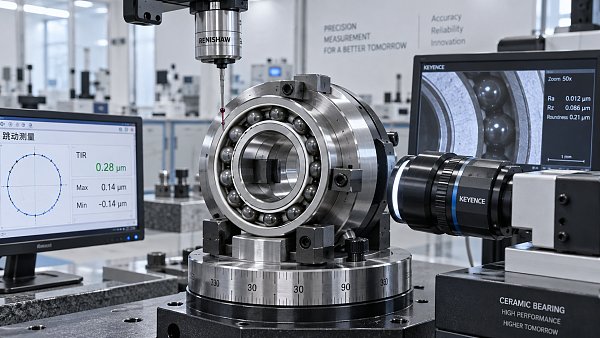
Precision grades generally control geometric characteristics such as dimensional tolerances and rotational accuracy. Depending on bearing type and applicable standard, this can include radial runout, axial runout, bore and outside-diameter variation, and face geometry. Tighter control can reduce unwanted shaft motion and improve the predictability of an assembled axis.
But robot positioning error has several sources. Gearbox backlash, harmonic-drive compliance, structural deflection, encoder resolution, cable forces, assembly alignment, and controller compensation can all matter as much as—or more than—the bearing. A high-grade angular-contact bearing cannot correct a flexible arm casting or a transmission with changing backlash. In that situation, specifying a more precise bearing may create cost and sourcing pressure while leaving the visible performance problem untouched.
Repeatability and absolute accuracy should also be separated. Many industrial robots can repeatedly return to a taught position while still carrying a larger absolute positioning error caused by calibration, kinematic variation, or thermal movement. Bearing runout can influence both, but its relative importance depends on where the bearing sits in the kinematic chain and how error is amplified toward the tool center point.
A bearing close to the output flange of a long-reach arm has a different system effect from one located within a compact drive module. In a highly loaded wrist, even small changes in stiffness or preload behavior can alter tool deflection. In a mobile robot wheel module, contamination resistance and robust sealing may be more consequential than incremental improvements in rotational accuracy.
Where higher-precision grades usually earn their place
Higher-precision bearings are most defensible when a robot must maintain controlled motion under conditions that expose bearing variation. High-speed spindles, precision rotary tables, vision-guided inspection equipment, metrology systems, and semiconductor handling mechanisms are common examples. These applications tend to be sensitive to vibration, runout, settling time, or a combination of all three.
Consider an inspection or dispensing axis where a camera, nozzle, or probe must stabilize rapidly after each move. The issue may not be the final static position alone. A bearing with poor rotational consistency, unsuitable preload, or excessive internal clearance can contribute to oscillation and longer settling time. The controller may mask part of the behavior, but compensation has limits when the mechanical response changes with orientation, speed, temperature, or payload.
Higher-grade bearings can also be justified in compact joints that carry significant moment loads. Precision is relevant here because mounting quality, matched geometry, and predictable preload support a stiffer, more repeatable interface. This does not mean every robotic joint requires the tightest available grade. It means the bearing must preserve intended stiffness across the actual duty cycle, including accelerations, reversals, payload changes, and externally applied forces.
For cleanroom or vacuum-adjacent equipment, the decision becomes broader still. Material selection, lubrication compatibility, particulate behavior, corrosion resistance, and cleaning requirements can dominate the engineering discussion. A high-precision grade without a suitable lubricant, cage material, seal strategy, or cleaning specification may be the wrong component for the environment.

When a tighter tolerance is unlikely to solve the problem
Many robotic applications need dependable bearings, but not necessarily ultra-high rotational accuracy. Conveyor transfer robots, warehouse AGVs, outdoor inspection platforms, packaging cells, and heavy material-handling units are often governed by other priorities: shock loading, sealing, corrosion protection, misalignment tolerance, easy replacement, and available service support.
In these environments, choosing a tighter grade can sometimes increase sensitivity to assembly conditions. Precise bearings still need correctly toleranced housings and shafts, controlled fits, clean mounting practices, and appropriate preload or clearance. If the surrounding structure is poorly machined, distorted during fastening, or exposed to frequent impacts, a premium bearing may not retain the expected performance advantage.
There is also a persistent misconception that precision grade directly predicts service life. It does not. Bearing life is affected by load, speed, lubrication, contamination, alignment, temperature, installation, and fatigue conditions. A standard-grade bearing correctly selected and protected can outlast a more accurate bearing exposed to ingress, incorrect fits, or insufficient lubrication. Precision and durability are related in some operating conditions, but they are not interchangeable specifications.
For cost-sensitive robot platforms built at volume, an unnecessarily narrow tolerance band can add procurement complexity. Supply lead times may be less flexible, approved-source options may narrow, and incoming inspection requirements may become more demanding. Those trade-offs are reasonable only if the system has a demonstrated need for the added precision.
The engineering variables that should drive the decision
A useful bearing selection review asks what the robot must achieve at the point of operation, then traces those requirements back through the mechanics. The following factors deserve attention before a grade is specified:
- Required repeatability and absolute accuracy: Identify whether the process is limited by return-to-position consistency, calibrated position, path accuracy, or tool orientation.
- Axis stiffness: Evaluate radial, axial, and moment stiffness under actual payload and acceleration. A bearing’s preload arrangement can matter as much as its nominal precision grade.
- Speed and acceleration: High rotational speed and aggressive reversals make friction, heat generation, cage behavior, and balance more relevant.
- Load spectrum: Continuous light loads, intermittent shock loads, and changing moment loads can produce very different bearing requirements.
- Environmental exposure: Dust, washdown, chemical vapors, vacuum conditions, and temperature fluctuation can outweigh geometric accuracy.
- Assembly and service model: The bearing grade should be compatible with machining capability, inspection methods, replacement procedures, and field maintenance realities.
This review often reveals that the central issue is not grade selection but bearing arrangement. A paired angular-contact arrangement, crossed-roller bearing, thin-section bearing, tapered roller configuration, or integrated slewing solution will behave differently under combined loads. The suitable architecture depends on available space, desired stiffness, rotation range, load direction, and whether the joint must tolerate occasional overloads.
Preload, fits, and temperature can erase the advantage of a precision bearing
Bearing precision cannot be evaluated independently from preload. Insufficient preload can permit unwanted displacement and reduce stiffness. Excessive preload raises friction and temperature, potentially shortening lubricant life and changing torque characteristics. In robotic axes with frequent start-stop movement, torque consistency may influence servo behavior and energy consumption as much as low runout does.
Fits deserve equal attention. An interference fit can alter internal geometry, while a loose or improperly supported seat can permit creeping or micro-movement. Housing roundness, shaft shoulder geometry, surface finish, and fastening sequence are not secondary production details; they are part of the bearing system. This is particularly true for thin-section and high-stiffness bearings, which may be more affected by mounting distortion than bulkier designs.
Thermal behavior adds another layer. Motors, gearboxes, brakes, and nearby process equipment do not always heat at the same rate. Differential expansion between shaft, housing, and bearing can alter clearance or preload during operation. A design that performs well during a short laboratory test may behave differently after extended cycling. Where temperature shifts are material, designers should model or validate the full assembly rather than selecting a grade from a static specification sheet.
A practical way to specify bearings for a robotics program
Instead of placing “high precision” as a broad purchasing requirement, define measurable application needs. State the bearing arrangement, load directions, duty cycle, target stiffness, allowable runout at the relevant interface, speed range, temperature range, lubrication approach, contamination exposure, and expected maintenance interval. Include any constraints created by cleanroom procedures, regional material requirements, or equipment-level standards.
Then distinguish between requirements that must be verified at component level and those that can only be validated after assembly. Component certificates or inspection records may be appropriate for critical production equipment, but they do not replace assembled-axis tests. Torque, vibration, positional repeatability, and thermal behavior should be assessed in the actual joint or module whenever the risk justifies it.
This distinction is valuable for sourcing as well. A bearing supplier may meet a recognized tolerance standard, yet the robot builder may need additional controls for matched sets, preload classes, traceability, lubrication, packaging cleanliness, or inspection criteria. Those requirements should be clear before supplier comparison begins. Otherwise, quotations that appear comparable may represent materially different delivered performance.
The procurement view: precision should reduce risk, not merely raise specification
For large technology and infrastructure programs, bearing selection increasingly sits at the intersection of mechanics, quality assurance, and supply-chain resilience. A technically correct bearing that cannot be supplied consistently, verified adequately, or replaced within an acceptable service window may still expose the project to risk. This is especially relevant where robotics is embedded in semiconductor fabrication equipment, automated process plants, or digitally monitored production systems.
That is why cross-disciplinary benchmarking is useful. G-CST examines precision motion-control components alongside manufacturing standards, industrial software, advanced materials, and supply-chain conditions. In practice, the bearing decision may need input from mechanical engineering, controls teams, quality functions, and procurement—not because every application is unusually complex, but because isolated specifications often miss the source of lifecycle cost.
The question is a higher precision bearing grade necessary for robotics? should therefore end with a conditional answer. Specify the higher grade when it supports a demonstrated requirement for runout control, stiffness, vibration management, high-speed stability, or process accuracy. Do not specify it by default when environmental robustness, load capacity, serviceability, or broader system error dominate performance. The sound decision comes from an axis-level error budget, realistic operating conditions, and a supply specification that defines what must be verified before the robot reaches production.
Recommended News
 Oct 18, 2026Which Quality Checks Matter Most for Precision Ceramic Bearings?What quality checks matter most for precision-manufactured parts? Discover essential ceramic bearing inspections, from defect screening to preload testing, to reduce risk and buy confidently.
 Oct 19, 2026How dust exposure changes hybrid bearing lubrication intervalsOptimize your bearing lubrication interval for dust-exposed hybrid bearings. Learn when to grease more often, fix ingress paths and use condition checks to reduce costly downtime.
 Oct 18, 2026How to calculate relubrication intervals for hybrid ceramic bearingsMaster relubrication interval calculation for hybrid ceramic bearings. Learn to adjust for speed, temperature, and contamination to reduce downtime and avoid overgreasing.
![]() Oct 18, 2026Do Robotics Applications Need Higher-Precision Bearing Grades?Is a higher precision bearing grade necessary for robotics? Explore how runout, stiffness, preload, loads, and operating conditions shape robot accuracy, reliability, and cost.
![]() Oct 17, 2026How Often Should Ceramic Bearings Be Inspected?How often should ceramic bearings be inspected? Learn condition-based intervals, warning signs, and maintenance tips to improve reliability and prevent costly downtime.
 Sep 01, 2026How to use bearing lubrication interval benchmarks for service schedulingBearing lubrication interval benchmarks help maintenance teams build smarter service schedules, reduce failures, prevent overgreasing, and improve asset reliability.
 Jul 27, 2026Bearing Lubrication Interval by ISO: How to Set Safe Relubrication CyclesBearing lubrication interval ISO guide: learn how to set safe relubrication cycles using speed, temperature, contamination, and grease quantity to reduce downtime and improve bearing reliability.
 Jul 18, 2026Advanced Materials Ceramics: Key Performance Factors for High-Wear ApplicationsAdvanced Materials ceramics for high-wear applications: explore key factors like toughness, thermal stability, surface quality, and lifecycle value to choose reliable industrial components.
 Jul 13, 2026Ceramic Hardness Scale Explained for Material SelectionCeramic hardness scale explained for smarter material selection. Compare Mohs, Vickers, and Knoop methods to improve wear resistance, reliability, and cost-fit decisions.
 Jun 27, 2026Cross Roller Bearing Inner Ring Tolerance BasicsCross roller bearing inner ring tolerance basics explained: learn how fit, runout, roundness, and surface quality affect precision, reliability, and inspection decisions.
 Jun 23, 2026How to Compare Bearing Suppliers on Quality, Lead Time, and CostBearing suppliers compared the smart way: learn how to evaluate quality consistency, lead time risk, and total cost to choose reliable partners and avoid costly sourcing mistakes.
: Common Causes and Fixes") Jun 10, 2026Bearing Noise and Vibration (NVH): Common Causes and FixesBearing noise and vibration (NVH) explained: discover common causes, warning signs, and proven fixes to prevent repeat failures, cut downtime, and improve equipment reliability.
 Jun 03, 2026How to Read Technical Ceramics Hardness DataTechnical ceramics hardness data helps you compare wear resistance, test methods, and supplier claims—learn how to read values with confidence before material selection.
 May 24, 2026Aerospace Bearing Market Insights: 2026 Cost and Supply RisksAerospace bearing market insights for 2026: uncover cost drivers, lead-time risks, and supplier qualification challenges to make smarter sourcing decisions and protect delivery stability.
 May 23, 2026Global Bearing Supply Chain Alerts: 2026 Risk SignalsGlobal bearing supply chain alerts reveal the top 2026 risk signals affecting lead times, quality, compliance, and sourcing. Learn how buyers can spot exposure early and build a smarter response.
 May 23, 2026Innovations in Friction Reduction That Improve UptimeInnovations in friction reduction help maintenance teams cut wear, extend service intervals, and improve uptime across pumps, bearings, valves, and precision systems.
 May 23, 2026New ISO Standards for Bearings: What Changes in 2026New ISO standards for bearings in 2026 will reshape inspection, supplier audits, and compliance. Learn the key changes and how to prepare early to reduce risk.
 May 22, 2026Advancements in Ceramic Materials for High-Speed Wear ControlAdvancements in ceramic materials are reshaping high-speed wear control with lower friction, cleaner operation, and longer uptime. Discover where ceramics deliver measurable lifecycle gains.
 May 21, 2026Bearing Fatigue Life L10 Data and Replacement TimingBearing fatigue life (L10) data helps maintenance teams set smarter replacement timing using real load, lubrication, and condition signals to reduce downtime, improve reliability, and optimize spares.
 May 21, 2026Bearing Noise and Vibration NVH: Pass or Fail?Bearing noise and vibration (NVH): pass or fail? Learn the key criteria, test logic, and practical benchmarks quality teams use to reduce risk, improve reliability, and make confident acceptance decisions.
 May 20, 2026Ceramic Bearing Speed and Load Data: What Matters MostCeramic bearing speed and load data explained for real operating conditions—learn how speed, load, lubrication, and thermal limits affect reliability, precision, and service life.
 May 19, 2026Miniature Bearing Factory Checks for Low-Particle RunsMiniature bearing factory checks now go beyond precision alone. Discover how low-particle validation, traceability, and clean process control reduce risk and strengthen supplier confidence.
 May 18, 2026Wholesale Ceramic Bearings: When Higher Unit Cost Lowers Total MaintenanceWholesale ceramic bearings can cost more upfront, but they often reduce total maintenance through longer life, less downtime, and lower lubrication and failure-related costs.
 May 03, 2026Ceramic Bearings Solutions: When the Higher Upfront Cost Pays OffCeramic Bearings solutions deliver ROI when downtime, corrosion, high speed, or electrical damage make steel bearings costly. Learn when the premium pays off.