Search News
Industry Portal
Popular Tags
How dust exposure changes hybrid bearing lubrication intervals
Author
Time
Click Count
Dust exposure can shorten a hybrid bearing’s lubrication interval when contamination reaches the lubricant or rolling contacts. Ceramic rolling elements do not make the bearing immune to abrasive particles: the steel raceways, lubricant and seals remain vulnerable. However, visible dust around a machine does not automatically justify more frequent greasing. The useful distinction is between dust outside an effective barrier and dust entering the bearing housing.
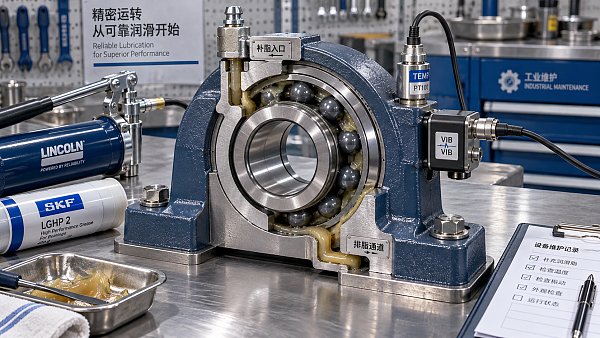
For maintenance teams, the first decision is whether the assembly can be relubricated and whether fresh grease has a controlled route through the bearing to an outlet. Where replenishment can remove contaminated grease, a shorter interval may help. Where grease remains trapped, extra injections can increase temperature and pressure without removing the contamination. A damaged seal or continuously open ingress path requires corrective work alongside any schedule change.
Why hybrid bearings still need protection from dust
Hybrid bearings generally combine ceramic rolling elements with steel rings. Their material combination can offer advantages in suitable applications, but those advantages do not establish a universal bearing lubrication interval. The interval still depends on bearing size and arrangement, speed, load, operating temperature, lubricant, housing design and environmental exposure.
When particles enter a rolling contact, their effect depends on hardness, size, shape and concentration relative to the contact and lubricant film. Hard mineral particles can indent or abrade steel raceways. Damage to the surface can create local stress concentrations and disturb lubrication, encouraging further deterioration. Ceramic rolling elements may resist certain damage mechanisms better than steel elements, but the bearing assembly remains exposed to contamination-related failure.
Dust can also affect lubrication without immediately producing obvious raceway damage. Particles distributed through grease can impair its ability to lubricate the contact. Some contaminants absorb oil or moisture; others promote deposits, corrosion or chemical degradation. The consequences depend on the material involved. A dry-looking powder should not automatically be treated as chemically harmless.
Relubrication addresses only part of this problem. Fresh grease replenishes the lubricant supply and, in a suitable housing, can help displace used grease. It cannot reverse existing indentations, restore damaged seals or guarantee that particles lodged inside the bearing will leave. Once damage has begun, a temporary improvement in noise after greasing is insufficient evidence that the bearing is fit for continued service.
Judge exposure by the route into the bearing
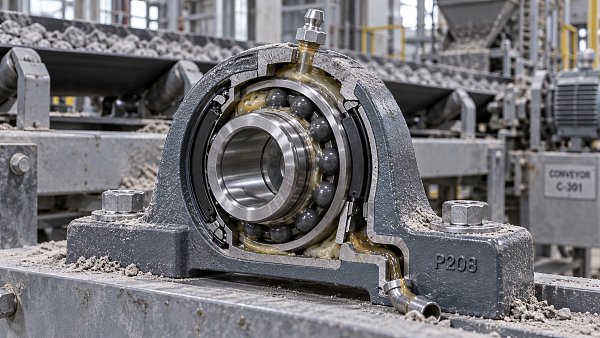
A useful dust assessment starts at the housing. Inspect where dust accumulates, how it reaches seal interfaces and what happens during operation, shutdown and cleaning. Airborne material around a conveyor bearing presents a different ingress challenge from powder settling onto a stationary spindle or debris driven toward a shaft seal by a cooling fan.
Dust loading at the seal matters more than a general description such as “dusty workshop.” A bearing behind an effective enclosure may experience little contamination despite heavy dust nearby. Conversely, a relatively clean machine can suffer ingress through a damaged seal, an exposed breather, an unsecured inspection cover or a dirty grease fitting.
The contaminant itself helps determine urgency:
- Hard mineral dust: Sand, silica-containing dust and abrasive process powders warrant particular attention because particles reaching the contact can damage steel surfaces.
- Metallic debris: Machining or wear particles may be hard, sharp or reactive. Investigate their source as well as their route into the housing.
- Fibrous or organic material: Material that appears less abrasive can still collect around seals, obstruct outlets or carry moisture into the assembly.
- Moisture-bearing or chemically active dust: Evaluate corrosion and lubricant compatibility as well as abrasion. More frequent grease replenishment may leave the underlying mechanism unresolved.
These categories guide inspection; they do not provide a numerical correction factor. Particle appearance alone cannot establish hardness or chemical behavior, and airborne concentration does not directly reveal the concentration inside the grease.
Also inspect the maintenance process. An uncapped grease connector, contaminated transfer container or dirty sampling tool can introduce particles directly. Clean the fitting before connection and protect dispensing equipment between uses. Otherwise, shortening the service interval may increase the number of opportunities to introduce contamination.
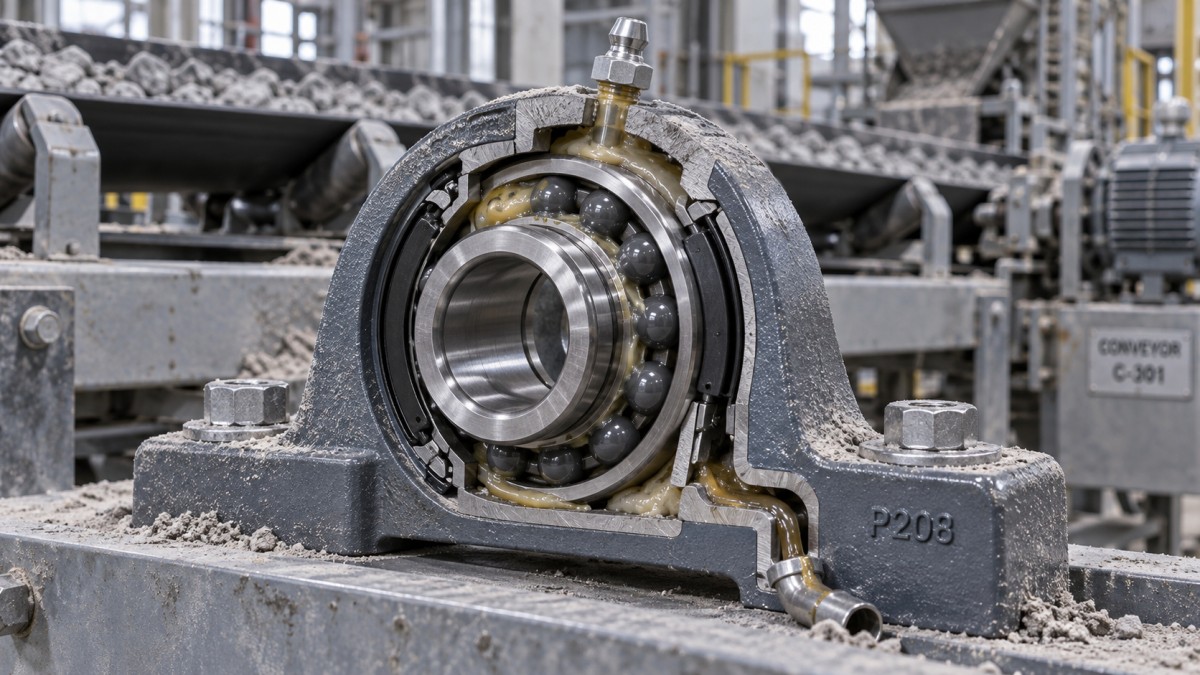
Trace the complete path from the surrounding process to the seal, housing cavity, bearing and grease outlet. This inspection often explains whether the next action should be more frequent replenishment, a sealing repair, improved housekeeping or a change to the lubrication arrangement.
When shortening the interval is appropriate—and when it is not
Begin with the equipment manufacturer’s lubrication instructions and the bearing or lubricant supplier’s guidance for the actual assembly. Confirm that any stated interval accounts for speed, temperature, load, orientation and environmental conditions. A schedule developed for a clean installation may be unsuitable after a machine moves beside a powder-handling process, even if its mechanical duty remains unchanged.
A shorter interval is most defensible when inspection or lubricant evidence shows contamination developing during the existing service period, and the system permits controlled replenishment. The aim is to intervene before lubricant condition becomes unacceptable. The revised schedule should be accompanied by an inspection point so the team can determine whether it is achieving that purpose.
Do not apply a universal rule such as halving the interval whenever dust is present. Such a rule ignores ingress rate, seal performance and the amount of grease the housing can accommodate. Dust exposure can be intermittent: a transfer operation, cleaning shift or seasonal process change may create a concentrated contamination event that a fixed calendar schedule handles poorly.
Relubrication quantity and frequency must be considered separately. A shorter interval does not automatically justify a larger dose at every visit. Too much grease can cause churning and elevated temperature, especially in high-speed assemblies. Pressure buildup may also affect seals or push grease along an unintended route. Any change in frequency should use a quantity and delivery method appropriate to the housing.
Before relying on grease to remove contamination, establish that the flow path works. The presence of an outlet does not prove that fresh grease passes through the bearing; it may bypass the contact area or accumulate in another cavity. Check the equipment’s intended lubrication route, outlet condition and procedures for managing discharged grease. Do not improvise a purge by injecting grease until it appears at a seal.
Different assembly conditions call for different responses:
- Relubricatable housing with a verified discharge path: Controlled replenishment may help manage contamination. Confirm its effect through lubricant inspection and operating trends.
- Relubricatable housing with restricted discharge: Resolve the restriction and assess grease accumulation before increasing service frequency.
- Sealed bearing without a provision for relubrication: Follow the manufacturer’s service or replacement instructions. External grease application is not a dependable way to renew the internal lubricant.
- Bearing with recurring ingress through a defective seal: Repair the barrier. A shorter interval may serve as a temporary measure only where continued operation is technically acceptable.
For oil-lubricated hybrid bearings, dust may call for better filtration, breather protection or an oil change based on condition. Adding oil does not remove particles already circulating through the system. Keep oil sampling, filter maintenance and oil replacement decisions distinct from grease relubrication practices.
Use condition evidence to set a workable schedule
Maintenance teams need enough evidence to distinguish contamination from lubricant depletion, thermal degradation and developing mechanical damage. No single observation does that reliably. A bearing may run hotter because of excess grease, increased load, misalignment or damage; noise may change for several reasons. Interpret these signals together and under comparable operating conditions.
Establish a baseline before revising the schedule. Record the bearing designation, lubricant product, replenishment quantity, delivery method, operating hours and relevant duty conditions. Include seal condition, recent cleaning practices and any changes in nearby dust-generating operations. Without this context, a shorter interval may appear successful simply because the machine ran fewer hours or carried less load.
Where the arrangement allows safe collection, inspect discharged grease or obtain a representative lubricant sample. Visible grit, moisture or a substantial change in consistency can justify further investigation. Color alone is weak evidence: fresh greases have different colors, and used grease can darken for several reasons. A clean-looking sample also cannot rule out small damaging particles.
Laboratory analysis can help identify contamination, wear debris, moisture or lubricant deterioration when those findings will affect the maintenance decision. Choose methods suited to the sample. Grease is heterogeneous, and results depend strongly on sampling location and handling. An oil-style particle count should not be assumed to provide a straightforward contamination assessment for every grease sample.
Use the same sampling point and procedure when comparing successive results. A sample from an external grease outlet may differ from grease close to the rolling contact. Avoid drawing conclusions from material contaminated during collection, and record whether the sample was taken before replenishment or from a discharge afterward.
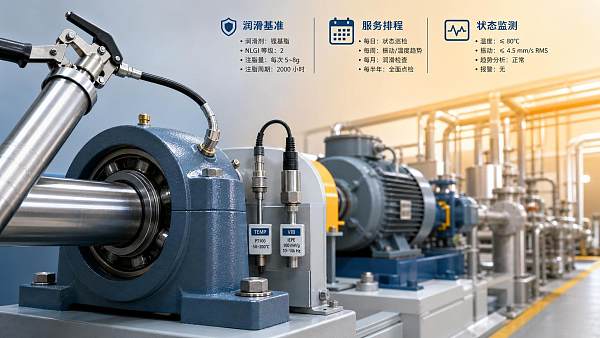
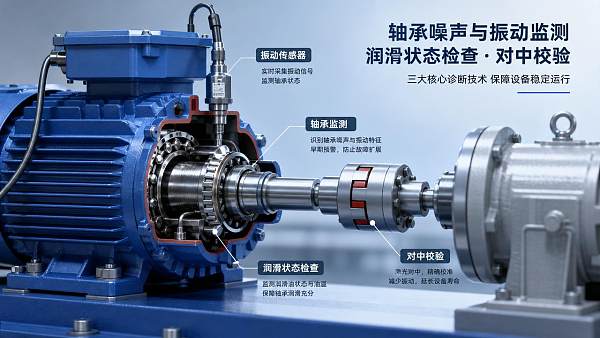
Combine lubricant findings with temperature and vibration trends. Temperature comparisons are more useful at similar speed, load and ambient conditions. Vibration can help detect developing bearing damage, although interpretation may require specialist support and knowledge of the machine. Inspection of seals and outlets remains necessary even when monitoring results look stable.
A practical schedule adjustment follows a short sequence:
- Verify the specified lubricant, relubrication quantity and permissible servicing procedure.
- Correct accessible ingress points and contamination risks in dispensing equipment.
- Select a shorter trial interval using manufacturer guidance and observed deterioration.
- Review lubricant condition and operating trends at the revised service points.
- Retain, revise or stop the trial according to the evidence, with clear escalation criteria for abnormal operation.
Keep inspection frequency separate from greasing frequency. A team may need to inspect seals after every heavy dust event while retaining the existing replenishment interval. Conversely, evidence of rapid lubricant contamination may justify more frequent replenishment even when external inspection reveals little. Treating both activities as one task can cause either unnecessary grease consumption or missed ingress.
Increasing noise, vibration or temperature should trigger investigation rather than another automatic grease injection. Where findings indicate damaged raceways, serious contamination or compromised seals, assess whether shutdown, cleaning, repair or replacement is required. Continuing to replenish grease can obscure the trend without restoring reliability.
The revised maintenance record should state why the interval changed and what would justify changing it again. “Dusty environment” is too broad to guide the next technician. A useful entry identifies the ingress route, the observed lubricant condition, the corrective action and the review point. After a sealing improvement, extend the interval only when subsequent evidence supports it. If contamination returns rapidly despite controlled replenishment, the next effort belongs at the ingress path and housing arrangement; repeated greasing has reached the limit of what it can solve.
Recommended News
 Oct 18, 2026Which Quality Checks Matter Most for Precision Ceramic Bearings?What quality checks matter most for precision-manufactured parts? Discover essential ceramic bearing inspections, from defect screening to preload testing, to reduce risk and buy confidently.
 Oct 19, 2026How dust exposure changes hybrid bearing lubrication intervalsOptimize your bearing lubrication interval for dust-exposed hybrid bearings. Learn when to grease more often, fix ingress paths and use condition checks to reduce costly downtime.
 Oct 18, 2026How to calculate relubrication intervals for hybrid ceramic bearingsMaster relubrication interval calculation for hybrid ceramic bearings. Learn to adjust for speed, temperature, and contamination to reduce downtime and avoid overgreasing.
![]() Oct 18, 2026Do Robotics Applications Need Higher-Precision Bearing Grades?Is a higher precision bearing grade necessary for robotics? Explore how runout, stiffness, preload, loads, and operating conditions shape robot accuracy, reliability, and cost.
![]() Oct 17, 2026How Often Should Ceramic Bearings Be Inspected?How often should ceramic bearings be inspected? Learn condition-based intervals, warning signs, and maintenance tips to improve reliability and prevent costly downtime.
 Sep 01, 2026How to use bearing lubrication interval benchmarks for service schedulingBearing lubrication interval benchmarks help maintenance teams build smarter service schedules, reduce failures, prevent overgreasing, and improve asset reliability.
 Jul 27, 2026Bearing Lubrication Interval by ISO: How to Set Safe Relubrication CyclesBearing lubrication interval ISO guide: learn how to set safe relubrication cycles using speed, temperature, contamination, and grease quantity to reduce downtime and improve bearing reliability.
 Jul 18, 2026Advanced Materials Ceramics: Key Performance Factors for High-Wear ApplicationsAdvanced Materials ceramics for high-wear applications: explore key factors like toughness, thermal stability, surface quality, and lifecycle value to choose reliable industrial components.
 Jul 13, 2026Ceramic Hardness Scale Explained for Material SelectionCeramic hardness scale explained for smarter material selection. Compare Mohs, Vickers, and Knoop methods to improve wear resistance, reliability, and cost-fit decisions.
 Jun 27, 2026Cross Roller Bearing Inner Ring Tolerance BasicsCross roller bearing inner ring tolerance basics explained: learn how fit, runout, roundness, and surface quality affect precision, reliability, and inspection decisions.
 Jun 23, 2026How to Compare Bearing Suppliers on Quality, Lead Time, and CostBearing suppliers compared the smart way: learn how to evaluate quality consistency, lead time risk, and total cost to choose reliable partners and avoid costly sourcing mistakes.
: Common Causes and Fixes") Jun 10, 2026Bearing Noise and Vibration (NVH): Common Causes and FixesBearing noise and vibration (NVH) explained: discover common causes, warning signs, and proven fixes to prevent repeat failures, cut downtime, and improve equipment reliability.
 Jun 03, 2026How to Read Technical Ceramics Hardness DataTechnical ceramics hardness data helps you compare wear resistance, test methods, and supplier claims—learn how to read values with confidence before material selection.
 May 24, 2026Aerospace Bearing Market Insights: 2026 Cost and Supply RisksAerospace bearing market insights for 2026: uncover cost drivers, lead-time risks, and supplier qualification challenges to make smarter sourcing decisions and protect delivery stability.
 May 23, 2026Global Bearing Supply Chain Alerts: 2026 Risk SignalsGlobal bearing supply chain alerts reveal the top 2026 risk signals affecting lead times, quality, compliance, and sourcing. Learn how buyers can spot exposure early and build a smarter response.
 May 23, 2026Innovations in Friction Reduction That Improve UptimeInnovations in friction reduction help maintenance teams cut wear, extend service intervals, and improve uptime across pumps, bearings, valves, and precision systems.
 May 23, 2026New ISO Standards for Bearings: What Changes in 2026New ISO standards for bearings in 2026 will reshape inspection, supplier audits, and compliance. Learn the key changes and how to prepare early to reduce risk.
 May 22, 2026Advancements in Ceramic Materials for High-Speed Wear ControlAdvancements in ceramic materials are reshaping high-speed wear control with lower friction, cleaner operation, and longer uptime. Discover where ceramics deliver measurable lifecycle gains.
 May 21, 2026Bearing Fatigue Life L10 Data and Replacement TimingBearing fatigue life (L10) data helps maintenance teams set smarter replacement timing using real load, lubrication, and condition signals to reduce downtime, improve reliability, and optimize spares.
 May 21, 2026Bearing Noise and Vibration NVH: Pass or Fail?Bearing noise and vibration (NVH): pass or fail? Learn the key criteria, test logic, and practical benchmarks quality teams use to reduce risk, improve reliability, and make confident acceptance decisions.
 May 20, 2026Ceramic Bearing Speed and Load Data: What Matters MostCeramic bearing speed and load data explained for real operating conditions—learn how speed, load, lubrication, and thermal limits affect reliability, precision, and service life.
 May 19, 2026Miniature Bearing Factory Checks for Low-Particle RunsMiniature bearing factory checks now go beyond precision alone. Discover how low-particle validation, traceability, and clean process control reduce risk and strengthen supplier confidence.
 May 18, 2026Wholesale Ceramic Bearings: When Higher Unit Cost Lowers Total MaintenanceWholesale ceramic bearings can cost more upfront, but they often reduce total maintenance through longer life, less downtime, and lower lubrication and failure-related costs.
 May 03, 2026Ceramic Bearings Solutions: When the Higher Upfront Cost Pays OffCeramic Bearings solutions deliver ROI when downtime, corrosion, high speed, or electrical damage make steel bearings costly. Learn when the premium pays off.